Postharvest Mechanical Damage and Its Effects on Fresh Produce Quality

Dr. Vijayalaxmi Kinhal

June 2, 2026 at 10:14 pm | Updated June 2, 2026 at 10:14 pm | 8 min read
- Mechanical damage occurs most during harvest, sorting, grading, packaging, and distribution transport stages.
- The mechanical damage types are impact, compression, friction, puncture, vibration, and cutting.
- The mechanical damage phenotypes can include bruising, tissue collapse, perforation, cracking, and breaking.
- Internal factors and external environmental conditions in the postharvest chain are crucial in determining the extent of damage.
Fresh produce production has increased by over 20% between 2008 and 2018 and is expected to rise by 60% by 2050, driven by improved living standards and increased health awareness among consumers. Mechanical damage occurs at various points in the supply chain and is a major cause of postharvest decline, resulting in the loss of 6 to 24% of total production. In this article, stakeholders can learn about the various forms of mechanical damage to prevent such losses, improve their ROI, and increase the supply of high-quality food to consumers.
What is Mechanical Damage?
Vegetables and fruits suffer mechanical damage when physical stress exceeds their tissues’ tolerance threshold.
Fresh produce’s high water content and softness make it very susceptible to mechanical damage, which can degrade food quality and safety and shorten shelf life. Mechanical damage degrades quality by triggering biochemical and physiological changes. It can increase respiratory rate, ethylene production, water loss, and the rate of senescence. As a result, it reduces soluble sugar content and titrable acidity, and causes changes in color, firmness, nutritional value, and flavor. The risk of fungal and bacterial infections from damaged skin and tissue also increases, leading to greater microbial spoilage and toxin production, making the food unsafe.
Subscribe to receive our monthly round-up of articles.
The food loss due to mechanical damage is lower and below 5% in developed countries with sophisticated logistics and packaging than in developing countries, where mechanical damage causes 25-35% loss of total production. For example, losses of fresh produce due to mechanical damage are only 1-2% in the USA.
Mechanical or physical damage is a broad term encompassing several types of damage caused by different factors and stress levels. So, while mechanical damage can occur at many postharvest stages, operations at each stage can lead to different stresses and the extent of damage. For example, the fresh weight of a banana is reduced by 0.2% due to impact, 0.25% due to cutting, 0.37% due to abrasion, and 0.7% due to compression.
Types of Mechanical Damage
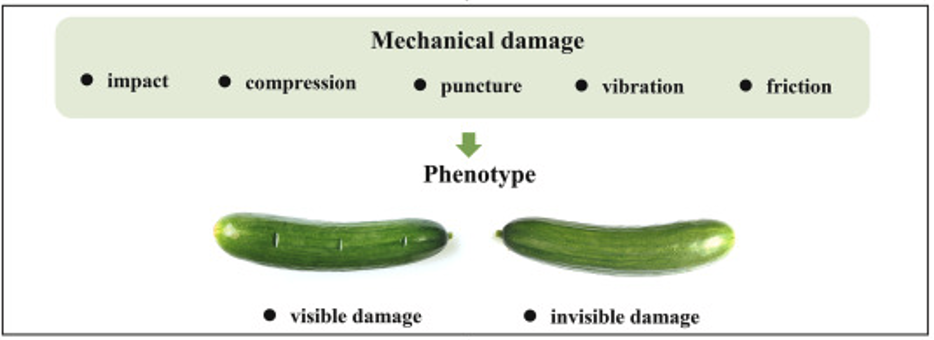
Figure 1: “Some major types of mechanical damage,” Li et al. (2025). (Image credits: https://www.sciencedirect.com/science/article/pii/S0023643825014665)
The types of mechanical damage that can occur are impact, compression, vibration, puncture, cutting, and friction, as listed in Figure 1, and each is described below.
Impact
Impact damage occurs due to unexpected drops from a height onto a rigid surface, collisions between fruits and vegetables, and inadequate cushioning in packaging material. It can occur during harvest, loading, unloading, grading, sorting, and transporting.
The result of impact is bruising and cracks, and visible quality effects appear quickly.
- Low-intensity impact produces bruising, which increases moisture loss and browning of the pericarp or skin, and shortened shelf life.
- Cracks are high-intensity impact effects that occur when fresh produce has a very high water content.
Impact causes weight loss, reduced firmness, increased respiration rate, discoloration, electrolyte leakage from the peel, and increased enzymatic activity. Handling with care during harvest and postharvest operations and using appropriate packaging, such as trays and cushioning, can reduce impact effects.
Compression
Compression damage occurs during harvesting, packaging, loading, storage, transportation, and marketing.
Compression occurs when an external force acts perpendicular to the vegetables and fruits. These damages arise when fresh produce is compressed together with other produce or against a rigid surface. Fruits and vegetables at the bottom of a container can get compressed due to increased bin depth. Fresh produce at the tops or edges of overfull, stacked containers can be compressed by adjacent containers due to improper handling, stacking, and packaging. The carton stack height is a crucial factor.
Compression damage effects can include internal bruising or immediate cracking, flattening, and deformation when the compression force exceeds the tissues’ tolerance threshold. Fresh produce at advanced maturity and ripeness, and those with softer tissue are more prone to compression, such as tomatoes and peaches. Compression alters tissue structure and physicochemical properties, reducing firmness, soluble solids content, and titrable acidity.
Friction
Friction forces are produced when one fruit or vegetable moves against another and produce abrasion and removal of the fruit surface. Friction can occur during transportation at high speeds.
Abrasion causes wounds and compromises the integrity of the fruit membrane, leading to epidermal cell breakdown. Ripening is inhibited, and the fruit membrane loses permeability during the process. Other effects are loss of moisture and discoloration. The abrasion also affects metabolic processes, hastens deterioration, and reduces the shelf life of fruits, such as bananas.
Puncture
Puncture damage occurs when sharp and pointed objects pierce through fresh produce. The plant cells at the puncture site are deformed irreversibly, leading to tissue maceration and juice leakage. The skin, pulp, and internal structure of fresh produce can be damaged due to puncturing. The wounds increase the entry of pathogens into fruits and vegetables.
Puncture damage can occur during harvesting, field handling, washing, trimming, sorting, grading, packaging, transport, and marketing.
Fresh produce with soft tissue is more susceptible to puncture forces; for example, pepper, apple, kiwifruit, pears, and citrus. Even small punctures can reduce the economic value due to the easily visible blemishes and rapid decay.
Vibration
Vibration occurs during the transportation of fresh produce. When the vibrational forces exceed certain limits, they can damage fresh produce. The intensity and duration of vibration can determine displacement and the repeated force exerted on fresh produce, influencing the extent of damage. Vibration damage alters physiological and morphological parameters and is apparent as peel softening, reduced cell wall and plasma membrane integrity, and color changes. Vibrational damage is seen in tomatoes, peaches, and cucumbers.
Cut
Cut forces come into play when fruits and vegetables encounter sharp blades or borders or are rotated. Cut damage occurs when fruits and vegetables are cut, during processing, trimming, sorting, and grading. The sharpness of the edge and the wedge angle of tools like knives, as well as cutting speed, determine the damage to fresh produce.
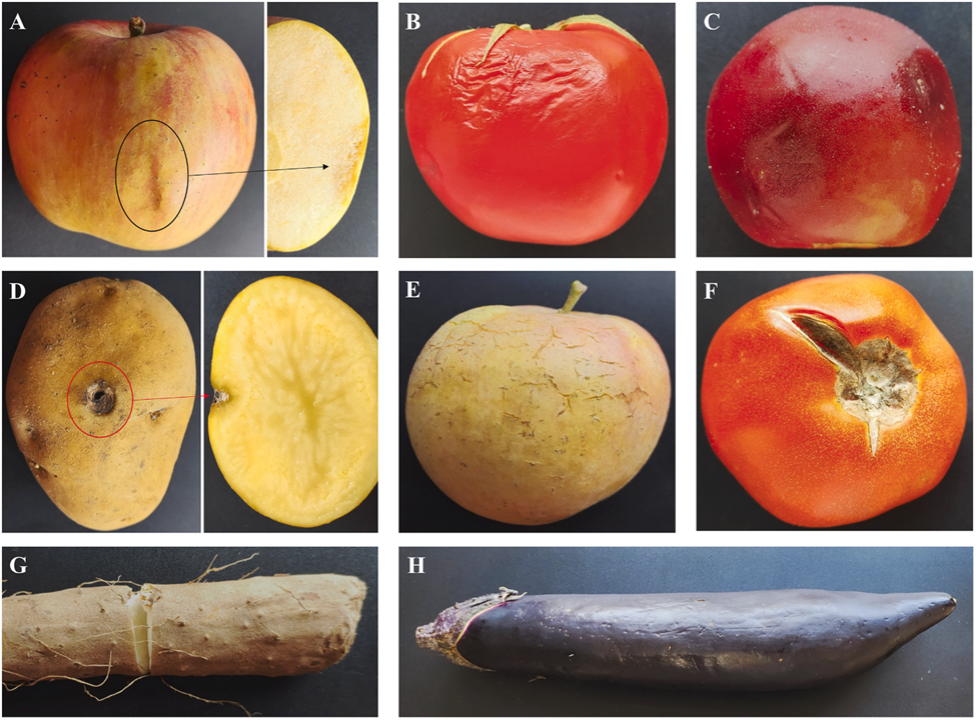
Figure 2. “Different phenotypes of mechanical damage and its influencing factors. A, bruise of apple; B, bruise of tomato; C, collapse of peach; D, perforation of potato; E, tiny crack of apple; F, significant crack of tomato; G, breakdown of Chinese yam; H, chilling injury of eggplant,” Li et al. (2025). (Image credits: https://www.sciencedirect.com/science/article/pii/S0023643825014665)
Mechanical Damage Phenotypes
The mechanical damage can manifest itself in many ways. Some effects are immediately visible, like cuts and breaks, but others, such as bruises, take time to develop. The most common phenotype is bruising, but it can also be tissue collapse, perforation, cracking, and breaking.
Bruising
Bruising occurs from impacts, vibrations, cuts, and friction during harvesting, handling, and transportation. Around 50-80% losses of the mechanical damage is due to bruising.
The tissue is damaged during bruising, but the skin remains unbroken. Therefore, bruising can initially be invisible, and the changes from the damage become apparent after a few hours or days. The symptoms that appear depend on the severity and duration of the external stress. The cell membranes rupture in damaged tissue, releasing cytoplasmic enzymes that lead to ethylene production, internal browning, and cell death, which can progress outward over time.
Bruising degrades quality by altering color, texture, and flavor, and by reducing nutrient content. The damage caused can depend on the bruise susceptibility of vegetables and fruits. Some species and cultivars are more prone to bruising than others due to soft skins, ripeness, and harvest maturity. Bruising is common among tomatoes, cucumbers, leafy vegetables, peppers, apples, berries, peaches, pears, grapes, loquats, pomegranates, and mangoes.
Quality degradation can reduce the economic value of fresh produce.
Collapse, Perforation, Cracking, and Breaking
Visible damage occurs when external stress is severe, resulting in structural collapse, surface perforation, cracks, and internal tissue breakdown; examples are depicted in Figure 2. The damage is irreversible and becomes an entry point for pathogens, so microbial infections occur more quickly in these cases than in bruising. The visible defects can lead to rejection and loss of economic value.
- Collapse: Structural collapse occurs due to impact, compression, and vibration. It is commonly seen in peaches, blueberries, raspberries, waxberries, cherries, longans, grapes, mulberries, mushrooms, figs, citrus, peppers, bean sprouts, and leafy vegetables.
- Perforation: Puncture leads to perforations. The pore size and type of fresh produce will influence the change in economic value due to this damage. Punctures are seen in potatoes, Chinese yams, cucumbers, peas, peppers, kidney beans, zucchinis, bitter gourds, radishes, apricots, apples, pears, peaches, citrus, kiwifruits, and loquats.
- Cracking: Superficial cracking is caused by the epidermis splitting due to imbalances in internal and external pressures, due to stress. Excessive water absorption can also cause cracking, especially at advanced maturity in fresh produce such as cherries, plums, peaches, tomatoes, radishes, figs, and watermelon.
- Breaking: Tissue breakdown occurs due to severe impact and compression. Postharvest commodities with a high length-to-diameter ratio are prone to breaking, including tapioca, carrot, radish, cucumber, bitter gourd, zucchini, muskmelon, pear, figs, and cantaloupe. The defect can start as small cracks, which develop into larger cracks and ultimately break under repeated forces, such as continuous compression.
Influence of Factors on Mechanical Damage
In addition to the type of damage, external and internal factors affect the intensity of the phenotype. These factors influence physiological processes and, therefore, the development of symptoms in the fresh produce.
External factors: Postharvest environmental factors such as temperature, relative humidity (RH), light, and gas composition influence symptom development. For example, higher temperatures increase respiration, transpiration, ethylene production, and senescence rates. Maintaining cold temperatures, an RH of 95%, lower light exposures, and altered ratios of oxygen, carbon dioxide, and ethylene in controlled-atmosphere facilities and modified-atmosphere packaging is the best way to limit and control damage.
Internal factors: Intrinsic factors that can influence the extent of mechanical damage begin in the preharvest stages, with the choice of genotype (species and cultivars) and the type of fresh produce. For example, leafy greens are very delicate and are more susceptible to mechanical damage than other categories of fresh produce. Harvest maturity and picking time can determine softness and susceptibility to mechanical damage. So, using harvest maturity indices to optimize picking time is crucial.
Monitoring and Controlling Mechanical Damage Effects
The development of mechanical damage effects can be limited by controlling the external factors. Precise devices that monitor factors such as temperature, RH, and gas composition during storage and transport can help stakeholders maintain conditions that minimize quality deterioration. Felix Instruments Applied Food Science offers the fixed F-910 AccuStore, which can monitor and remotely control all relevant factors around the clock. The company also offers a range of portable gas analyzers to monitor oxygen, carbon dioxide, and ethylene at various stages of postharvest operations. The measurements are non-destructive, rapid, and precise.
All tools are easy to use with a little training and robust for on-site use in the entire fresh produce supply chain.
Contact us for more information on our gas analyzers and atmosphere monitoring devices for your fresh produce supply chains.
Sources
Al-Dairi, M., Pathare, P. B., Al-Yahyai, R., & Opara, U. L. (2022). Mechanical damage of fresh produce in postharvest transportation: Current status and future prospects. Trends in Food Science & Technology, 124, 195-207.
Hailu, G., & Derbew, B. (2015). Extent, causes and reduction strategies of postharvest losses of fresh fruits and vegetables–A review. Journal of Biology, Agriculture and Healthcare, 5(5), 49-64. https://fileserver-az.core.ac.uk/download/pdf/234660772.pdf
Li, Z., & Thomas, C. (2014). Quantitative evaluation of mechanical damage to fresh fruits. Trends in Food Science & Technology, 35(2), 138-150.https://doi.org/10.1016/j.tifs.2013.12.001
Liu, F., Hai, M., Mei, B., Yi, L., & Xie, S. (2025). How does mechanical damage affect the preservability of postharvest fruits and vegetables?. LWT, 118781.
Singh, V., Das, M., Das, S.K. (2016). Effects of knife edge angle and speed on peak force and specific energy when cutting vegetables of diverse texture. International Journal of Food Studies, 5(1):22–38.
Related Products
- F-751 Grape Quality Meter
- Custom Model Building
- F-910 AccuStore
- F-751 Melon Quality Meter
- F-751 Kiwifruit Quality Meter
- F-750 Produce Quality Meter
- F-751 Avocado Quality Meter
- F-751 Mango Quality Meter
- F-9XXDK Dynamic Sampling Kit
- F-900 Portable Ethylene Analyzer
- F-950 Three Gas Analyzer
- F-920 Check It! Gas Analyzer
- F-960 Ripen It! Gas Analyzer
- F-940 Store It! Gas Analyzer
Most Popular Articles
- Spectrophotometry in 2023
- NIR Applications in Agriculture – Everything…
- The Importance of Food Quality Testing
- The 5 Most Important Parameters in Produce Quality Control
- Melon Fruit: Quality, Production & Physiology
- Fruit Respiration Impact on Fruit Quality
- Guide to Fresh Fruit Quality Control
- Liquid Spectrophotometry & Food Industry Applications
- Ethylene (C2H4) – Ripening, Crops & Agriculture
- Understanding Chemometrics for NIR Spectroscopy
Related Reading