What Are the Latest Fresh Produce Storage Technologies Extending Shelf Life?

Dr. Vijayalaxmi Kinhal

June 15, 2026 at 7:06 pm | Updated June 15, 2026 at 7:06 pm | 11 min read
- Technological innovations for storage have to slow the physiological processes that cause premature ripening, senescence, and quality loss, and shorten shelf life.
- Environmental factors such as temperature, relative humidity, and gas composition must be tailored to specific fresh produce to extend shelf life and preserve quality.
- Stakeholders need precise control over environmental factors to slow postharvest decline, which can be achieved through continuous or regular monitoring of storage facilities.
The fresh produce market is the largest segment of the food supply chain. It was worth USD 893.50 billion in 2025 and is expected to grow at a CAGR of 4.6% to USD 1,465.36 billion by 2036. Fruits and vegetables are also highly perishable and are the food category with the highest food loss in the supply chains. Storage, which increases marketing time and options, is a crucial step in reducing these losses, preserving quality and nutrition, and improving profits when done properly. This article covers the innovations in fresh produce storage technology that achieve these aims in supply chains that have become longer over time.
Aims of Storage Technology
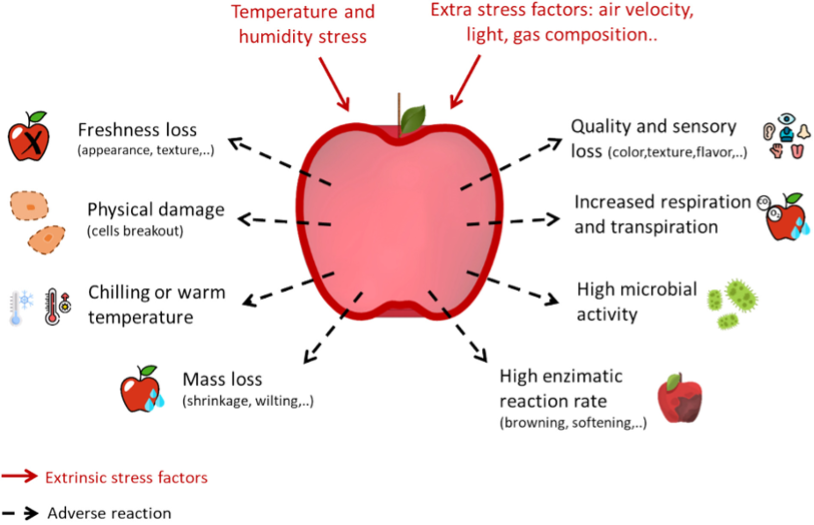
Figure 1: “Air temperature and relative humidity stress in postharvest cold storage of fruit and vegetables and their adverse reactions,” Hoffmann et al. (2022). (Credits: https://www.sciencedirect.com/science/article/pii/S0963996925017442)
Subscribe to receive our monthly round-up of articles.
Fresh produce is perishable because of its high-water content, softness, and sugar content, which make it susceptible to microbial spoilage, mechanical damage, and senescence. Also, the vegetables and fruits are living entities that continue to breathe, transpire, and ripen even after they are separated from the plants and trees, which can degrade their quality. All these factors lead to the rejection and culling of fresh produce, resulting in a loss of 40-50% of the total yield. Storage losses in developing countries (9-10%) are double those of developed countries (4-5%).
The postharvest decline and losses are due to internal and external factors:
- Internal factors: The intrinsic properties that cause postharvest decline are the continuing physiological processes of respiration, transpiration, ethylene production, and enzymatic activity. Moreover, the species and varieties of the fresh produce will determine the postharvest storage time.
- External factors: Environmental factors such as temperature, relative humidity (RH), light, and gas composition will determine the rate of the physiological processes and the effects of mechanical damage and microbial infections on quality and shelf life; see Figure 1.
The aim of any storage system is to keep the rate of the physiological processes as low as possible to prevent spoilage, unplanned ripening, and quality loss. Two types of technologies are used for this purpose:
- Maintaining optimal conditions: Storage technologies are designed to maintain optimal environmental conditions, especially temperature through cold logistics, to preserve quality and extend shelf life, thereby preventing losses.
- Monitoring and control technologies: Another set of technologies is designed to monitor the environment and the quality of fresh produce, enabling stakeholders to fine-tune storage systems and control relevant factors.
Storage technology that maintains optimal conditions is common but not ubiquitous. However, monitoring and control technologies for all relevant environmental factors, though crucial for improving storage efficiency, are often missing.
Maintaining Optimal Storage Conditions
Proper postharvest storage can slow the rates of respiration, transpiration, ethylene production, and enzymatic activity, and inhibit microbial growth, thereby extending shelf life. It helps preserve quality by limiting the loss of color, freshness, texture, taste, flavor, and weight.
Storage solutions maintain a low temperature and relative humidity of around 95% to slow the physiological processes. The choice of temperature depends on the species to ensure that fresh produce, especially tropical in origin, does not develop chilling injury at very low temperatures. Since the causes of post-harvest decline vary in importance across categories of fresh produce, different options or combinations may be necessary. Table 1 provides a brief summary of fresh produce characteristics that can guide choice. Availability of funds, distance to market, and regulation compliance can be other factors that will influence the choice of storage solutions.
The four advanced innovative solutions available on the market are
- Controlled Atmosphere
- Modular Storage Modules
- Hypobaric Storage
- Dynamic Controlled Atmosphere Systems
Table 1: “A comparative overview of the optimal storage conditions and recommended cooling technologies for key categories of fresh produce,” Hoffmann et al. (2022). (Credits: https://www.sciencedirect.com/science/article/pii/S0963996925017442)
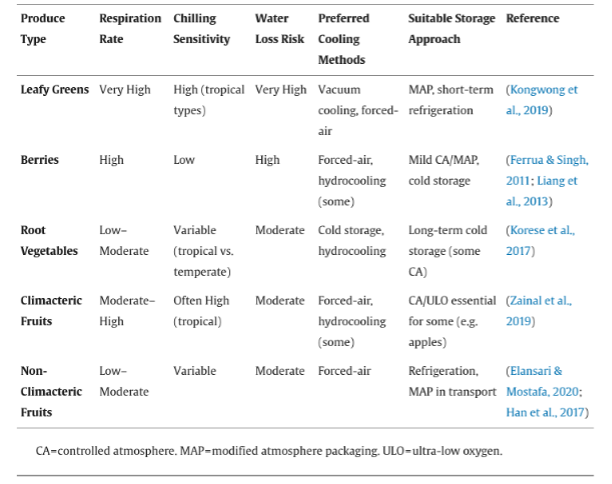
These advanced storage systems are becoming popular because they are chemical-free and more sustainable than other supply chain methods, such as chemical treatments, used to extend shelf life. Supply chain stakeholders can use these methods to provide safe produce with no negative environmental impact.
-
Controlled Atmosphere Storage
Controlled-atmosphere (CA) storage rooms go beyond being cold storage units. They are designed to regulate the physiological processes that cause postharvest decline. In addition to low temperature and high relative humidity, the gas composition of the rooms also differs from ambient levels. CA facilities lower oxygen (O2) concentrations and ethylene levels while maintaining higher carbon dioxide (CO2) levels by adding the gas.
- Low temperature, O2, and high CO2 lower respiration, transpiration, and ethylene production rates.
- Lower respiration rates increase shelf-life. Controlling ethylene prevents premature ripening and senescence.
- High humidity also reduces transpiration, limiting weight loss and preserving freshness.
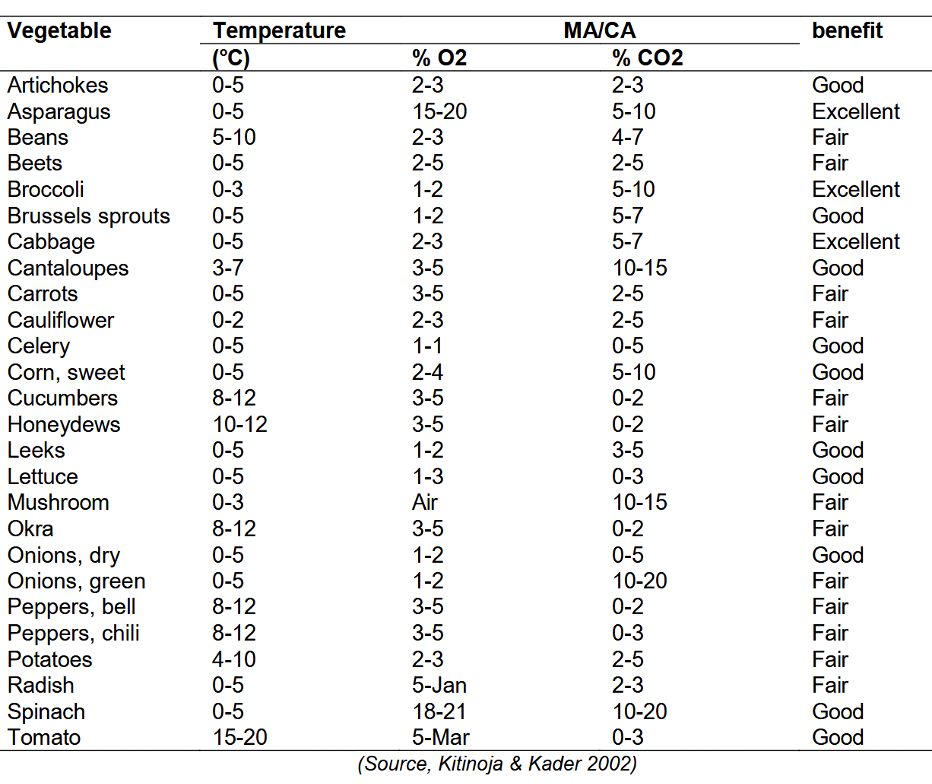
The exact required combination of the five factors will depend on the species of fresh produce; see Table 2. CA systems are sophisticated and expensive, and are therefore usually used for long-term storage, to extend the shelf life of high-value crops such as berries, root vegetables, and climacteric fruits and vegetables. The technology is also suitable for short-term storage of leaf greens. Nowadays, energy-efficient systems with good insulation and solar power are extending CA use in remote rural areas.
Table 2: “List of different vegetable and their benefits used under MA/CA storage method,” Verma et al. 2025. (Image credits: DOI: 10.9734/acri/2025/v25i21076)
-
Modular Storage Modules
Storing fresh produce with varying environmental needs in the same large room can create new quality problems, such as chilling injury, that can reduce quality and shelf life. It is therefore crucial that each piece of fresh produce receives the ideal set of factors. Modular storage units have smaller compartments with temperature and relative humidity suitable for different vegetables. These are useful for storing mixed fresh produce during retail and storage.
-
Hypobaric Storage
Hypobaric storage, or low-pressure (LP) storage, involves keeping fresh produce at a pressure below normal atmospheric pressure (101.3 kPa) to slow physiological processes and microbial growth. At normal atmospheric pressure, O2 makes up 21% of the air. In hypobaric storage, the air pressure is reduced to 0-0.1 MPa by a vacuum pump along with ventilation, which lowers the O2 pressure to 2.1% by volume. Lowering O2 levels reduces respiration and ethylene rates, slowing ripening and senescence and increasing shelf life. The room must be ventilated with fresh air to maintain the target atmospheric pressure and O2 levels.
Harmful volatile compounds produced by fruits and vegetables during storage are also removed by ventilation. For example, acetaldehyde, which causes off flavors, is removed.
However, water loss can increase significantly under low pressure, so 100% RH must be maintained to prevent wilting and weight loss of fresh produce. Hypobaric rooms must also have robust construction to prevent implosion under low pressure.
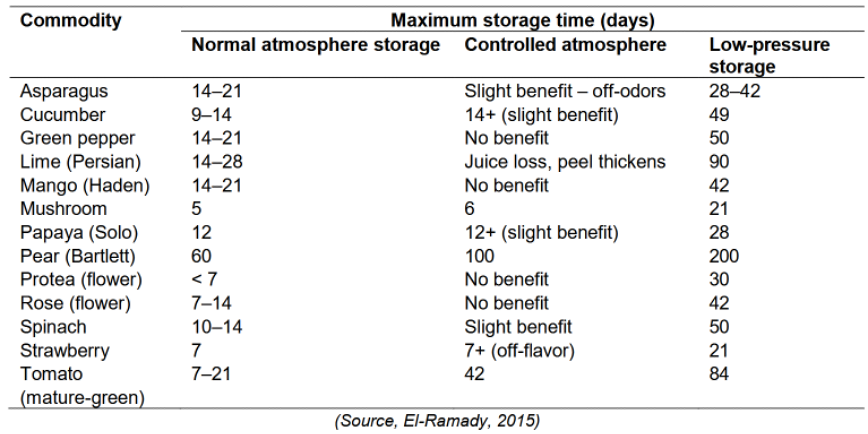
Hypobaric storage can significantly extend shelf life compared to CA without loss of nutritional value; see Table 3. The technology is suitable for high-value export commodities.
Table 3: “Maximum storage life (days) in normal atmosphere storage (NA), controlled
atmosphere (CA) and low-pressure storage (LP),” Verma et al. 2025. (Image credits: DOI: 10.9734/acri/2025/v25i21076)
-
Dynamic Controlled Atmosphere Systems
Dynamic controlled-atmosphere (DCA) systems are an adaptation of conventional CA facilities. The DCA systems maintain the lowest possible oxygen limits to reduce oxygen partial pressure for fresh produce before anaerobic respiration begins. The O2 levels are reduced at the start of the storage. Since fresh produce continues to respire, the O2 levels keep changing. Hence, O2 is continuously monitored and maintained at the target levels throughout the storage period. The required O2 levels depend on species, cultivar, harvest maturity, season, and storage duration.
These DCA systems are integrated with real-time data collection on respiration rate and consider factors such as ethylene sensitivity of fresh produce. While only climacteric fruits and vegetables produce ethylene, several non-climacteric fresh produce can be sensitive to the ethylene effects of senescence. The degree of ethylene sensitivity varies, and only fresh produce that reacts similarly to the phytohormone should be stored together. The other integrated sensors in these systems measure chlorophyll fluorescence and ethylene levels.
The temperatures in these systems are higher than those of CA and can lead to energy savings.
Storage Monitoring Technology
All the advanced storage techniques rely on precise control of environmental factors. Non-destructive technology capable of measuring these factors continuously and objectively is necessary to monitor fresh produce and storage conditions.
So far, most in-depth monitoring of exported fresh produce has focused solely on temperature measurements. Though temperature is the most important environmental cause of postharvest decline in the fresh produce chain, monitoring other factors can also provide insights to cut food losses.
The complexity of advanced storage rooms requires equally sophisticated monitoring solutions, with real-time data collection and analysis, and automated control processes. These can help track food quality and safety, minimize errors, improve operational efficiency, and support compliance with national and international standards. The main monitoring solutions available for storage facilities are as follows:
- Gas analyzers
- NIR-VIS spectroscopy
- AI and IoT Integration
- Traceability
- Nanotechnology
These technologies are also used in other supply chain operations such as transport, ripening, and retailing.
-
Gas Analyzers
The gas composition is a crucial factor in storage. Maintaining precise levels of various specific gases is vital for the advanced storage solutions to function efficiently. Therefore, it is necessary to use technology that can easily measure these gases in real time on-site to make quick decisions. Several devices are available that use electrochemical, pyroelectric, and infrared sensors to simultaneously measure the levels of O2, CO2, and ethylene. The devices should be capable of high-resolution measurement of changes in ppm (parts per million) and ppb (parts per billion).
Monitoring gas composition needs to be around the clock, and several devices are connected to automatic control systems. Storage units that maintain high CO2 or low O2 levels are harmful to people, so devices installed inside the room and operated remotely are safer for employees and help prevent occupational illnesses and hazards. In some cases, portable sensors can also be used.
-
NIR-VIS Spectroscopy
Near infrared (NIR) and visual (VIS) spectroscopy is a non-destructive technology for rapid analysis of the rays absorbed, reflected, or transmitted by fresh produce when the device directs a beam of light in the NIR band (780–2500 nm) and the VIS band (380-750 nm) on it. The light in these wavelengths uniquely interacts with the bonds between carbon and hydrogen (C-H), carbon and nitrogen (C-N), and oxygen and hydrogen (O-H) that are present in the organic compounds, which constitute the bulk of fresh produce. These interactions produce specific spectra arising from the three interactions with fresh produce. It helps determine the composition and exact quantity of the compounds and is used to estimate sweetness or soluble sugar content (SSC), sourness or titratable acidity (TA), dry matter (DM), and peel and pulp color, without cutting or other destructive sampling.
Monitoring quality changes during storage provides further insight into how storage systems operate. It is also useful for early identification of premature ripening, senescence, mechanical damage, and microbial growth before the appearance of external symptoms in the later stages of spoilage. Identifying and culling spoiled fresh produce can prevent the rest of the batch from being damaged by ethylene and microbial spread.
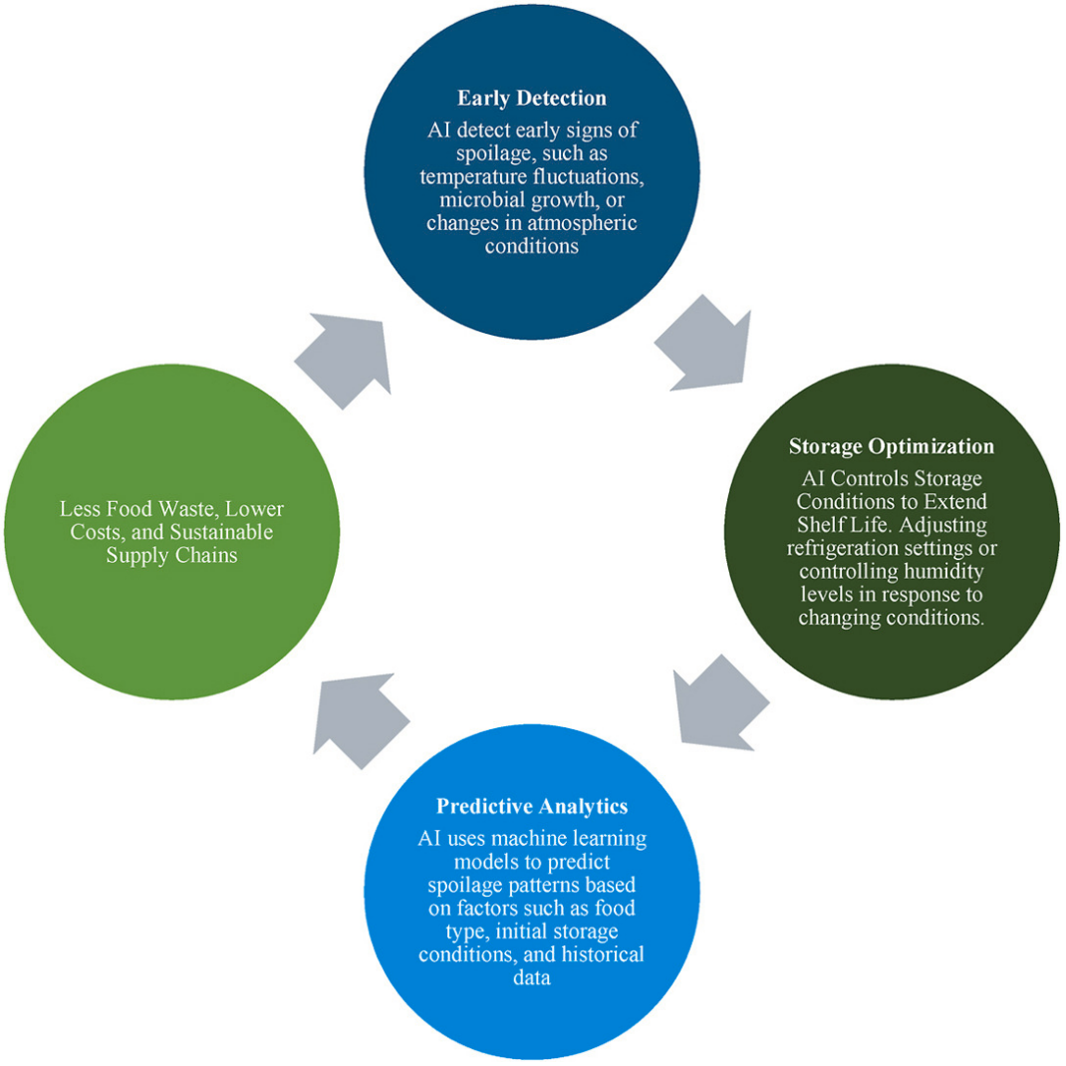
Figure 2: AI can reduce food loss, Onyeaka et al. (2025). (Image credits: https://www.sciencedirect.com/science/article/pii/S2666154325002662)
-
Artificial Intelligence and Internet of Things Integration
Increasingly, the emphasis is on using smart solutions by integrating Internet of Things (IoT) sensors. It allows sensors to operate around the clock without manual intervention for monitoring or controlling storage processes. It reduces labor costs and is useful for both small and large producers.
Artificial intelligence (AI) is integrated into storage in many ways; also see Figure 2.
- The vast amounts of real-time data collected through continuous monitoring or complex spectral data rely on AI and machine learning algorithms or models for analysis, providing easy-to-understand insights to improve decision-making.
- AI models are also being used to predict shelf life based on intrinsic and external factors, informing marketing decisions and helping prevent spoilage and food loss.
- Machine vision can also be used to detect diseases.
-
Traceability
The highly perishable nature of fresh produce compounds any flaws caused in the early stages of the supply chain. The problems that materialize in storage may have their beginnings in farm conditions, for example, pathogen infection of fresh produce in the field, some of which grow better in the high relative humidity of storage conditions. Data such as harvest maturity are important not only for determining picking time but also for setting environmental conditions during storage. Hence, the exchange and flow of information between various stakeholders is necessary.
According to the International Fresh Produce Association (IFPA), 78% of food loss in the supply chain was due to a lack of efficient, transparent data. Various traceability technologies facilitate cross-sector collaboration among producers, packers, suppliers, transporters, and retailers to exchange information and preserve product value.
These technologies include the following options:
- Unique IDs like barcode or radio frequency identification [RFID] tags
- Sensors and digital systems, like blockchain, that record and store data
Traceability can improve food safety by identifying and removing contaminated fresh produce, helping with sustainability verification, and ensuring compliance with quality standards and regulations.
-
Nanotechnology
Nanotechnology can improve the storage and preservation of fresh produce. Earlier innovations were based on treatments of individual fresh produce commodities. However, advances in nanocapsulation enable the slow release of antimicrobial compounds in storage facilities, thereby controlling their growth and extending the shelf life of fresh produce.
Choosing the Correct Technology
The rising demand for fresh produce can be best met by using advanced cold chain infrastructure. Choosing the correct technology will be based on the specific product and its intended market. For precise gas analysis and quality estimation devices, consider Felix Instruments Applied Food Science. The company has one general fresh produce and several quality meters customized for specific fruits that measure SSC, TA, DM, and external and internal color. Felix Instruments also offers the portable F-940 Store It! Gas Analyzer and the fixed F-910 AccuStore for continuous monitoring and control of storage facilities that need to monitor gas composition.
Contact us for more information on our precision instruments for your storage facilities.
Sources
Hahn-Petersen, L.A., and Eeg, S.H. (2025, Aug 26). How emerging technologies can advance food quality traceability and prevent waste. Retrieved from https://www.weforum.org/stories/2025/08/emerging-technologies-food-quality-traceability-loss/
Hoffmann, T. G., de Souza, C. K., Sonawane, A. D., Praeger, U., Büchele, F., Neuwald, D. A., … & Mahajan, P. V. (2025). Challenges and future perspectives in postharvest cold storage: A technological review of sustainable and efficient cold storage of fresh produce. Food Research International, 117406.
Hort Frontiers. (2019). Routine fresh produce supply chain monitoring– making the most of your data. Retrieved from https://www.google.com/url?sa=t&source=web&rct=j&opi=89978449&url=
https://www.publications.qld.gov.au/dataset/b79225ec-0136-4eb3-b4a3-8e0bc221e725/
resource/8fca2012-dab0-47a0-8c47-eaa1536b12e3/download/routine-fresh-produce-supply-chain-monitoring-making-the-most-of-your-data.pdf&ved=2ahUKEwiyqeu19N6UAxVmRPEDHZJPPBwQFnoECCUQAQ&usg=AOvVaw1o3qIdpPdw6iZnLpssXd6U
Kavitha, N. & Dev, Petikam & Akhil, Mamidanna. (2026). Real-Time Vegetable Storage and Monitoring System with User Alertsfor a Smart Kitchen. International Journal of Engineering Technology and Management Sciences. 10. 10.46647/ijetms.2026.v10i02.037.
Khan, M. R., Muhammad, A., Guo, Y., Hashmi, M. S., & Ahmad, R. (2024). Dynamic Controlled Atmosphere Technology for Fruits and Vegetables. In Sustainable Postharvest Technologies for Fruits and Vegetables (pp. 86-94). CRC Press. 1st Edition First
Olagoke-Komolafe, O., & Oyeboade, J. (2022). The Role of Digital Monitoring Systems in Improving Food Quality and Safety. International Journal of Multidisciplinary Futuristic Development (IJMFD), 3(1), 43-53. DOI: https://doi.org/10.54660/IJMFD.2022.3.1.43-53
Onyeaka, H., Akinsemolu, A., Miri, T., Nnaji, N. D., Duan, K., Pang, G., … & Ugwa, C. (2025). Artificial intelligence in food system: Innovative approach to minimizing food spoilage and food waste. Journal of Agriculture and Food Research, 21, 101895.
Socheata, C., & Somaly, S. (2026). Cold storage technologies for fresh fruits: impacts on shelf life and nutritional quality. Journal of Agriculture and Technology, 2(1), 66-71.
Spindler, W., Hahn-Petersen, L.A., and Eeg, S.H. (2025, May 19). How traceability can unwrap our food systems to give visibility on loss and waste. Retrieved from https://www.weforum.org/stories/2025/05/food-systems-waste-loss-traceability/
Thompson, Anthony. (2016). Hyperbaric Storage. In book: Fruit and Vegetable Storage (pp.93-114). 10.1007/978-3-319-23591-2_4.
Verma, S., Kumar, S., Kumar, V., Yadav, S., Singh, P., Saurabh, A., … & Jain, M. (2025). Recent Advancements and Innovations in Post-harvest Handling, Storage, and Technology for Vegetables: A Review. Archives of Current Research International, 25(2), 161-180. https://doi.org/10.9734/acri/2025/v25i21076
Related Products
Most Popular Articles
- Spectrophotometry in 2023
- NIR Applications in Agriculture – Everything…
- The Importance of Food Quality Testing
- The 5 Most Important Parameters in Produce Quality Control
- Melon Fruit: Quality, Production & Physiology
- Fruit Respiration Impact on Fruit Quality
- Guide to Fresh Fruit Quality Control
- Liquid Spectrophotometry & Food Industry Applications
- Ethylene (C2H4) – Ripening, Crops & Agriculture
- Understanding Chemometrics for NIR Spectroscopy