Freezing and Chilling Injury: What’s the Difference?

Dr. Vijayalaxmi Kinhal

November 5, 2026 at 11:30 pm | Updated November 5, 2026 at 11:33 pm | 6 min read
- Freezing injury occurs when storage temperatures fall below the freezing points of fresh produce, which vary by product.
- Chilling injury occurs at temperatures above the freezing point and affects chilling-sensitive fresh produce from tropical and subtropical regions.
- Ice crystal formation causes freezing injury, while cell membrane degradation, ROS production, and reduced energy cause chilling injury.
- Checking temperature records is the best way in the supply chain to differentiate and control both disorders.
Storing fresh produce at low temperatures is the most common method to extend postharvest storage and transport time and maintain quality. However, low temperatures can cause physiological disorders, freezing, and chilling injury that affect the appearance and internal quality of vegetables and fruits, leading to consumer rejection and significant economic losses. The mechanisms and damage differ, arise from different postharvest conditions, and must be accurately identified to mitigate supply-chain losses. This article discusses the differences between freezing and chilling injury to help identify each quality problem.
Freezing Injury
Freezing injury occurs when fresh produce is stored below its freezing point and ice crystal formation damages cells and cell walls.
Mechanism: Ice crystals can form inside cells and/or between cells, and as they grow, they rupture cells through physical, mechanical force. The cell membrane tears, and the damage is irreversible. No metabolic changes occur; therefore, some scientists sometimes do not even classify freezing injury as a physiological disorder, but as mechanical damage due to freezing. Once the product thaws, ruptured cells release their contents into intercellular spaces. Fresh produce cooled slowly develops larger crystals, resulting in greater freezing injury.
Subscribe to receive our monthly round-up of articles.
Freezing injury stops all metabolic functions, so the product is effectively killed and tissue can be completely lost. However, some vegetables, like cabbage, tolerate freezing and can recover if thawed slowly.
Conditions: The freezing point is the temperature at which ice crystals begin to form inside fresh produce tissue. The freezing point differs among fresh produce. Most fresh produce has over 90% water content; however, it also contains biocompounds such as soluble sugars, organic acids, pigments, etc. The amount and nature of these compounds differ between species, cultivars, or harvest maturity within the same cultivar. So, the freezing point of fresh produce differs, but is always below that of water (32°F; 0°C). The higher the solute concentration, the lower the freezing point. For example, lettuce with less sugar has a freezing point of 31.7°F (-0.2°C), but plums with higher sugar have a freezing point at or below 29°F (-1.7°C).
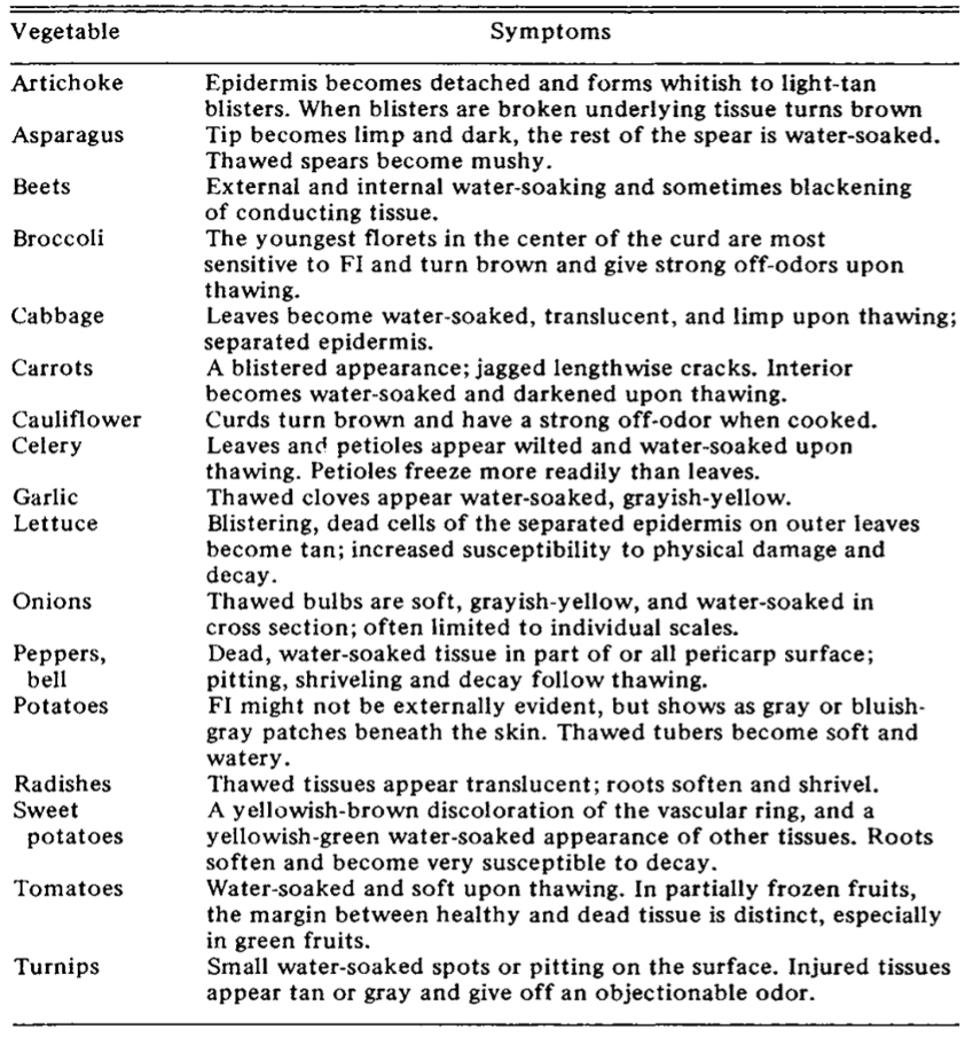
Table 1: “Symptoms of freezing injury in some vegetables,” Adapted from Kader et al. 1974. (Credits: https://journals.ashs.org/hort/hort/published/rest/pdf-watermark/v1/journals/hortsci/9/6/article-p523.pdf/watermark-pdf/)
Sensitivity: Freezing injury can occur in all fresh produce if storage temperatures fall below their freezing point. However, the sensitivity to freezing can vary among fresh produce. Fresh produce from tropical regions can suffer more damage, while produce from colder countries can survive if the freeze event is not severe. Exceptions occur; for example, lettuce from temperate countries can suffer freezing damage close to 0 °C.
Symptoms: Damage is not evident as long as the fresh produce remains frozen because it is rigid; however, once it thaws, cell contents seep into intercellular spaces, replacing air with liquid, and the contents can leak if the fresh produce is cut.
- Loss of firmness and texture can make products mushy.
- Loss of sensory attributes occurs because of a glassy, translucent, water-filled appearance and color changes.
- Dehydration occurs due to drip loss of contents.
- Freezing injury leads to loss of flavor and nutritional value.
Table 1 lists species-specific symptoms of freezing injury in vegetables.
Occurrence in store rooms: Freezing damage is localized in a storage room. Batches or units near cold-air discharge, next to an exterior wall, or on the side of the pallet exposed to cold temperatures will suffer freezing injury, not the entire batch of fresh produce in the storage room.
Chilling Injury
Chilling injury is a physiological disorder that occurs in chilling-sensitive fresh produce exposed to cold temperatures above freezing. This cellular, metabolic, and membrane-related disorder can occur across a range of temperatures and degrade quality, making the fresh produce susceptible to microbial decay.
Mechanism: Multiple mechanisms can contribute to chilling injury.
- Cell membrane: Cold temperatures act as chilling stress, and lipids in the cell membrane that typically remain fluid and flexible to allow movement of gases, water, and nutrients become gel-like and rigid. As a result, the cell membrane’s normal functions are disrupted, and essential metabolites leak out of the cell.
- Reactive oxygen species (ROS): Overproduction of ROS due to stress destabilizes the cell membrane, causes solute leakage, and increases oxidative stress.
- Energy: Energy (ATP) production decreases, reducing the cell’s ability to repair and recover from chilling, which can become irreversible in severe cases.
Conditions: Chilling injury can occur over a range of temperatures, and exposure duration also matters. According to the Food and Agriculture Organization (FAO), chilling can occur at temperatures below 13 to 16 °C (55 to 60 °F). The severity of effects increases as temperatures drop and storage duration increases.
Sensitivity: Fresh produce from tropical and subtropical countries, which typically shows chilling sensitivity, is susceptible to chilling injury. However, some from temperate areas, such as asparagus, potatoes, apples, and cranberries, are also susceptible to chilling injury at very low storage temperatures of 2-3°C.
Symptoms: Unlike freezing injury, chilling injury symptoms can affect fresh produce throughout a room. Chilling injury symptoms begin to develop in cold storage but become more apparent after rewarming at room temperature. Chilling injury changes internal and external quality parameters.
Chilling injury can cause several symptoms such as surface pitting, discoloration, and water-soaked areas. Internal damage can include water-soaked tissue, pulp browning, and seed blackening. Fruits affected by chilling injury fail to ripen and have poorer quality due to changes in color, texture, taste, and aroma. Chilling injury can also cause fresh produce to develop off-flavors at warmer temperatures after removal from cold storage. Symptoms vary by species, and Table 2 lists some.
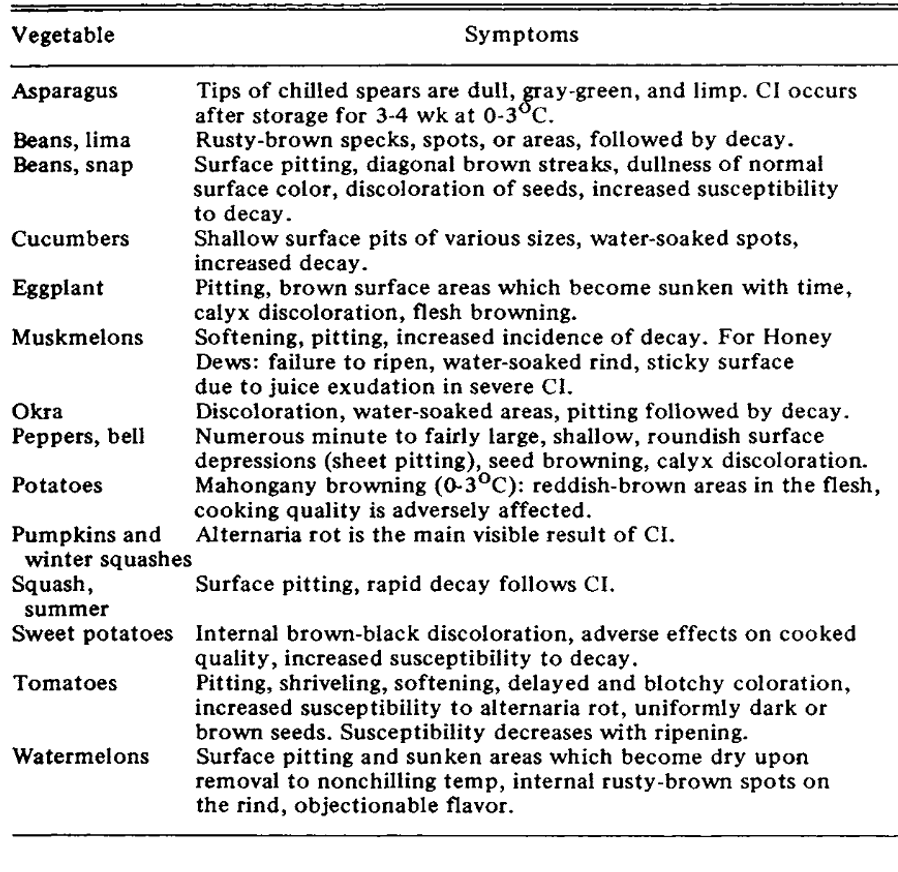
Table 2.: “Visible symptoms of chilling injury in some fresh produce,” Adapted from Kader et al. 1974. (Credits: https://journals.ashs.org/hort/hort/published/rest/pdf-watermark/v1/journals/hortsci/9/6/article-p523.pdf/watermark-pdf/).
How to Differentiate Between Freezing and Chilling Injury
Freezing injury and chilling injury become more evident at room temperatures and can be identified by their respective symptoms. Some of the other methods are listed below:
Temperature records: The main way to differentiate freezing and chilling injury in the supply chain is through temperature records.
Symptom development pattern: Freezing injury affects pallets and units more on the side exposed to cold temperatures, producing severe symptoms. Chilling injury is distributed across the entire room.
Sensitivity: Freezing injury can occur in all fresh produce regardless of origin, while chilling injury affects mainly tropical and subtropical fresh produce.
Ice formation: Products that have ice crystals in the tissue have freezing injury. An absence of ice crystals points to chilling injury.
Preventing Freezing and Chilling Injury
Preventing freezing and chilling injury is the best way to limit losses, as the damage can be irreversible in severe cases. Temperature and relative humidity are two storage factors to monitor to prevent these injuries. Changes in internal and external color are symptoms of both disorders and can be identified using near-infrared (NIR) spectroscopy-based technology.
Felix Instruments Applied Food Science offers NIR spectrometers for non-destructive, real-time analysis of several quality parameters, including external and internal color: the F-750 Produce Quality Meter. It is small and portable and can be used at every stage of the supply chain, from farms to retailers.
Contact us to learn more about NIR spectroscopy-based quality meters for monitoring fresh produce in the supply chain.
Sources
Agriculture. Institute. (2025, June 15). Understanding Chilling Injury in Fruits and Vegetables. Retrieved from https://agriculture.institute/food-chemistry-and-physiology/understanding-chilling-injury-fruits-vegetables/
FAO. (n.d.). CHAPTER 4 – FROST DAMAGE: PHYSIOLOGY AND CRITICAL TEMPERATURES. Retrieved from https://www.fao.org/4/y7223e/y7223e0a.htm
FAO. (n.d.). CHAPTER 6: TEMPERATURE AND RELATIVE HUMIDITY CONTROL – 2. Retrieved from https://www.fao.org/4/ae075e/ae075e14.htm
Golding, J. (2019, Aug 13). A review of chilling injury causes and control. Retrieved by https://www.citrusaustralia.com.au/latest-news/a-review-of-chilling-injury-causes-and-control/
Kader, A. A., Lyons, J. M., & Morris, L. L. (1974). Postharvest Responses of Vegetables to Preharvest Field Temperature1. HortScience, 9(6), 523-527.
Korumilli, T., Kesavamoorthy, I., Prashant, P. P., Selva Kumar, T., Jagajjanani Rao, K., & Sevanan, M. (2026). Understanding chilling injury in postharvest produce: mechanisms, diagnosis, and mitigation strategies. Planta, 263(1), 29.
Mishra, V. K., & Gamage, T. V. (2007). Postharvest physiology of fruit and vegetables. In Handbook of food preservation (pp. 37-66). CRC press. https://d1wqtxts1xzle7.cloudfront.net/62471899/Handbook_of_Food_Preservation20200325-50299-hu1jr6-libre.PDF?
UCDavis. (n.d.). What is the difference between freezing and chilling injury? Retrieved from https://postharvest.ucdavis.edu/ask-produce-docs/what-difference-between-freezing-and-chilling-injury
Wu, J., Tang, R., & Fan, K. (2024). Recent advances in postharvest technologies for reducing chilling injury symptoms of fruits and vegetables: A review. Food Chemistry: X, 21, 101080.
Related Products
- F-751 Grape Quality Meter
- Custom Model Building
- F-910 AccuStore
- F-751 Melon Quality Meter
- F-751 Kiwifruit Quality Meter
- F-750 Produce Quality Meter
- F-751 Avocado Quality Meter
- F-751 Mango Quality Meter
- F-9XXDK Dynamic Sampling Kit
- F-900 Portable Ethylene Analyzer
- F-950 Three Gas Analyzer
- F-920 Check It! Gas Analyzer
- F-960 Ripen It! Gas Analyzer
- F-940 Store It! Gas Analyzer
Most Popular Articles
- Spectrophotometry in 2023
- NIR Applications in Agriculture – Everything…
- The Importance of Food Quality Testing
- The 5 Most Important Parameters in Produce Quality Control
- Melon Fruit: Quality, Production & Physiology
- Fruit Respiration Impact on Fruit Quality
- Guide to Fresh Fruit Quality Control
- Liquid Spectrophotometry & Food Industry Applications
- Ethylene (C2H4) – Ripening, Crops & Agriculture
- Understanding Chemometrics for NIR Spectroscopy
Related Reading