What Affects Melon Quality? Common Postharvest Problems and How to Prevent Them

Dr. Vijayalaxmi Kinhal

July 1, 2026 at 8:57 pm | Updated July 1, 2026 at 8:57 pm | 8 min read
- Musk melon cultivars can develop physical, physiological, and pathological disorders that degrade quality in the postharvest stages.
- Mechanical damage and excessive free moisture are the physical problems.
- The physiological problems are quality loss due to exposure to endogenous or exogenous ethylene and chilling sensitivity.
- Diseases caused by pathogens carried on the melon rind have led to many food-borne illness outbreaks.
Melons are among the most widely cultivated cucurbitaceous crops, accounting for 3% of the area under vegetable cultivation. Melons’ physiology remains strong even after harvest, which can lead to quality deterioration and disease in the supply chain, resulting in economic losses. To prevent losses in melon quantity and ensure consumer satisfaction, postharvest quality management is crucial. In this article, stakeholders can learn about common quality problems that can occur and how to control them in the postharvest chain.
Melon Quality
Muskmelons, or melons belonging to the species Cucumis melo, are subdivided into seven cultivar groups: inodorus, cantalupensis, reticulatus, conomon, chito, and dudaim melons. The cultivars are differentiated based on size, shape, external color, rind type, pulp color, texture, and sweetness. However, all of them are annuals and grow on vines, most as creepers and some as climbers, and have a thick rind.
Muskmelons can be climacteric, like the cantaloupes, and need ethylene for ripening. Melons can also be non-climacteric, such as honey melons or those in the inodorous group, which do not require ethylene for ripening. Some common traits used to judge the quality of melons, without considering shape and size due to differences among cultivars, are as follows:
Subscribe to receive our monthly round-up of articles.
- Absence of surface defects, scars, and sunburn
- Firm with no bruising or mechanical damage effects
- Smooth stem end without a peduncle
- Heavy for its size
Internal quality parameters used to evaluate post-harvest quality are soluble sugar content (SSC) and titrable acidity. In the U.S., melons are classified into two grades: Fancy (No. 1) if the fruit has an SSC of 11%, and No. 2 if the SSC is 9%.
Usually, breeding for melon cultivars focuses on extending shelf life at the expense of flavor. Hence, it is essential to harvest melons at the correct maturity to get fruits with high SSC and flavor. Proper postharvest management is also crucial to preserve postharvest quality and flavor.
Problems that stakeholders must monitor and control in the melon postharvest chain include physical, physiological, and pathological disorders, which are discussed in the following sections.
Physical Problems
Physical problems affecting melons are mechanical damage and excessive moisture on the rind, which can lead to structural and physiological issues.
Mechanical damage
Although melons have a thick rind, mechanical damage can still occur. The most common causes reported by many sources are the use of weak cartons and incorrect handling, such as tossing cartons.
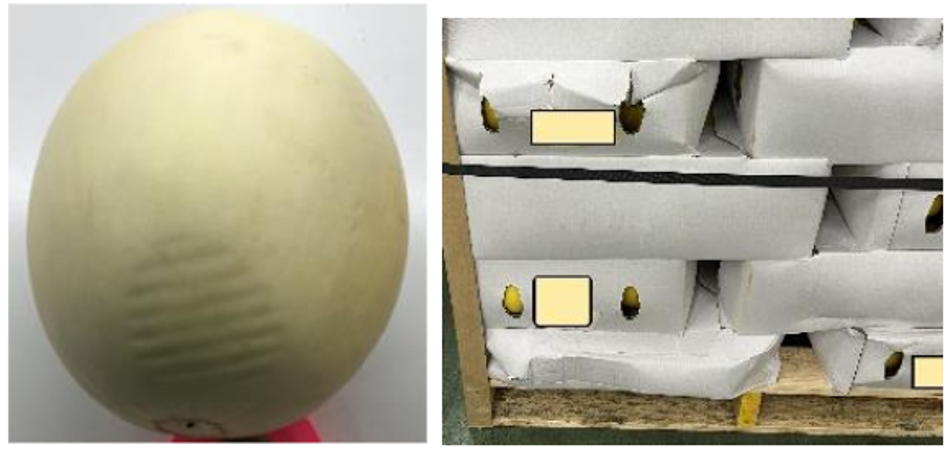
Image 1: “Carton mark on honeydew (left) and squashed cartons on pallet (right),” Agnew. (Image credits: daf.qld.gov.au)
Compression of fruits stacked in weak cartons can leave visible marks, and improper stacking can cause squashing or tissue breakdown; see Figure 1. Tossing cartons of melons also causes impact damage, including cracks, bruising, and inner rind necrosis.
Excessive moisture
Free moisture on the melon surface must be avoided to extend shelf-life and quality, as the fruits are susceptible to postharvest decay. Melons must be washed to remove soil and debris, then sanitized with chlorine. The melons should be dried, preferably by air-drying, to reduce the risk of cross-contamination from wiping.
Physiological Disorders
Physiological problems in melons lead to quality deterioration, weight loss, chilling injury, decay, off flavors, and ripening issues.
Quality deterioration
Ethylene is a natural phytohormone produced by climacteric melons and is necessary for ripening. Ultimately, ripening leads to senescence and decay. Even non-climacteric melons decay when exposed to ethylene. Hence, ethylene exposure needs to be controlled during the postharvest stages to preserve melon quality and extend shelf life. Melons will decay when exposed to ethylene from external sources, such as machines that burn fossil fuels or other fruits and vegetables that produce ethylene naturally. Some of the quality parameters that deteriorate postharvest due to unplanned ripening include color, firmness, soluble sugar content, and titratable acidity.
Color loss: The first quality parameter that consumers evaluate is peel color. It is necessary to prevent premature color development by inhibiting pigment biosynthesis and accumulation. On the other hand, only fully mature melons will develop the desired colors after ripening. Melons picked too early to extend storage time can remain paler.
Using 1-methylcyclopropylene (1-MCP) treatment or storing melons at low temperatures can delay changes in peel and flesh color, and maintain fruit brightness and original color.
Firmness loss: Softening occurs due to degradation of the cell wall, increasing water-soluble pectin, and reducing insoluble pectin. Treatment with 1-MCP as a gas or liquid microbubbles can delay softening. The duration of treatment depends on cultivars and the storage temperatures. Aqueous calcium treatment can increase calcium content in the cell wall and improve cell wall stability.
Unplanned increase of soluble solids content: Soluble solids content (SSC), measured by oBrix, increases with ripening and is an indicator of taste, flavor, and nutritional value. It is a total of sugars, amino acids, vitamins, and minerals. Various methods used to inhibit the premature increase in SSC include heat treatment, gaseous ozone, and a combination of 1-MCP and an enhanced freshness formulation (EFF).
Titrable acidity loss: The main acid in cantaloupe is citric acid. As fruits ripen, titrable acidity (TA) decreases because it serves as a substrate for respiration, affecting quality. The SSC-to-TA ratio is used as an indicator of taste, and changes in TA will affect taste and flavor. Fumigation with 1-MCP followed by cool storage can prevent the reduction of TA. Gas composition of oxygen, carbon dioxide, and nitrogen can be altered in modified-atmosphere packaging (MAP) to maintain TA. Other means of delaying the loss of TA include hot-water treatment and a combined treatment of 1-MCP and sodium metabisulfite (Na2S2O5).
Weight loss
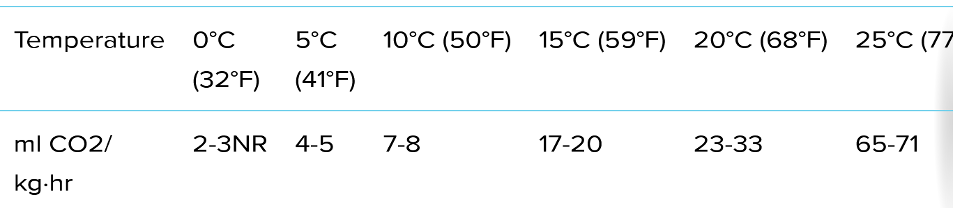
Table 1: Rates of respiration in melons at different temperatures, Suslow et al. 1997. (Credits: https://postharvest.ucdavis.edu/produce-facts-sheets/cantaloupe)
Among the melons that undergo climacteric ripening, the rate of respiration spikes during ripening along with ethylene production. During respiration, carbohydrates are broken down, resulting in weight loss. Water loss also occurs due to enzymatic activity, adding to weight loss.
Storing melons at lower temperatures of 7 to 10 °C and high relative humidity of 90 to 95%, especially in a controlled atmosphere (CA) or in MAP, can reduce respiration rate and delay weight loss; see Table 1. Also, storing chitosan-treated melons at 5 °C can control weight loss.
Decay
Ethylene production can cause senescence or decay in all melon types stored under ambient conditions or for extended periods. Decay can also occur due to diseases and mechanical damage. Preventing decay is necessary to maintain quality. The decay index is used to evaluate the efficacy of fruit storage.
Treating with 1-MCP can lower the decay rate, but these melons can still be attacked by pathogens.
Chilling injury
Storing at low temperatures can prevent, reduce, or delay several quality problems in melons. However, if storage temperatures are very low, this can cause chilling injury, as most melons are tropical or subtropical in origin.
The optimal storage conditions of tropical melons are 7–10 ℃ with a high relative humidity (RH) of 90–95%. Chilling injuries are reported to begin when melons are stored below 4°C for several days. The symptoms are more severe as temperatures get lower. As melon maturity and ripeness increase, susceptibility to chilling injury reduces. Chilling injury leads to browning, soaking, pitting, sunken spots, Alternaria infection, and ripening failure.
Ripening problems
Storage temperatures below 5 °C also cause problems with ripening. One of them is incomplete ripening, especially in melons harvested at early maturity stages or after insufficient days after anthesis. These early-mature stages must be stored at 13 °C for dudaim melon cultivars to achieve higher ethylene production during ripening. Impaired ripening can also occur due to very low oxygen (<1%) or high carbon dioxide (>20%) in controlled-atmosphere storage.
Off-flavors
Off-flavors are another effect of postharvest management methods, such as cold temperatures and controlled-atmosphere storage, where gas levels are altered from ambient levels. Gas composition with high carbon dioxide (10-20%) produces a carbonated flavor due to anaerobic respiration, but this flavor disappears when melons are transferred to normal air.
Pathological Problems
Pathological problems include the presence of bacteria, fungi, viruses, and parasites on melons, rendering them unsafe. Many severe outbreaks of Salmonella-related foodborne illness have been linked to melons.
Melons grow close to the ground, and the risk of the rind becoming contaminated by soilborne pathogens is high. Besides soil, the use of improperly composted manure and contaminated water can be other causes in the field. The melons develop a “ground spot” on the side that lies on the soil because the rind does not develop fully due to contact with the ground and is thinner than the rest of the rind. The thinner ground spots are more susceptible to microbial contamination and can be internalized during washing. Also, cantaloupes with netted rinds are at greater risk of contamination, since pathogens can be trapped by the surface netting and are more challenging to remove while cleaning. Handling, storage, and transport are the postharvest stages during which rind contamination can occur. The pathogen load depends on season, region, and field sanitation practices.
The most harmful pathogens carried by melons that do not cause external infections are Listeria, Salmonella, Norovirus, and E. coli. These can contaminate the flesh when the fruit is cut by consumers or processors.
Other common fungal pathogens that can be present on the rind and cause surface lesions and decay are Alternaria, Aspergillus niger, Pseudallescheria, Neosartorya, Cladosporium, Geotrichum, Penicillium, Mucor, and Rhizopus. Treatment with hot water at 55°C for 0.5-1.0 min is effective in controlling surface mold. Controlled-atmosphere storage and lower temperatures can delay fungal growth on the fruit surface and at the stem end.
Monitoring Melon Quality in the Supply Chain
It is necessary to regularly monitor melon quality throughout the supply chain to support postharvest management plans and methods. The quality evaluation method should therefore be non-destructive to avoid loss of harvest. Conventional methods use destructive sampling and require longer waiting times for results. Using advanced and modern quality assessment tools can be a game-changer. Felix Instruments Applied Food Science offers the F-750 Produce Quality Meter for non-destructive measurements of SSC and TA, which can be used to assess quality on farms and at all stages of the postharvest supply chain. The company is also developing another device, the F-751 Melon Quality Meter, which will be customized for assessing melon quality. The quality meters can be used onsite by anyone, as they do not need extensive training. The precise results are given in real time and are easy to understand.
Melon supply chain stakeholders should also explore the gas analyzers Felix Instruments offers for monitoring the gas composition of oxygen, carbon dioxide, and ethylene in CA storerooms and MAPs.
Contact us to learn more about the Felix Instruments Applied Food Science’s quality meters and gas analyzers for melon postharvest management.
Sources
Agnew, J. (n.d.). Key post-harvest practices impacting melon quality in domestic and export markets. Retrieved from https://www.publications.qld.gov.au/ckan-publications-attachments-prod/resources/41f4fc14-d8af-47e8-8603-651978dcbb76/key-post-harvest-practices-impacting-melon-quality-in-domestic-and-export-markets.pdf?ETag=a32c03b275d8028c7afbe1f36019cae4
Australian Institute of Food Safety. (n.d.). Food Safety Practices for Rockmelon Growers. Retrieved from https://blog.foodsafety.com.au/food-safety-practices-rockmelon-growers
Government of Canada. (n.d.). Food safety tips for melons. Retrieved from https://www.canada.ca/en/health-canada/services/food-safety-fruits-vegetables/melons.html
Haraminac, E. (2012, July 10). Melons: Prepare and store properly for safe consumption. Retrieved from https://www.canr.msu.edu/news/melons_prepare_and_store_properly_for_safe_consumption
Hatami, M., Kalantari, S., Soltani, F., & Beaulieu, J. C. (2019). Storability, quality changes, and general postharvest behavior of dudaim melon harvested at two maturity stages. HortTechnology, 29(3), 241-250.
Kabiru, S.M., & Danzaki, M.M. (2025). Identification of Fungal Pathogens of Postharvest Rot
of Sweet Melon Fruit (Cucumis melo L.) In Jimeta, Yola-North Local Government Area of Adamawa State. IRE Journals, 9(6), 878-887. https://doi.org/10.64388/IREV9I6-1712719
Karimi, F., Aria, F. R., & Qarluq, A. Q. (2019). Studies on food safety of melon in its food supply chain. International Journal of Innovative Research and Scientific Studies, 2(3), 33–38. https://doi.org/10.53894/ijirss.v2i3.19
Madrid, M. (2020). Subtropical fruits: Melons. In Controlled and Modified Atmospheres for Fresh and Fresh-Cut Produce (pp. 455-461). Academic Press.
Park, M. H., Do, K. R., Moon, H. W., Malka, S. K., & Ku, K. M. (2023). Hot water treatment alleviates peel browning in oriental melons through cutin biosynthesis: A comprehensive metabolomics approach. Postharvest Biology and Technology, 204, 112451.
Suslow, T.V., Cantwell, M., & Mitchell, J. (1997). Cantaloupe. Retrieved from https://postharvest.ucdavis.edu/produce-facts-sheets/cantaloupe
Wang, C. Y. (1989). Chilling injury of fruits and vegetables. Food Reviews International, 5(2), 209–236. https://doi.org/10.1080/87559128909540850
Wang, H., Cui, J., Bao, R., Zhang, H., Zhao, Z., Chen, X., Wu, Z., & Wang, C. (2024). Research progress on the effects of postharvest storage methods on melon quality. PeerJ, 12, e17800. https://doi.org/10.7717/peerj.17800
Related Products
- F-751 Grape Quality Meter
- Custom Model Building
- F-910 AccuStore
- F-751 Melon Quality Meter
- F-751 Kiwifruit Quality Meter
- F-750 Produce Quality Meter
- F-751 Avocado Quality Meter
- F-751 Mango Quality Meter
- F-9XXDK Dynamic Sampling Kit
- F-900 Portable Ethylene Analyzer
- F-950 Three Gas Analyzer
- F-920 Check It! Gas Analyzer
- F-960 Ripen It! Gas Analyzer
- F-940 Store It! Gas Analyzer
Most Popular Articles
- Spectrophotometry in 2023
- NIR Applications in Agriculture – Everything…
- The Importance of Food Quality Testing
- The 5 Most Important Parameters in Produce Quality Control
- Melon Fruit: Quality, Production & Physiology
- Fruit Respiration Impact on Fruit Quality
- Guide to Fresh Fruit Quality Control
- Liquid Spectrophotometry & Food Industry Applications
- Ethylene (C2H4) – Ripening, Crops & Agriculture
- Understanding Chemometrics for NIR Spectroscopy
Related Reading