Raspberry Shelf Life: What Causes Quality Loss After Harvest?

Dr. Vijayalaxmi Kinhal

October 5, 2026 at 6:59 pm | Updated October 5, 2026 at 6:59 pm | 6 min read
- Raspberry postharvest quality problems include loss of firmness, color, and flavor, weight loss, microbial decay, physiological disorders, leakage, and rapid senescence.
- Raspberries’ characteristics, such as their high fruit respiration and transpiration rates, thin cuticle, and ethylene sensitivity, cause postharvest problems.
- Cold storage, high relative humidity, and an artificial controlled atmosphere of ethylene, oxygen, and carbon dioxide can extend raspberries’ naturally short shelf life.
Raspberries are cash crops that command some of the highest prices among fruits and are valued for their taste and nutraceutical value. Moreover, consumers demand flawless quality, safety, and freshness. However, raspberries are among the most perishable fruits, and postharvest losses are high. This article covers the common raspberry postharvest quality problems that supply chain stakeholders should monitor and eliminate to protect their ROI.
Raspberries
Raspberries (Rubus idaeus L.) belong to the family Rosaceae and are among the most widely cultivated berries for the global market. Consumers seek raspberries for their taste, quality, appearance, naturalness, health benefits, and versatility, ranging from table fruit to several processed products. The berries are rich in sugars, organic acids, volatile compounds, vitamin C, anthocyanins, carotenoids, and flavonols that contribute to their sensory appeal and health benefits. Demand for raspberries has risen over the last two decades in functional food markets because of their anti-inflammatory, antioxidant, and cardioprotective effects.
Fruit Characteristics of Raspberries
However, raspberries have the shortest shelf life among small fruits, with a postharvest life of only 2-3 days, which leads to economic losses. Postharvest problems in raspberries can stem from their morphology, physiology, and biochemistry.
Subscribe to receive our monthly round-up of articles.
- Morphology: Raspberries have a very soft texture and thin cuticle, making them prone to mechanical damage and susceptible to pathogens.
- Physiology: Raspberries have very high fruit respiration and transpiration rates and are sensitive to ethylene. Berries have the highest respiration among non-climacteric fruits at 15 to 70 mg CO2·kg−1 per hour.
These fruits are non-climacteric and must ripen on the plant. Therefore, they must be harvested at the right time, as overripe fruits have a shorter shelf life. After ripening, they cannot be stored long, as senescence and decay follow; see Figure 1. Therefore, raspberries are harvested every 2-3 days to pluck them at the correct harvest maturity.
Biochemistry: The biochemical composition of raspberries, which is essential for their taste, flavor, and appearance, includes compounds like anthocyanins and ascorbic acid that are chemically unstable and prone to oxidation, leading to quality degradation.
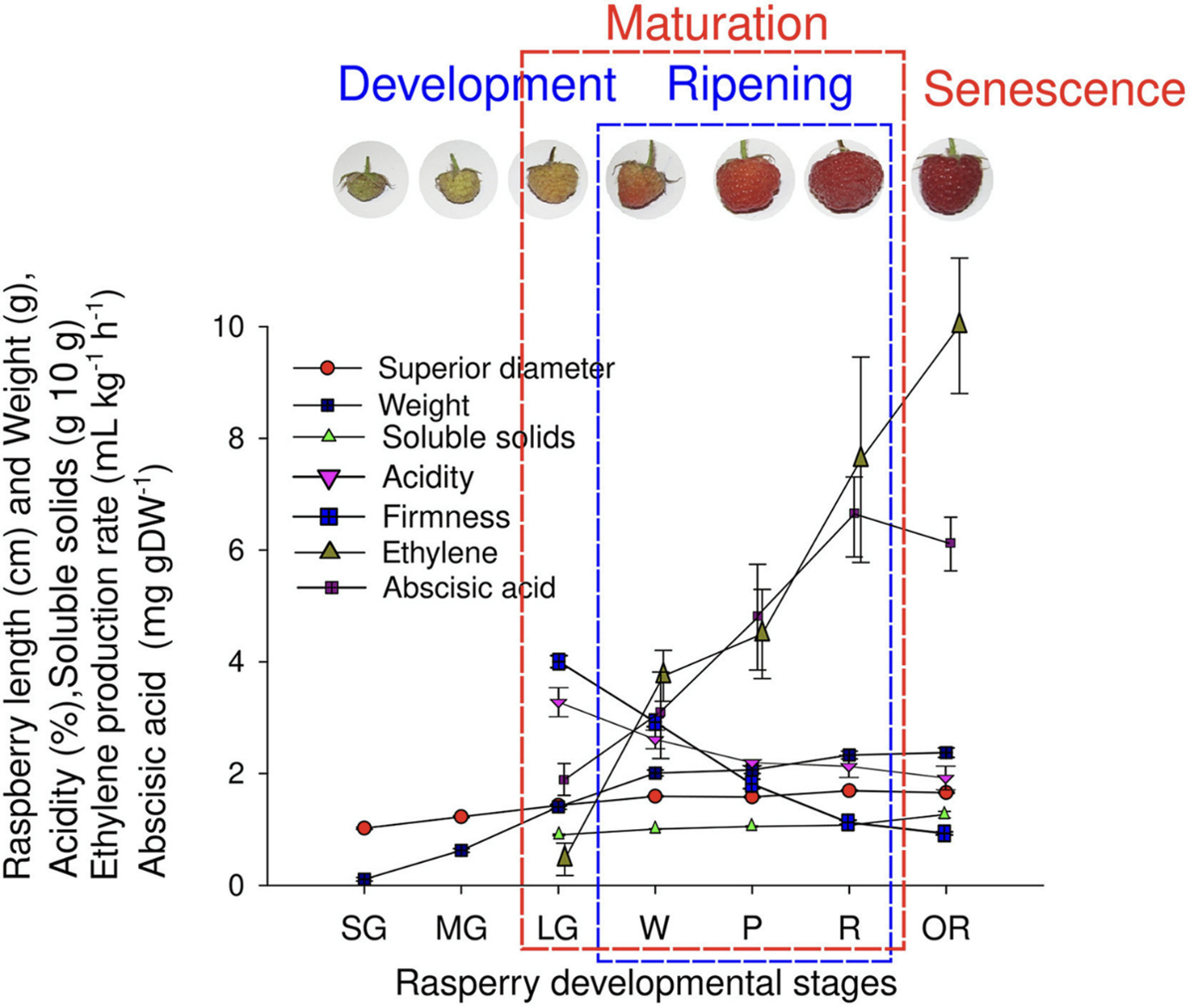
Figure 1.: “Progression of raspberry ripening parameters during developmental stages presented by Bernales et al. (2019) and Álvarez et al. (2023). The data used to generate this figure was obtained from ‘Heritage’ raspberry grown in Chile. SG: small green, MG: medium green, LG: large green, W: white, P: pink, R: red, OR: overripe fruit, N: Newton, DW: Dry weight,” Fuentes et al. (2026). (Image credits: https://doi.org/10.1016/j.scienta.2026.114692)
Postharvest Quality Problems
The raspberries’ morphology, physiology, and biochemistry, individually and in combination, lead to several postharvest quality problems discussed below that can shorten shelf life.
Loss of firmness and weight loss
Raspberries have a high-water content, exceeding 85-90%. Any increase in fruit transpiration, due to higher temperatures, lower relative humidity (RH), and increased respiration, can intensify water loss. Even a 3-5% water loss can lead to wilting, shriveling, and loss of freshness, firmness, and weight, reducing raspberry yield quality and quantity in the postharvest stages. Therefore, storage at low temperatures and high RH (90-95%) is advisable.
Loss of firmness in postharvest stages is also linked to preharvest factors such as growth conditions. Raspberries are larger and firmer when grown in protected indoor greenhouse conditions than in open fields.
Change in appearance
Raspberries’ appearance is affected by rapid shriveling and loss of shine due to dehydration. Oxidation of anthocyanins can also degrade pigments to brown, making the fruit look purple. Fruit color is the first quality parameter that consumers use to choose fruits, so color loss is a major problem in raspberries.
Loss of flavor
Ascorbic acid and compounds such as anthocyanins, ellagitannins, phenols, and aroma volatile compounds that contribute to flavor also degrade during storage, leading to rejection and food loss. Anthocyanins, which are needed for color and taste, are sensitive to temperature, light, and pH, so storage conditions can reduce or improve shelf life.
Increased senescence
Although raspberries are non-climacteric, ethylene, a phytohormone, is involved in ripening processes such as color development; see Figure 1. Fruits also show ethylene sensitivity, which accelerates raspberry ripening processes that make the fruit overripe, with associated changes in color and taste. Finally, ethylene will hasten senescence during storage, further reducing shelf life. Therefore, stakeholders should monitor the storage atmosphere and remove any ethylene produced by internal fruit processes and external machinery.
Leakage
Raspberries’ thin cuticle and lack of a thick skin make them prone to mechanical damage such as impact, abrasion, and compression. Skin damage can cause deformation, juice leakage, and pulp loss. Moreover, damaged fruit is more susceptible to pathogen attack.
Over-maturity and harvesting overripe fruits also increase mechanical damage and leakage in raspberries. To minimize damage, harvesting at the correct maturity is essential.
Due to their delicate nature, manual picking is usually used for fruits meant for fresh consumption. When machines are used, a lower drop height and soft handling systems are necessary. The number of times raspberries are handled postharvest is also reduced; fruits are picked, usually placed in clamshell packages in the orchards, and carried out in larger containers (see Figure 2). The second handling occurs during consumer use.
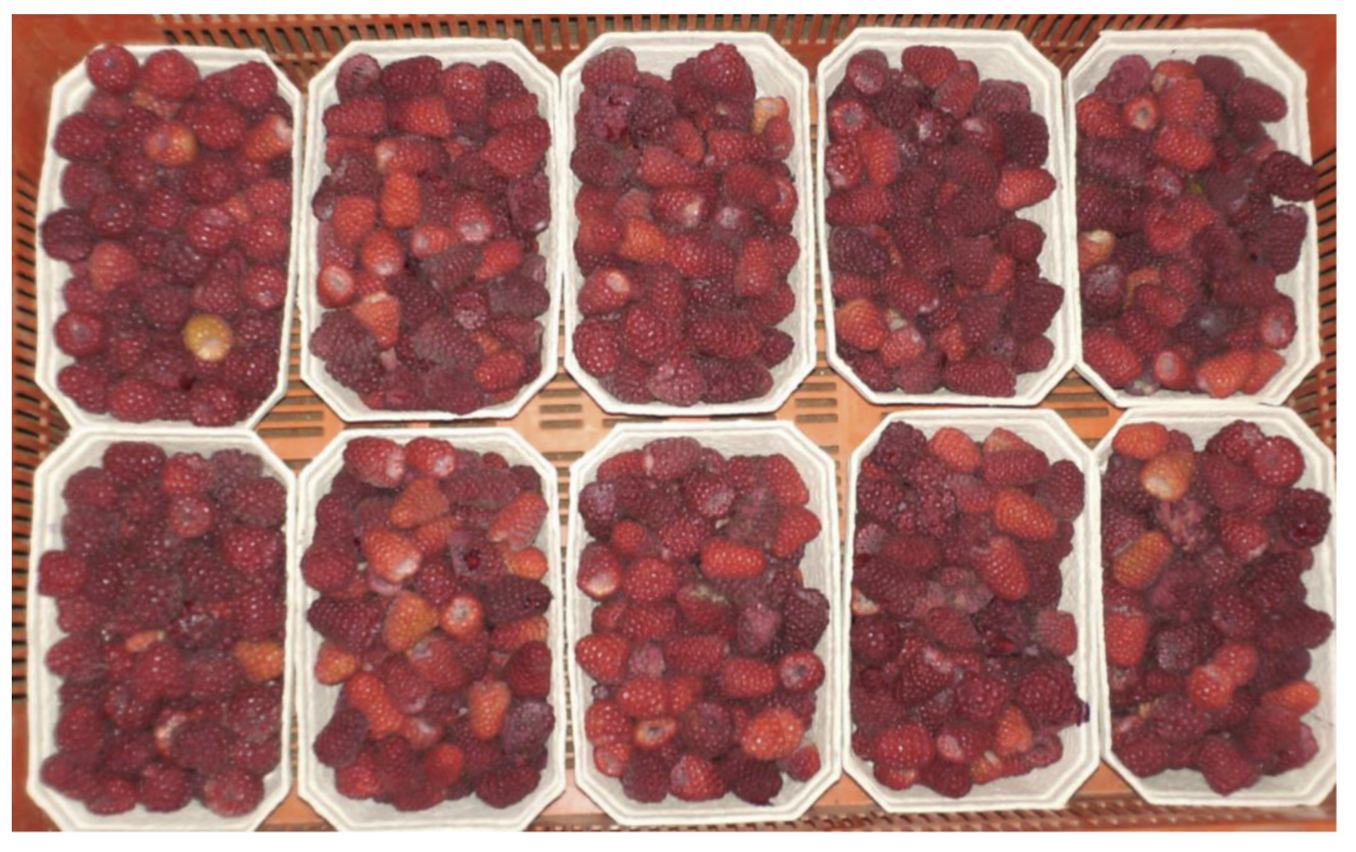
Figure 2: Raspberry fruits of the ’Laszka’ variety in 0.5 kg packages in a collective container. Sawicka et al. (2023). (Image credits: https://www.preprints.org/manuscript/202305.1660
Microbiological deterioration
Microbial decay is a major cause of food spoilage in all berries, including raspberries, and accounts for around 40% of postharvest losses and 25% of total production.
High water content and a thin cuticle, combined with improper postharvest handling, can increase the incidence of pathogen attacks. Some pathogens are also present preharvest and carried on the fruits as spores that later attack the fruits because of the high RH maintained during storage.
Common postharvest microbial decays in raspberries include gray mold caused by the fungus Botrytis cinerea. High RH, temperature fluctuations due to interruptions in cold storage, or changes in controlled and modified atmosphere can boost its growth. Rhizopus rot, caused by Rhizopus stolonifera, is another common cause of microbial decay in raspberries.
Other common fungal pathogens that attack raspberries include Alternaria alternata, Penicillium expansum, Penicillium italicum, Cladosporium spp., and Colletotrichum acutatum. Yeasts such as Candida, Metschnikowia, and Pichia can also cause microbial deterioration in raspberries.
This causes changes in color and taste, making the fruit unsafe for consumption.
Physiological disorders
Raspberries suffer from a few physiological disorders, such as white drupelet disorder and off-flavors.
- White drupelet: This disorder can start during the preharvest or postharvest stages due to fruit exposure to heat or UV rays. Hot, sunny days can cause the exposed side to turn white and become flavorless. However, the fruit remains safe to eat.
- Off-flavors: Mechanical damage can release phenolic compounds by rupturing cells. These compounds undergo enzymatic oxidation by polyphenol oxidase (PPO) and peroxidase (POD), producing off-flavors in raspberries.
Shelf-life reduction
A major cause of shelf-life reduction is increased fruit respiration due to high postharvest temperatures. Higher respiration rates reduce shelf life. So precooling and cold storage are among the best ways to extend shelf life in raspberries.
Solutions
Because raspberries have a short shelf life of 2-3 days after harvest, only a small percentage are eaten fresh. Most are processed into jams, jellies, juice, etc.
To extend storage and transport time to 14 days or more, store raspberries at 0°C and 90-95% RH. Controlled-atmosphere (CA) storage and modified-atmosphere packaging with oxygen (O2) levels of 3-10% and carbon dioxide (CO2) levels of 5-20%, or O2 (2-5%) and CO2 (10-15%), are recommended. High CO2 levels over 20% can lead to browning, fruit softening, and off-flavors. Gas levels should be customized for each cultivar.
Monitoring Postharvest Atmosphere
Maintaining the correct atmospheric conditions is critical for extending raspberry shelf life. Precision devices exist on the market that can help stakeholders throughout the supply chain monitor and control atmospheric conditions. Felix Instruments Applied Food Science offers the F-910 AccuStore, a fixed device that can control temperature, RH, O2, CO2, and ethylene levels around the clock in CA storage. Workers can change the parameters remotely without exposing them to high CO2 levels. Whereas the F-920 Check It! Gas Analyzer is a portable instrument to measure gas levels in the headspace of MAP packaging.
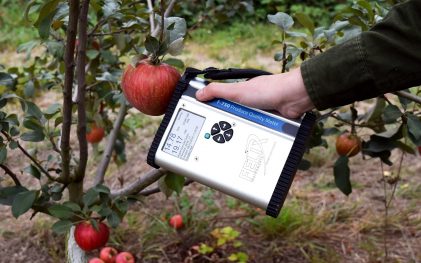
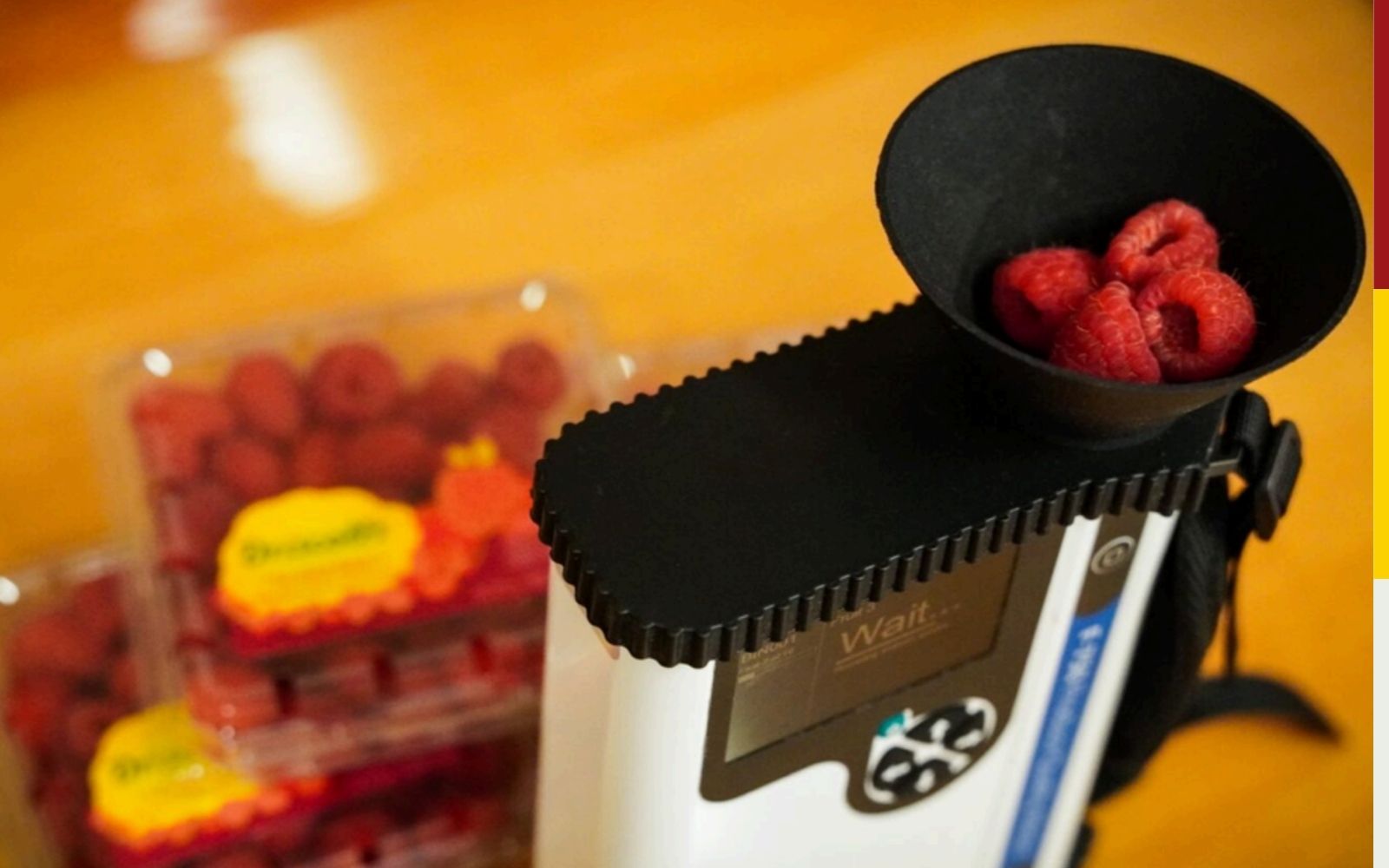
Growers can use the F-750 Produce Quality Meter to fix harvest time based on raspberry harvest maturity indices.
Contact Felix Instruments Applied Food Science to learn more about our precision tools for monitoring raspberry quality.
Sources
Fuentes, L., Rivera, S., & Contreras, C. (2026). Potential negative impacts of rising temperatures on fruit ripening and quality in raspberries, blackberries, and blueberries. Scientia Horticulturae, 358, 114692.
Gonçalves, E. M., Ganhão, R., & Pinheiro, J. (2026). Pre- and Postharvest Determinants, Technological Innovations and By-Product Valorization in Berry Crops: A Comprehensive and Critical Review. Horticulturae, 12(1), 19. https://doi.org/10.3390/horticulturae12010019
Haffner, K., Rosenfeld, H.J., Skrede, G., & Wang, L. (2002). Quality of red raspberry “Rubus idaeus L.” cultivars after storage in controlled and normal atmospheres. Postharvest Biol. Technol., 24, 279–289
Islam, M. R., & Mitcham, E. (2024). Extending Raspberry Shelf Life and Maintaining Postharvest Quality with CO2 Atmospheres. Horticulturae, 10(10), 1092. https://doi.org/10.3390/horticulturae10101092
Maria J. Paris, Emma Mani-López, Nelly Ramírez-Corona, & Aurelio López-Malo. (2025). Postharvest Mold Growth Control in Raspberries and Blackberries Using Cinnamon Essential Oil-Loaded Alginate Beads. ACS Food Sci. Technol., 5 (1): 127–136. https://doi.org/10.1021/acsfoodscitech.4c00649
Perkins-Veazie, P., & Fernandez, G. (2023, Nov 30). Postharvest Handling and Storage of Blackberries and Raspberries. Retrieved from https://rubus.ces.ncsu.edu/rubus-postharvest-handling-and-storage-of-blackberries-and-raspberies/
Sawicka, B., Barbaś, P., Skiba, D., Krochmal-Marczak, B., & Pszczółkowski, P. (2023). Quality of Raspberry Fruit (Rubus idaeus L.) Cultivated under Balanced Fertilization Conditions: Commodity Evaluation. Preprints. https://doi.org/10.20944/preprints202305.1660.v1
Related Products
Most Popular Articles
- Spectrophotometry in 2023
- NIR Applications in Agriculture – Everything…
- The Importance of Food Quality Testing
- The 5 Most Important Parameters in Produce Quality Control
- Melon Fruit: Quality, Production & Physiology
- Fruit Respiration Impact on Fruit Quality
- Guide to Fresh Fruit Quality Control
- Liquid Spectrophotometry & Food Industry Applications
- Ethylene (C2H4) – Ripening, Crops & Agriculture
- Understanding Chemometrics for NIR Spectroscopy