How Does Ethylene Cause Physiological Disorders in Fresh Produce?

Dr. Vijayalaxmi Kinhal

November 17, 2026 at 7:22 pm | Updated November 17, 2026 at 7:22 pm | 7 min read
- Ethylene induces physiological disorders in fresh produce through exposure to high levels or a lack of the gas.
- Ethylene can also alleviate or aggravate physiological disorders caused by other stress factors, such as temperature and gas composition.
- Physiological disorders caused by ethylene result from exposure to exogenous sources, not endogenous production of the phytohormone.
The phytohormone ethylene, involved in many negative postharvest physiological processes such as senescence and unintended ripening, also causes physiological disorders. Physiological disorders are a major cause of postharvest quality decline and shelf life reduction in fresh produce. Stakeholders can use this article to assess whether any ethylene-induced physiological disorders are affecting their stock and to control conditions to improve profits.
Physiological Disorders
Physiological disorders result from changes in normal metabolism and processes due to stress on fresh produce, leading to cell necrosis, accumulation of undesirable chemicals, and water-soaking. The physiological disorders reduce postharvest quality by causing changes in appearance, texture, and flavor, which manifest in one or more of the following ways:
- Softening,
- Degreening
- Discoloration
- Scalds
- Lesions
- Pitting
- Watercore
- Off-flavors
- Internal breakdown
- Watery breakdown
- Cracks
- Spot decay
- Chilling injury
Physiological disorders differ from normal physiological processes such as respiration, ripening, and senescence, which postharvest management controls to prolong the shelf life and quality of fresh produce. Physiological disorders are also distinct from spoilage caused by diseases and pests, mechanical damage, exposure to gases like ammonia, or chemical treatment solutions.
Subscribe to receive our monthly round-up of articles.
Knowing which conditions are physiological disorders and their causes can help reduce postharvest food losses, maintain fresh produce quality, and increase marketability, income, and export potential.
Preharvest conditions such as intense sunlight, climate, agricultural practices, harvest maturity, and nutritional imbalances can cause physiological disorders that persist postharvest.
Fresh produce faces various stresses during postharvest handling, and environmental factors such as temperature and gas composition in storage and transport units can also cause physiological disorders.
Ethylene
Ethylene is one factor that can cause physiological disorders during postharvest handling.
Ethylene is a phytohormone produced by plants at various stages of plant life and is also necessary for climacteric fruit ripening. However, it also contributes to senescence and decay in many fresh produce. In postharvest stages, ethylene levels are strictly controlled to prevent fresh produce from ripening before a suitable retail time and to prevent decay in ethylene-sensitive produce, extending shelf life.
Beyond these effects, stakeholders should consider ethylene as a stressor, as both its accumulation and absence can cause physiological disorders.
- Too much ethylene: Most ethylene-related physiological disorders result from exposure to exogenous or externally produced ethylene, which can accumulate in storage units from production by fruits and vegetables or from anthropogenic sources such as the combustion of straw and fuels, smoke, and plastics.
- Too little ethylene: Ethylene is scrubbed in storage and transport units through various means to extend shelf life, which can produce some physiological disorders.
In some cases, ethylene either worsens or alleviates physiological disorders caused by other stresses.
All four types of ethylene roles in physiological disorders in fresh produce are discussed below.
Physiological Disorders Due to Ethylene Exposure
Excessive ethylene exposure can become a stressor, causing several species-specific physiological disorders. The severity and incidence of these disorders depend on the physiological age of fresh produce, temperature, ethylene concentration, and exposure duration.
Lettuce russet spotting
Ethylene is the main factor that causes russet spotting in lettuce. It causes distinct spot-like lesions that start in the mesophyll or epidermis. Even small ethylene concentrations of 0.1 ppm can cause commercial damage during storage or transport of lettuce at 5°C within 5 to 8 days. Cell walls thicken, and the cytoplasm becomes granular. In advanced stages, the mesophyll develops pit-like depressions and vascular tissue becomes discolored.
Russet spotting occurs because ethylene triggers production of phenolic compounds in the pigmented areas. The condition changes only the appearance but makes the lettuce unmarketable; see Figure 1.
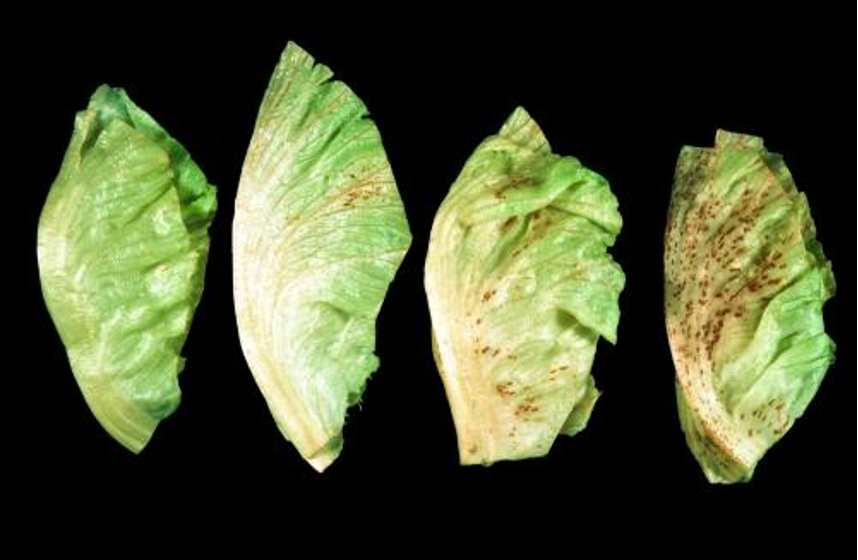
Figure 1.: “Symptoms of russet spotting on iceberg leaves and midribs. Left to right: no symptoms, slight, moderate and severe symptoms,” UCDavis.edu (Credit: Marita Cantwell: https://postharvest.ucdavis.edu/produce-facts-sheets/lettuce-crisphead)
Carrot bitterness
Ethylene exposure causes bitterness due to isocoumarin accumulation. This problem causes flavor and taste loss.
Watermelon water-soaking
Ethylene exposure causes water-soaking in watermelons. Endocarp tissues become liquified, accompanied by loss of cell wall rigidity, cell separation, pectin degradation, lipid degradation, and increased activity of membrane-degrading enzymes. This results in fruit softening and solute leakage. Quality loss includes changes in appearance, texture, and taste.
Physiological Disorders due to Lack of Ethylene
Stressors usually cause physiological disorders; however, ethylene plays a crucial role in fruit ripening and senescence. Therefore, its absence causes physiological disorders by interrupting ripening and senescence, leading to commercial losses. Apple susceptibility to these disorders depends on cultivars (genotype), orchard blocks, and seasons.
Watercore in apples
Many apple cultivars develop watercore before harvest, in which the tissue accumulates sugars such as sorbitol and takes on a glassy appearance. Often the disorder disappears during storage. However, in severe instances of watercore, anaerobic conditions can develop in the tissue, leading to internal breakdown. Some apple cultivars, like ‘Delicious’, are more susceptible to this disorder. Suppression of ethylene by1-MCP treatments increases internal breakdown.
Skin discoloration in apples
Lack of ethylene can interrupt ripening, which stakeholders in apple supply chains usually want. However, interrupting ripening disrupts necessary changes in fruit peel wax and other compounds. This results in diffuse skin discoloration, which is also influenced by cooling rates, especially in ‘Golden Delicious’ apples. Lenticel breakdown also occurs during storage and packing and appears as small, distinct black spots. Allowing fruit to ripen can reduce susceptibility to these disorders.
Ethylene and Other Stressors Interaction
Ethylene can worsen or improve physiological disorders caused by other stressors, such as temperature, carbon dioxide, and controlled atmosphere storage.
Chilling injury
Chilling injuries occur mostly in fruits of tropical and subtropical origin, and those from warmer seasons of cooler temperate climates. However, chilling injury occurs and increases when ripening is inhibited. Ethylene-mediated processes usually help alleviate chilling injury, so removing the gas can increase chilling injury in many fruits.
- Banana: Chilling injury increases in bananas treated with 1-MCP due to low ethylene.
- Stone fruits: Flesh wooliness develops due to low ethylene, which inhibits enzymes such as polygalacturonase. Cold storage disorders occur in nectarines because low ethylene levels impair metabolism by reducing expression of polygalacturonase and pectinesterase genes.
- Citrus: Chilling injury in citrus can sometimes increase in susceptible cultivars when ethylene is controlled by 1-MCP. The citrus develops necrosis, pitting, and staining of peel tissues.
- Sweet potatoes: Chilling injury in sweet potatoes involves the development of a hard core. Exposure to ethylene in the post-chilling phase reduces hard-core severity by stimulating pectin methylesterase activity.
- Muskmelons: Treating honeydew muskmelons with 1000 ppm ethylene for 24 hours at 20°C can reduce chilling injury by 75% when stored later at 2.5°C.
Ethylene could also aggravate chilling injury depending on species and cultivar.
- Avocado: Lowering ethylene can be beneficial in reducing browning in avocado due to chilling injury.
Higher Temperatures
The temperatures maintained in cold storage can vary. At the higher end, ethylene’s presence can cause some disorders.
Asparagus toughening: Asparagus is a non-climacteric vegetable that does not produce ethylene but is medium to highly sensitive to it. Asparagus develops spear toughening when the storage temperature is above 10°C (50°F). Exposure to exogenous ethylene at commonly present storage levels can accelerate the toughening through lignification.
Apple browning: Flesh browning incidence in apples stored at 3 °C in ethylene-deprived atmospheres is higher than in fruits stored at 0.5 °C. For example, in ‘Empire’ apples.
Carbon dioxide injury
In controlled atmosphere (CA) storage, fresh produce is kept at low temperatures, with gas concentrations such as oxygen (O2) and carbon dioxide (CO2) altered from normal ambient levels. CO2 levels are maintained high to lower respiration rates and because of its antimicrobial properties, but it can cause physiological disorders.
Both very high and very low ethylene levels can increase the severity and incidence of CO2-induced physiological disorders.
Too little ethylene: Fruits can sustain internal and external injury when exposed to increased CO2 levels during early storage. The incidence is significantly lower if fruit is kept in ambient air before exposure to high CO2. Scientists think this is because ripening processes begin, allowing ethylene production and helping fruits adapt and develop resistance to injury.
Lower ethylene levels or restricted ripening also increase fruit susceptibility to microbial attack and spoilage.
Too much ethylene: Higher ethylene levels in CA can also cause physiological disorders. Kiwifruits develop white inclusions in cores when exposed to ethylene in CA storage. Ethylene levels as low as 50 ppb in CA storage can cause white inclusions in the core and soften tissue. The disorder develops due to interaction between CO2 and ethylene.
CA -related disorder
‘Delicious’ apples stored for a long time (around seven months) develop severe scald when exposed to high levels of ethylene (10-500 ppm). However, the same cultivar did not develop scald at ethylene levels below 10 ppm.
Accurate Measurement of Ethylene is Necessary
It is clear that very minute amounts of ethylene can induce physiological disorder acting alone or in combination with other stressors. Hence, monitoring its levels requires highly accurate, precise instruments. Felix Instruments Applied Food Science supplies precision tools that are industry standards for gas analysis. It offers robust portable tools customized for ethylene measurements across various stages and facilities, and also estimates CO2 and O2, making it suitable for situations where interactions must be checked.
F-900 Portable Ethylene Analyzer, for high-resolution measurements in CA environments.
F-920 Check It! Gas Analyzer for headspace and MAP analysis.
F-940 Store It! Gas Analyzer for CA and ripening rooms.
F-950 Three Gas Analyzer for CA, ripening rooms, and MAP.
F-960 Ripen It! Gas Analyzer for ripening rooms.
The fixed F-910 AccuStore provides around-the-clock gas measurements for storage facilities.
The tools are also accurate enough for food science research.
Contact us for more information on the precision tools for ethylene measurements.
Sources
Ansari, M. W., & Tuteja, N. (2015). Post-harvest quality risks by stress/ethylene: management to mitigate. Protoplasma, 252(1), 21–32. https://doi.org/10.1007/s00709-014-0678-0
Cantwell, M., Kulchin, N.X., & Donis-González, I.R. (updated 2026 Feb). Lettuce (Crisphead, Iceberg). Retrieved from https://postharvest.ucdavis.edu/produce-facts-sheets/lettuce-crisphead
Ferrante, A. (2023). Ethylene and horticultural crops. In The plant hormone ethylene (pp. 107-121). Academic Press.
Kader, A.A. (1985). Ethylene-induced Senescence and Physiological Disorders in Harvested Horticultural Crops. HortScience.
Saltveit, M. E. (1999). Effect of ethylene on quality of fresh fruits and vegetables. Postharvest biology and technology, 15(3), 279-292.
Suslow, T.V. (1996, Aug). Asparagus (Green). Retrieved from https://postharvest.ucdavis.edu/produce-facts-sheets/asparagus-green
Watkins, C. B. (2016). Postharvest physiological disorders of fresh crops. Encyclopedia of Applied Plant Sciences, 315.
Related Products
- F-751 Grape Quality Meter
- Custom Model Building
- F-910 AccuStore
- F-751 Melon Quality Meter
- F-751 Kiwifruit Quality Meter
- F-750 Produce Quality Meter
- F-751 Avocado Quality Meter
- F-751 Mango Quality Meter
- F-9XXDK Dynamic Sampling Kit
- F-900 Portable Ethylene Analyzer
- F-950 Three Gas Analyzer
- F-920 Check It! Gas Analyzer
- F-960 Ripen It! Gas Analyzer
- F-940 Store It! Gas Analyzer
Most Popular Articles
- Spectrophotometry in 2023
- NIR Applications in Agriculture – Everything…
- The Importance of Food Quality Testing
- The 5 Most Important Parameters in Produce Quality Control
- Melon Fruit: Quality, Production & Physiology
- Fruit Respiration Impact on Fruit Quality
- Guide to Fresh Fruit Quality Control
- Liquid Spectrophotometry & Food Industry Applications
- Ethylene (C2H4) – Ripening, Crops & Agriculture
- Understanding Chemometrics for NIR Spectroscopy
Related Reading