How NIR Technology Supports the Circular Economy in Agriculture

Dr. Vijayalaxmi Kinhal

March 16, 2026 at 4:51 pm | Updated March 16, 2026 at 4:51 pm | 7 min read
- Near-infrared (NIR) spectroscopy-based technology makes food production circular by improving process efficiency from farm to retailer.
- NIR technology helps design waste reduction at critical points in the food supply chain by providing non-destructive, real-time data on the external and internal quality of food.
- Monitoring crops with NIR enhances food value by ensuring the safety, nutrition, and quality that consumers demand.
- NIR can be integrated with other advanced technologies and methods to reduce the use of natural resources and environmental impact during food production.
The circular economy principles provide a model to ensure food security sustainably for a growing population with finite natural resources and land. It can also address the negative impacts of the current economic system. Facilitating the transition remains a critical challenge. The use of control technology is expected to be a key factor in making food production circular. This article explores how Near-Infrared Spectroscopy-based technology can promote agricultural circular practices in food chains.
Circular Agricultural Economy
The circular economy aims to create value while minimizing waste and resource use by keeping materials in circulation. The circular economy is a paradigm shift from the current linear economic system of “take-make-throw.” It advocates principles such as waste reduction and ecosystem regeneration, while continuing to produce high-quality, economically valuable products to maintain the modern living standards people expect.
The current industrial agricultural system has become a major source of soil, water, and air pollution, as well as greenhouse gas emissions (GHG), and is reducing biodiversity.
Subscribe to receive our monthly round-up of articles.
- Resource use: According to the United Nations (UN), 2% of food produced is lost before reaching retailers in the supply chain, resulting in the loss of resources such as water, energy, labor, capital, land, and chemicals.
- Environmental impact: Food production accounts for 30% of global greenhouse emissions.
These negative impacts can be eliminated from supply chains by adopting circular principles. Improving supply chain efficiency, processing, and creating food byproducts from agricultural waste can increase the value of the food produced and reduce waste. Replacing fossil fuels with clean, green energy sources can further reduce GHG emissions.
The advantages of incorporating circularity are manifold:
- Food security: Wastage is reduced, and food availability and security are enhanced.
- Sustainability: Applying circular principles to agriculture can create a system that optimizes resource use and minimizes negative environmental impacts and carbon emissions.
Circular economy principles for food supply chains involve reducing waste, optimizing logistics, and responsible sourcing. It can reduce costs and enhance sustainability and efficiency. Circularity will require the participation of all stages of food production, from farms to retailers, to maximize gains. Various methods and steps can be used to adopt regenerative agriculture in food production, thereby building natural capital and improving local biodiversity, soil, water, and air. The growing practices should include diverse crop species and varieties, the use of bio-stimulants, and crop rotation. Food loss must be curtailed at every step of the supply chain, including farms, packinghouses, distribution, storage, and retail.
Control technology can be crucial in the food supply chain for implementing the circular economy in agriculture by reducing losses. Technology should not replace, but supplement, the traditional knowledge and expertise of food producers.
Near-Infrared Spectroscopy
Near infrared (NIR) spectroscopy is one of the leading control technologies used in the food industry. This band of light (760–1400 nm) is best suited for analyzing the bio compounds that make up plants and animals. NIR wavelengths interact with the molecular bonds between hydrogen and other elements like carbon, oxygen, and nitrogen in the organic bio compounds in living tissue.
The NIR interaction with food is measured as the amount of the radiation absorbed, reflected, or transmitted by an object. Spectra vary with the compounds present and their concentrations, such as proteins, sugars, starch, water, fiber, and acids. NIR can also penetrate deeply into a food sample, making it ideal for detecting and quantifying its external and internal chemistry.
NIR spectra are complex and overlapping. Chemometrics, which integrates multivariate statistical models, including machine learning, and computers, is necessary to analyze and provide simple insights. Nowadays, NIR spectroscopy-based tools are standard in food supply chains, providing non-destructive, real-time, accurate data analysis.
NIR, along with visual (380–780 nm) wavelengths, can promote circular principles in the following ways:
- Analytical chemistry: NIR spectroscopy provides a chemical-free, environmentally friendly method of quality control. Miniaturizing the technology into small, portable tools is making NIR widely available. Instead of a few expensive laboratory tests, food producers in the entire supply chain can use NIR spectroscopy onsite in various systems: in-line, at-line, or online.
- Decision-making aid: An on-site analytical chemistry tool helps growers and other food producers make data-driven decisions throughout the food supply chain.
- Process control: Many food processing methods involve analyzing raw materials and controlling them through finished products. The whole process can be optimized by precise NIR technology.
- Integration with IoT: NIR spectroscopy can be integrated with IoT devices and sensors to transmit real-time data on composition, quality, and safety to platforms for analysis and decision-making. It can be used in production lines or at retailers to estimate the freshness of fruits and vegetables.
These properties of NIR spectroscopy can promote circular principles at different stages of the food supply chain to optimize resource use, food quality, yield, safety, and value, while reducing waste.
NIR Application in Circular Economy
NIR spectroscopy is useful not only in postharvest phases but also on farms, and these applications are discussed below.
Precision Agriculture
Precision agriculture leverages detailed multispectral and hyperspectral spatial data collected by remote sensing and field-based sensors, analyzed by AI to help farmers make informed decisions. Precision agriculture considers the micro-differences that exist in soil properties that affect nutrient and water availability. Plant biomass and physiology are analyzed using NIR and visible wavelengths, and the results are interpreted with vegetative indices to reveal micro-scale spatial differences in crop growth and health. It allows farmers to use Variable-Rate Technology (VRT) to apply nutrients and irrigation in the amounts and at the locations required, based on actual crop needs. They can avoid excessive, intensive use of nutrients and water, much of which ends up polluting distant seas.
Similarly, spatial data on the spread and intensity of weeds, pests, and diseases before symptoms appear enable timely, appropriate VRT-based treatment, reducing impacts on soil and local biodiversity. Providing the correct amounts of nutrients and water, and caring for the plant, optimizes crop yield while reducing resource use and expenses, thereby increasing profits. This method also has the potential to reduce farm machinery use and associated fossil fuel consumption and GHG. The reduction in GHG emissions from fertilizer manufacturing due to reduced use is an additional benefit. However, the resource reductions achieved by current precision agriculture practices have not yet met expectations and can be improved.
Determining Harvest Time
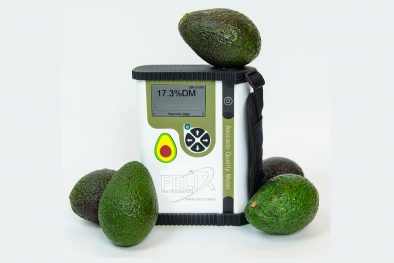
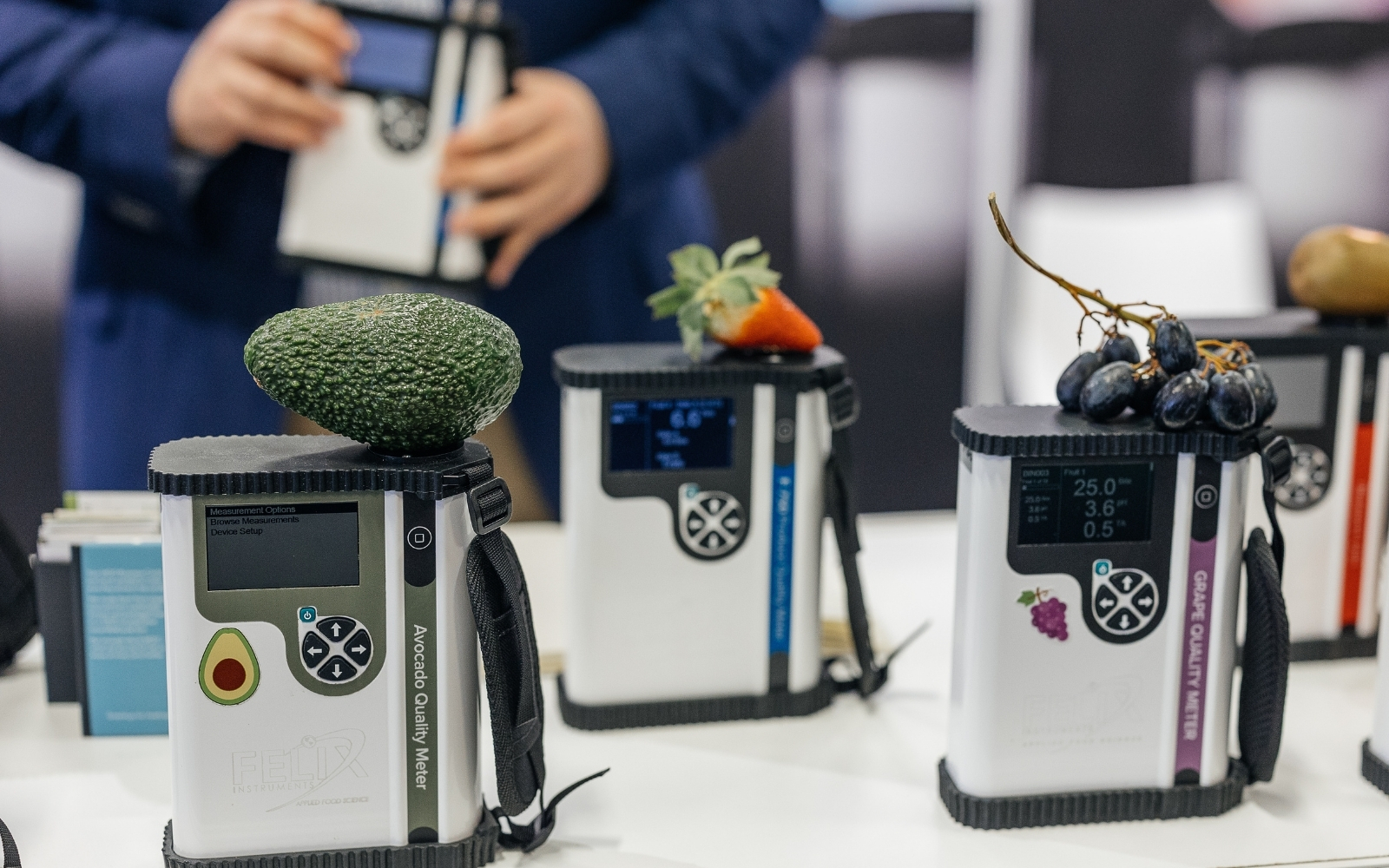
Harvesting crops at the correct stage of maturity is crucial, especially for fresh produce, to ensure high quality and extended shelf life for marketing. Harvest maturity indices based on external and internal quality parameters, such as peel and flesh color, fruit size and shape, firmness, soluble sugar content, dry matter, and titrable acidity, can help determine the appropriate harvest maturity for each fruit and vegetable. Objective, quantifiable data collected by NIR spectroscopy-based tools such as the Felix Instruments Quality Meters series can be used to monitor crop maturity in the weeks before harvest. Harvest maturity data can be shared with the following supply chain stakeholders, as it can influence use decisions, storage conditions, and duration.
Postharvest Stages
NIR spectroscopy data can help farmers, suppliers, and distributors monitor yield and make decisions based on crop quality in the post-harvest stages. Fresh produce can be segregated for fresh consumption or processing based on quality and maturity. The same parameters can also guide grading, sorting, and packaging needs. Controlled atmosphere, cold storage, and ripening conditions can also be adjusted based on harvest maturity, including temperature, humidity, and gas composition. Continuous monitoring helps stakeholders control quality, cull spoiled food, maintain the final product’s quality, and meet consumer requirements for freshness, taste, and nutrition.
NIR is also used in postharvest stages to detect pests and diseases in grains, authenticate and classify products, and detect contaminants. Retailers can use real-time quality data to set prices.
NIR is used not only for plant crops but also for quality control of dairy and meat products. NIR is used to control chemical composition (fat, protein, and water content), quality, identification, processing, and geographical authentication.
Using NIR, it is possible to design for waste reduction at each stage of food production from farms, storage, and distribution, as it provides nondestructive data and analysis before external symptoms of microbial and ethylene damage are visible, by which time many changes are irreversible. Identifying internal compounds formed in response to biotic and abiotic stress helps stakeholders adapt postharvest management to minimize losses. According to Nath et al. (2024), at present, postharvest losses of grains are around 19%, and fresh produce losses are about 44%. Physical damage and quality loss can affect 80% of cereals.
If NIR is used to reduce these losses, it can increase food production and enhance quality, improving overall agricultural efficiency. Moreover, reducing loss meets the other critical circular principle of designing out waste.
Recycling Waste
However, some biomass waste will still be produced on the farm and during postharvest stages due to culling or processing, and through consumer waste after retail. Biomass that is lost and is of food-grade can be used to make new products instead of being landfilled, reducing pollution. Biomass waste that is properly segregated by consumers and the postharvest stages can also be collected for biogas production and various other uses. NIR can again be helpful in identifying organic components to inform decisions on inputs suitable for biogas and other waste-processing practices.
Even wastewater recycled after food processing can be monitored using NIR tools to detect potential bio-remnants, improving water quality and purity.
NIR Spectroscopy from Lab to Basket
NIR spectroscopy is a viable technology already on the market that can be used in agricultural research and retail. Scientists also use NIR technology in their research on crops and management systems to ensure food meets consumers’ quality, safety, nutritional, and ecological needs. Food production using NIR technology can help improve the quantities, value, and quality of food from existing resources by reducing food loss and waste and adhering to circular principles. When consumers buy quality products, there is less rejection and spoilage, thereby improving the efficiency of food production and consumption. The involvement of all people, from researchers to consumers, will be necessary to make food production circular.
Contact us at Felix Instruments Applied Food Science to learn more about NIR-based tools.
Sources
Craigen, A. (2025, May 9). 5 ways to reduce food loss and waste through a circular economy. Retrieved from https://climatepromise.undp.org/news-and-stories/5-ways-reduce-food-loss-and-waste-through-circular-economy
Czaja, T. P., & Engelsen, S. B. (2025). Why nothing beats NIRS technology: The green analytical choice for the future sustainable food production. Spectrochimica acta. Part A, Molecular and biomolecular spectroscopy, 325, 125028. https://doi.org/10.1016/j.saa.2024.125028
Prempeh, N. Y. A., Nunekpeku, X., Kutsanedzie, F. Y. H., Murugesan, A., & Li, H. (2025). A Comprehensive Review of Non-Destructive Monitoring of Food Freshness and Safety Using NIR Spectroscopy and Biosensors: Challenges and Opportunities. Chemosensors, 13(11), 393. https://doi.org/10.3390/chemosensors13110393
Rabbi, M. F., & Amin, M. B. (2024). Circular economy and sustainable practices in the food industry: A comprehensive bibliometric analysis. Cleaner and Responsible Consumption, 14, 100206.
San. (2024, Apr 15). Circular Economy Principles Applied to Agriculture: From Farm to Fork. Retrieved from https://www.sustainableagriculture.eco/post/circular-economy-principles-applied-to-agriculture-from-farm-to-fork
Related Products
- F-751 Grape Quality Meter
- Custom Model Building
- F-910 AccuStore
- F-751 Melon Quality Meter
- F-751 Kiwifruit Quality Meter
- F-750 Produce Quality Meter
- F-751 Avocado Quality Meter
- F-751 Mango Quality Meter
- F-9XXDK Dynamic Sampling Kit
- F-900 Portable Ethylene Analyzer
- F-950 Three Gas Analyzer
- F-920 Check It! Gas Analyzer
- F-960 Ripen It! Gas Analyzer
- F-940 Store It! Gas Analyzer
Most Popular Articles
- Spectrophotometry in 2023
- NIR Applications in Agriculture – Everything…
- The Importance of Food Quality Testing
- The 5 Most Important Parameters in Produce Quality Control
- Melon Fruit: Quality, Production & Physiology
- Fruit Respiration Impact on Fruit Quality
- Guide to Fresh Fruit Quality Control
- Liquid Spectrophotometry & Food Industry Applications
- Ethylene (C2H4) – Ripening, Crops & Agriculture
- Understanding Chemometrics for NIR Spectroscopy
Related Reading