What Are Fresh Produce Standards? International Food Quality Standards Explained

Dr. Vijayalaxmi Kinhal

July 30, 2026 at 9:22 pm | Updated July 30, 2026 at 9:22 pm | 8 min read
- The Codex Alimentarius, developed by the Food and Agriculture Organization (FAO) and the World Health Organization (WHO), is the primary standard for fresh produce used voluntarily by other international organizations and national governments.
- Other prominent international organizations that establish and promote fresh produce quality standards include the United Nations Economic Commission for Europe (UNECE), the World Trade Organization (WTO), and the Organization for Economic Co-Operation And Development (OECD).
- These apex organizations collaborate to develop harmonized quality standards to avoid duplication.
- National governments and regional authorities, such as the European Union, align their fresh-produce quality standards with these international standards.
Fresh produce delivery has shifted from simple local systems to complex industrialized global supply chains in the past century. Fresh produce stakeholders must ensure food safety and quality to meet consumer demand and importing-country regulations. This article lists some of the major organizations that set standards to guide the fresh produce industry in meeting quality and safety demands, maximizing ROI, and ensuring efficient marketing.
What are Food Quality Standards?
Food quality standards have always existed to protect consumers and ensure transparency and business interests.
According to FAO (Food and Agriculture Organization), food standards are product standards, and are documented agreements that set technical specifications and other criteria defining product characteristics and serve as rules and guidelines to ensure food is fit for consumption. There are social and environmental standards for processes that may also affect product standards. The process standards are subdivided into management and performance standards.
Subscribe to receive our monthly round-up of articles.
- Management system standards regulate documentation, monitoring, and evaluation methods.
- Performance system standards cover factors such as the use of pesticides or sanitary services.
FAO notes that standards guiding international trade can be challenging for the vastly different agricultural systems, climates, and soils that exist. So, international standards provide generic guidelines that national or local organizations can use to formulate specific standards suited to their conditions.
The food can be inspected and evaluated for conformity with the chosen standards by third-party certification bodies, which issue a certificate confirming that the supplier has complied with them.
Fresh produce suppliers might have to comply with various levels of standards- international, national, or local.
International Agencies
The International organizations that set standards are
- Codex Alimentarius Commission
- United Nations Economic Commission for Europe (UNECE)
- World Trade Organization (WTO)
- Organization for Economic Co-Operation And Development (OECD)
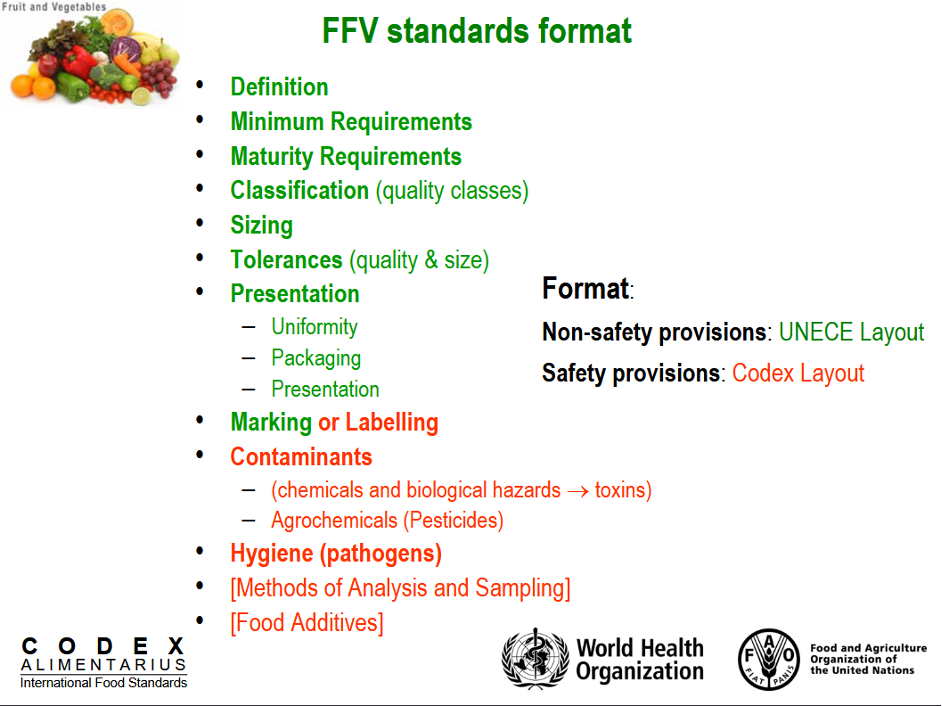
Figure 1.: The standards and texts by the Codex Committee On Fresh Fruits And Vegetables (Ccffv), UNECE.org. (Image credits: UNECE.org)
-
Codex Alimentarius
The Codex Alimentarius was first founded by the FAO (Food and Agriculture Organization) and the WHO (World Health Organization) in 1963. Also called the “Food Code” it is considered the single most important international food standard. It is a collection of standards, codes, and guidelines to protect consumers’ health and promote fair food trade. The joint document was produced through collective work by 188 member states, representing 99% of the world’s population. Inputs are collected from countries, international organizations, consumer organizations, and the private sector.
The Codex Alimentarius is a collection of food standards and related texts that have been adopted internationally as guidelines to harmonize definitions and requirements for food production and trade. It applies to all principal foods-raw, processed, semi-processed, covering the entire supply chain. The Codex book contains 191 commodity standards, 76 guidelines, and 17 maximum contaminant levels for food, including fruits and vegetables.
The Codex Committee On Fresh Fruits And Vegetables (Ccffv) has global standards and related texts for fresh fruits and vegetables, which were developed with the UNECE and OECD, to avoid duplication and harmonize standards.
The Ccffv includes guidelines on food hygiene, maturity requirements, minimum requirements, classification, sizing, tolerances, additives, pesticide residues, contaminants, labeling, presentation, packaging, storage, methods of sampling and risk analysis, certification, and import and export inspections; also see Figure 1.
The Codex standards are not obligatory or a substitute for national legislation. Countries can voluntarily adopt them into national legislation and regulations. It is used by the WTO as a reference for its Agreements on “Sanitary And Phytosanitary Measures” (SPS) and “Technical Barriers To Trade.”
The Codex Alimentarius Commission and its many subsidiary bodies review and revise the standards and texts as necessary to ensure the information is based on state-of-the-art scientific and related knowledge.
-
UNECE
The United Nations Economic Commission for Europe (UNECE), established in 1947, is one of the five regional UN commissions and has 56 member states from Europe, North America, and Asia. In addition, many international professional and non-governmental organizations are members.
The UNECE develops internationally agreed-upon quality standards for agricultural products through its “Working Party on Agricultural Quality Standards (WP.7).” The standards are based on existing industry, trade, and national practices, which are reviewed regularly and updated as necessary. As international agricultural trade continues to grow, any member of the UN or its specialized agencies can participate in its activities.
- The UNECE sets its standards in cooperation with the WTO and other standards-setting organizations, such as the Codex Alimentarius Commission, to avoid duplication and inconsistencies in standards.
- UNECE provides guidance material to improve food quality in the entire supply chain, focusing on good practices, traceability, minimum quality requirements, and reducing food loss. The UNECE has developed quality and marketing standards for many types of fresh produce.
- UNECE also outlines and promotes uniform quality-control procedures and quality-conformity certificates.
- It ensures the application of these standards in cooperation with the “OECD Scheme for the Application of International Standards for Fruit and Vegetables,” with whom it develops and disseminates explanatory materials and guidelines.
- UNECE organizes seminars and training courses for governments and the private sector to develop standards and the required technical and legal infrastructure for implementation.
The standards provide a common international framework for food producers, traders, exporters, importers, and international organizations. It also works with national governments and their organizations, civil society, and the private sector.
The UNECE standards aim to boost high-quality production, international trade, protect consumers’ interests, and profitability.
-
World Trade Organization
The World Trade Organization (WTO) provides a framework for trade in food by promoting agreed standards, the FAO’s Codex Alimentarius. The aim is to ensure safe, nutritious, and sufficient food for the growing global population.
The WTO encourages national governments to cooperate in establishing common international food standards and guidelines and to use them to avoid trade disputes, as adopting differing quality standards can complicate trade. The WTO allows countries to set their own standards and inspection methods based on science. It also provides a forum to resolve disputes.
To promote food safety and plant and animal health, the WTO has an agreement on the “Application of Sanitary and Phytosanitary (SPS) Measures” and uses the “Technical Barriers to Trade (TBT)” as a benchmark for harmonizing standards. To build national capacity for food control and to coordinate relevant stakeholders to benefit from common standards, the WTO, in cooperation with FAO, offers training and capacity-building.
-
OECD
The “Organization for Economic Co-Operation And Development” (OECD) is a forum where governments work together to find solutions for common problems, identify good practices, and coordinate international policies on several economic, social, and environmental issues. The OECD publishes and disseminates information on the organization’s research, guidelines, and standards agreed upon among members. The OECD was established in 1962 and, as of 2026, consisted of 38 member countries.
The OECD established the “Scheme for the Application of International Standards for Fruit and Vegetables” in 1962 to facilitate international trade in high-quality fresh produce by promoting harmonized standards and inspection procedures recognized among member countries. By promoting a shared understanding of quality, the OECD sought to build trust and confidence among trade partners. The organization also conducts training and educational programs for quality inspectors. Currently, 28 OECD countries are part of the Scheme, and they meet regularly to exchange views and elaborate OECD standards.
The Scheme also produces explanatory brochures with illustrations on the international standards for 51 fresh produce in several languages, for example like the one on bananas. The brochure contains information on minimum quality, grading, size, uniformity, packaging, labeling (identification, country of origin, etc.), hygiene, and contaminants.
Regional and National Fresh Produce Standards
Each country can also develop its own quality standards, for example, such as those of the USA. Some regions, such as the European Union, also have their own standards for fruit and vegetable production and imports.
European Union
The European Union (EU) has its own marketing standards based on UNECE guidelines to ensure that fresh produce is of marketable quality. The standards apply to all stages, including import, retail, and export. These standards are set by the Commission Delegated Regulation (EU) 2023/2429 and apply to most fruits and vegetables.
The marketing standards contain information on product technical definition, classification, species, variety, presentation, labeling, packaging, year of harvest, quality parameters (shape, appearance, water content), specific substances, farming method, method of collection, storage, transport, place of origin, restrictions on substances and practices, and specific use. All fresh produce must follow these rules, except for those covered by 11 specific marketing standards, which align with UNECE recommendations and guidelines. These fresh produce items are listed below:
- apples
- bananas
- citrus fruit
- kiwifruit
- lettuces and endives
- peaches and nectarines
- pears
- strawberries
- sweet peppers
- table grapes
- tomatoes
Since 2025, revised EU rules have allowed for the marketing of non-standard fresh produce
through direct deliveries, local markets, and for processing, use as animal feed, and donations, to reduce food loss and promote sustainability. Recent revisions to labeling and traceability were made to align EU standards with the Codex Alimentarius.
The marketing standards aim to
- Improve the quality of food for consumers, supported by transparent information
- Increase returns for growers and protect them from unfair competition
- Support efficient operation of markets with standard quality food products with consistent grading and labeling
Each EU country must also comply with the Commission Implementing Regulation (EU) 2023/2430, which establishes rules to verify that traders comply with the marketing standards. For this purpose, EU countries must establish a database of traders subject to market standards.
Each EU country introduces legislation to enforce the EU regulations.
United States of America
As an example of national rules for fresh produce standards, consider the USA. The US Department of Agriculture (USDA) has the Agricultural Marketing Service’s (AMS) Specialty Crops Inspection Division, which develops national standards for fresh and processed fruits, vegetables, nuts, and other specialty products in the food supply chain. The AMS also provides food safety auditing, quality assurance reviews, and inspections.
These standards are used by the fresh produce industry for the following purposes:
- As a foundation for domestic and international trade
- To promote efficiency in procurement and marketing
- Determine quality and value for sales, damage claims, loans, futures trading, market reporting, dispute resolution, and government purchases
- As a common means of communication, when the food product cannot be displayed or examined by potential buyers
- As guidelines for the processing industry
- A means of quality identification for getting official USDA labels for quality
The USDA’s “Quality Monitoring Program (QMP) ” assists buyers in monitoring the quality of fresh produce received/ produced by providing third-party assessments of quality, based on U.S. grade standards or customer quality specifications.
The U.S. Grade Standards for fruits and vegetables are voluntary and are supplemented by Inspection Instructions, which cover grading, quality requirements, and other topics. Visual aids, including photos, models, color standards, and other interpretive guides, are also available.
Devices for Quality Monitoring
Many of the organizations, such as the OECD, recommend using physiochemical parameters like soluble sugars, dry matter, firmness, titrable acidity, and starch for quality estimation and grading. Among the technologies, they suggest using near-infrared spectroscopy. These parameters are also useful for estimating maturity stages suggested by the Codex Alimentarius, which is the basis of nearly every food standard.
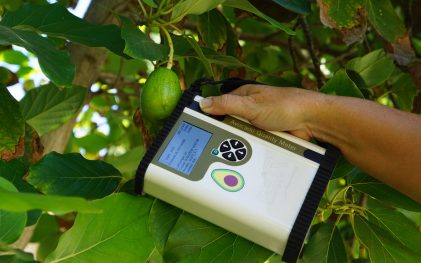
Felix Instruments Applied Food Science offers advanced quality-control tools based on near-infrared spectroscopy that collect and analyze spectral data on external peel color, internal pulp color, soluble sugar content, dry matter, and titrable acidity. The company offers an array of Quality Meters, the general F-750 Produce Quality Meter, and others customized for specific fresh produce: avocado, grape, kiwifruit, mango, and melon. The instruments are easy to use and provide precise, real-time results. The tools are trusted equally by the fresh produce supply chain and researchers.
Contact us to find out more about Felix Quality Meters for your supply chain needs.
European Commission. (n.d.). Fruit and vegetables. Retrieved from https://agriculture.ec.europa.eu/farming/crop-productions-and-plant-based-products/fruit-and-vegetables_en
FAO. (n.d.). 3. The concepts of standards, certification and labelling. Retrieved from https://www.fao.org/4/y5136e/y5136e07.htm
Federal Office for Agriculture and Food. (n.d.). Quality Control of Fruit and Vegetables at the BLE. Retrieved from https://www.ble.de/EN/Topics/Nutrition-Food/Quality-Control/quality-control_node.html
OCED. (n.d.). International Standards for Fruit and Vegetables. Retrieved from https://www.oecd.org/en/publications/serials/international-standards-for-fruit-and-vegetables_g1gha1c2.html
UNECE. (n.d.). Agricultural Quality Standards. Retrieved from https://unece.org/agricultural-quality-standards
UNECE. (n.d.). What is C O D E X A L I M E N T A R I U S ? Retrieved from https://unece.org/fileadmin/DAM/trade/agr/promotion/2011_Mexico/CodexoverviewUNECE_Codex.pdf?__cf_chl_f_tk=EmqLHqBnjlYXx3VbSKlPVklAyjbnqm5tgDu5.ztu7TM-1782881394-1.0.1.1-lPqA3gEs9oJt5tsInPcOY5o0bdknvOhy1Rz8vgsDCL8
USDA. (n.d.). Quality Monitoring Program. Retrieved from https://www.ams.usda.gov/services/auditing/qmp
USDA. (n.d.). Fruits. Retrieved from https://www.ams.usda.gov/grades-standards/fruits
USDA. (n.d.). Vegetables. Retrieved from https://www.ams.usda.gov/grades-standards/vegetables
…….
Related Products
- F-751 Grape Quality Meter
- Custom Model Building
- F-910 AccuStore
- F-751 Melon Quality Meter
- F-751 Kiwifruit Quality Meter
- F-750 Produce Quality Meter
- F-751 Avocado Quality Meter
- F-751 Mango Quality Meter
- F-9XXDK Dynamic Sampling Kit
- F-900 Portable Ethylene Analyzer
- F-950 Three Gas Analyzer
- F-920 Check It! Gas Analyzer
- F-960 Ripen It! Gas Analyzer
- F-940 Store It! Gas Analyzer
Most Popular Articles
- Spectrophotometry in 2023
- NIR Applications in Agriculture – Everything…
- The Importance of Food Quality Testing
- The 5 Most Important Parameters in Produce Quality Control
- Melon Fruit: Quality, Production & Physiology
- Fruit Respiration Impact on Fruit Quality
- Guide to Fresh Fruit Quality Control
- Liquid Spectrophotometry & Food Industry Applications
- Ethylene (C2H4) – Ripening, Crops & Agriculture
- Understanding Chemometrics for NIR Spectroscopy