What Is Crop Phenotyping and Why Is It Essential for Modern Crop Breeding?


Dr. Vijayalaxmi Kinhal

July 22, 2026 at 9:40 pm | Updated July 23, 2026 at 4:57 pm | 7 min read
- Genetic diversity in wild relatives of crops can provide crucial inputs to improve food production.
- High-throughput plant phenotyping (HTPP) methods can improve the efficiency of crop breeding research and crop monitoring in precision agriculture.
- Portable quality meters can be integrated into HTPP systems for biochemical and sensory fruit quality parameter phenotyping
Crop breeding efforts to provide yield and quality for a growing population with increasing health consciousness must factor in water shortages and global climate change. The necessary phenotyping of fresh produce quality traits requires numerous preharvest and postharvest data collection and biochemical analyses. This article explores why in-field phenotyping is essential and how near-infrared spectroscopy-based portable devices can facilitate accurate, non-destructive quality assessments to improve the efficiency of crop breeding.
Need for Phenotyping in Crop Breeding Programs
Crop breeding programs need genetic diversity to produce new cultivars with desired traits, such as tolerance to drought or higher-quality fruits. However, during the domestication of wild crop varieties, significant diversity was lost due to genetic bottlenecks. Wild relatives of crops exhibit wide variation in crop morphology, physiology, and yield quality. According to Kaur et al. (2020), domesticated tomato cultivars have only 5% of the genetic diversity of their wild relatives.
Subscribe to receive our monthly round-up of articles.
However, the influence of the environment on genetics must also be considered. Therefore, crop phenotype assessment becomes crucial.
Phenotypes are the observable expression of an organism’s genotype, resulting from the interaction between genetic makeup and the environment. So, a plant with the same genotype can exhibit dissimilar traits or phenotypes in different environments.
Thus, crop phenotypes are the observable plant traits controlled by genetics and influenced by the environment. These include the plant shape, size, structure, growth, response to biotic and abiotic stresses, yield, and yield quality.
Crop phenotyping is the process of systematically measuring, recording, and analyzing crop traits to understand how its genetics interact with the environment. It allows scientists to gain a picture of the plant at scales ranging from the microscopic to the macroscopic. The process of phenotyping allows scientists to screen genetic variation in the early stages of crop breeding and assess field performance.
Types of Crop Phenotyping
Phenotyping can occur in two ways: in controlled growth chambers, called Chamber-Crop Phenotyping (CCP), and in production sites, such as greenhouses and open fields, called Field-Crop Phenotyping (FCP). The difference is the extent of environmental control and the flexibility of the samples tested. CCP allows for more control and flexibility as pots can be repositioned. FCP plants grow in soil and are exposed to several factors that are challenging to monitor individually, but provide a realistic view of what actually happens in the field.
Phenotyping of wild relatives can be used to improve yield, quality, nutrition, and resistance.
- Phenotyping for yield: Yield is a measure of biomass and encompasses various morphological and structural traits that influence carbon accumulation, and the characteristics of the harvested organs. The morphological traits measured for phenotyping are crop height, canopy size, leaf length and width, leaf area, leaf area index, and fruit characteristics.
- Phenotyping traits for quality: The traits that are measured for phenotypic quality are morphological, structural, and biochemical. Using only external traits, such as shape, size, and color, is not enough to define the quality of fruits and vegetables. Fresh produce is consumed for taste, flavor, and nutritional value. Therefore, internal biochemical traits used to evaluate quality must also be phenotyped, including soluble sugar content (SSC), firmness, internal color, titratable acidity (TA), pH, and dry matter content. Phenotyping the nutritional content of harvested parts includes visual and biochemical assessments of the organs.
- Phenotyping nutrition traits: Phenotyping nutrition traits is necessary to understand crops’ nutrient demand, soil nutrient availability, and plants’ nutrient uptake capacity. Crop phenotyping of nutrient and mineral levels in plants is done by measuring crop appearance, color, and size. Crop phenotyping for nutrition is important for developing agricultural management practices such as fertilizer dosage and topdressing. It can also help with precision agricultural crop nutrition diagnosis.
- Phenotyping resistance traits: Crop phenotyping for resistance encompasses biotic stressors such as weeds, pests, and diseases, as well as abiotic stresses such as drought, flooding, salinity, and alkalinity. Multidimensional information is necessary for phenotyping resistance. These can be spectral reflectance and image analysis to study plant response to stress.
Crop phenotyping is typically a laborious process that requires time, labor, and money because multiple plants must be evaluated. Therefore, crop phenotyping can be a major bottleneck in any breeding pipeline, especially for quality phenotyping, as it involves postharvest biochemical assays.
High-throughput Plant Phenotyping
To address the challenges of phenotyping, a new phenotype-monitoring method has been developed for the systematic, rapid collection and analysis of phenotyping data. High-throughput plant phenotyping (HTPP) methods can improve the efficiency of phenotyping and crop breeding. HTPP can also provide crucial information for monitoring crops in precision agriculture.
Traditional phenotype monitoring methods rely on artificial sampling and measurements, which are subjective, inefficient, and focused only on a single characteristic. The data collection and analysis were done manually and yielded low data volumes. Older monitoring platforms that collected large volumes of data were still processed offline.
HTPP, on the other hand, is a highly precise, objective, rapid monitoring system that measures several traits simultaneously and has high data output. The HTPP method comprises sensors, intelligent control systems, mobile platforms, and data-processing algorithms.
- Sensors and algorithms: HTPP can monitor many traits from multiple sources simultaneously using multisensors. The sensors are high-resolution and highly accurate, and can collect and analyze complex data in real time. They use images and spectral data (multispectral and infrared). The data processing and management involve complex, advanced chemometric methods and algorithms, such as machine learning, deep learning, and computer vision.
- Platforms: The sensors are part of platforms that can be IoT-based, vehicle-mounted, drone-borne, or track-type platforms. The platforms can be used to collect phenotypic information at various scales from single leaves, fruits, plants, small plots, and farms.
- Control systems: These are motion control systems that regulate the execution of tasks by the platforms and are necessary for ensuring consistency of phenotype data. They can use fuzzy control, neural network control, and PID algorithms.
Diverse phenotype monitoring systems have been developed to address the demands of various complex agricultural situations.
HTPP for Fresh Produce Quality
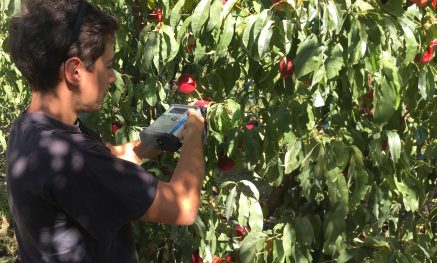
In-field phenotyping of fresh produce quality in HTPP to improve crop quality should be non-destructive, accurate, easy to use, rapid, and robust for in-field conditions. These tools have to tolerate variations not only in genotype and environment, but also in maturity.
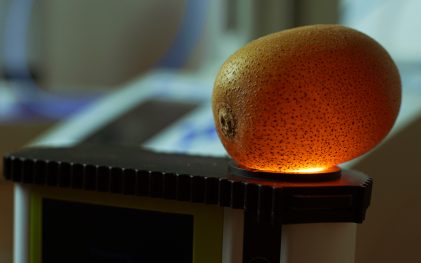
Fruit quality has been evaluated using spectroscopy at visible (Vis) and near-infrared (NIR) wavelengths. The NIR range interacts with the O–H, C–H, and N–H bonds found in biocompounds of plants and animals, making it suitable for measuring internal chemistry. Moreover, this light band can penetrate to a depth of ∼1–2 cm below the peel, to probe physicochemical properties of fruit pulp or other plant tissue. The validity of vis-NIR wavelengths for measuring various quality parameters, such as SSC, dry matter, TA, external and internal color, is well established for several fresh produce items, including cashew, apples, tomatoes, wax jumbo, pepper, avocados, melons, and mango.
When light in the vis-NIR range falls on a fruit, it interacts with the molecules, and a part of it is absorbed. The part of the wavelength band and the amount of light absorbed depend on the types of compounds and their concentrations. The rest of the light is either reflected by the tissue or transmitted through it. These light interactions are measured in spectroscopy. The reflectance spectra are highly complex because they are influenced by many confounding factors, such as the sample’s complex biochemistry and water content, light band overlap (simultaneous excitation and stretching of bands), the overtone bands (caused by molecules transitioning from ground to higher levels), and light scattering and other instrumental noise.
Therefore, raw data are usually unusable and need to be preprocessed using two methods: scatter correction (for example, standard normal variate) and spectral derivative (for example, Savitzky-Golay derivatives). The processed data can then be analyzed by chemometric models such as partial least squares regression
Testing Portable Quality Meters
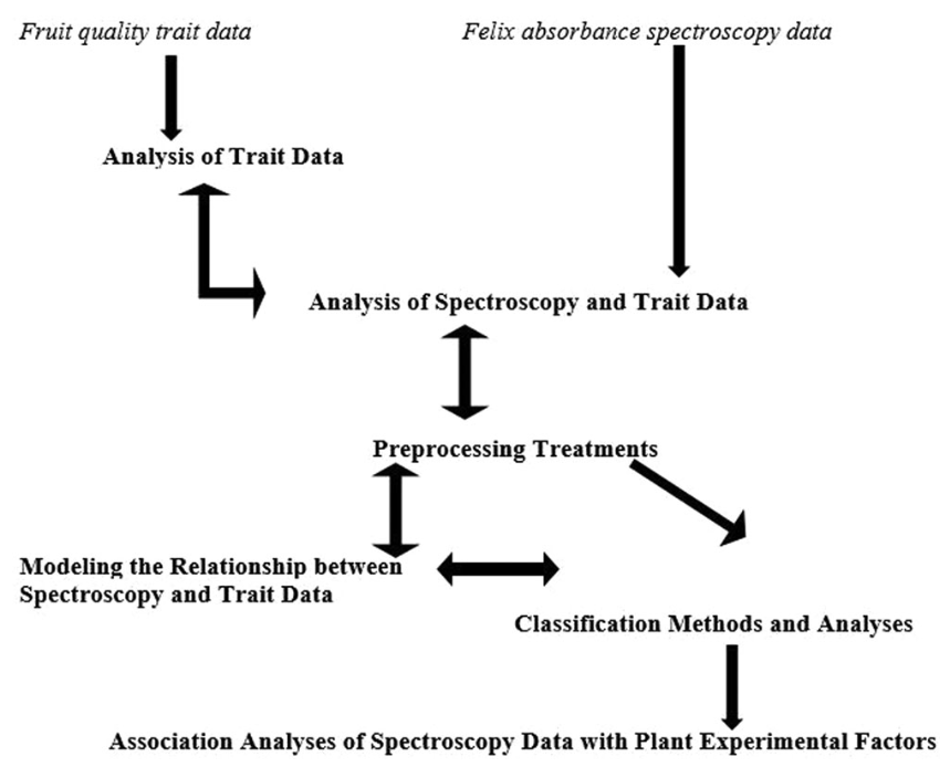
Figure 1: Schematic outline of the analyses of spectral data collected by the Felix F-750 Produce Quality Meter, Kaur et al. (2020). (Image credits: https://doi.org/10.1002/ppj2.20008)
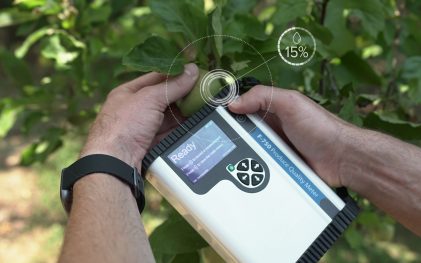
The use of portable, precise tools capable of real-time data collection and analysis has been missing in the HTTP systems for fruit quality breeding. The 2020 study by Kaur et al. evaluated a standard fresh-produce quality spectrophotometer for this purpose. They used the Felix-750 Produce Quality Meter, manufactured by Felix Instrument Applied Food Science, as a high-throughput phenotyping tool for in-field tomato and peppers. The instrument meets all the criteria set for HTTP systems. The measurements are non-destructive, precise, quantitative, and high-resolution, with real-time, simultaneous data collection and analysis of several quality parameters. The instrument is designed for use across the entire supply chain, from farms to retailers, and is also robust for in-field operations.
Two water treatments of full irrigation and reduced water (40% and 85% ETc for tomato and pepper, respectively) were used in a replicated split-plot experimental design. Up to 25 tomato inbred cultivars and introgression lines, as well as ten hybrid and 15 open -pollinated pepper lines, were monitored. Tomato and pepper were tested for °Brix (soluble solids), pH, carotenoid concentrations, and shrink in germplasm.
The scientists collected reflectance spectra, which were converted to absorbance mode by the instrument’s software. Reflectance provides information about the surface characteristics and absorbance of the fruit’s chemical composition. The spectra were analyzed in raw and preprocessed first- and second-derivative forms. For analysis, trait-based partial least squares regression models for prediction and principal component analysis to identify relevant patterns in fruit, genetic, and environmental factors were used; see Figure 1.
The scientists found that the pepper model’s suitability was trait and maturity-specific. A better fit of pepper models to maturity classes was achieved by grouping according to water treatment and by subgrouping the germplasm. The genetic diversity in tomatoes was too varied for the instrument to provide data suitable for predictive regression models. The models could group fruits suited for fresh consumption and processing.
For better results, the scientists suggest using more advanced multivariate analysis models and temperature-eliminating calibration models to analyze the spectral data. According to them, the tool is suitable with the tried models for early evaluation of diverse germplasm to select materials for breeding. In later stages, the tool can be used to select between or within lines and to assess family-based fruit quality traits.
Quality Meters by Felix Instruments Applied Food Science
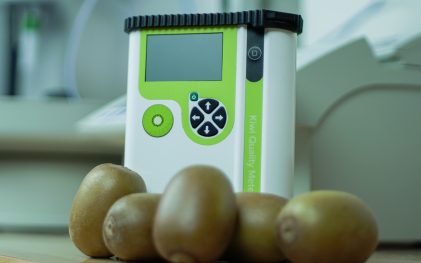
Felix Instruments Applied Food Science has been producing precision tools for food evaluation and plant physiology research for over 30 years. The F-750 is useful for assessing fresh produce, for preharvest maturity evaluation, and postharvest quality control. It offers a Custom Model Building service that can create machine learning models for specific cultivars and regions, improving efficiency in research and supply chains.
Contact Felix Instruments Applied Food Science for more information about our quality meters.
Source
Kaur, A., Donis‐Gonzalez, I. R., & St. Clair, D. A. (2020). Evaluation of a hand‐held spectrophotometer as an in‐field phenotyping tool for tomato and pepper fruit quality. The Plant Phenome Journal, 3(1), e20008. https://doi.org/10.1002/ppj2.20008
Omia, E., Park, E., Semyalo, D., Joshi, R., and Cho, B-K. (2026). Advancements in 3D field-crop phenotyping using point clouds: a comparative review of sensor technology, target traits, and challenges under controlled and field conditions. Front. Plant Sci., 17,1731852. doi: 10.3389/fpls.2026.1731852
Sheikh, M., Iqra, F., Ambreen, H., Pravin, K. A., Ikra, M., & Chung, Y. S. (2024). Integrating artificial intelligence and high-throughput phenotyping for crop improvement. Journal of Integrative Agriculture, 23(6), 1787-1802.
Yuan, H., Song, M., Liu, Y., Xie, Q., Cao, W., Zhu, Y., & Ni, J. (2023). Field Phenotyping Monitoring Systems for High-Throughput: A Survey of Enabling Technologies, Equipment, and Research Challenges. Agronomy, 13(11), 2832. https://doi.org/10.3390/agronomy13112832
Related Products
Most Popular Articles
- Spectrophotometry in 2023
- NIR Applications in Agriculture – Everything…
- The Importance of Food Quality Testing
- The 5 Most Important Parameters in Produce Quality Control
- Melon Fruit: Quality, Production & Physiology
- Fruit Respiration Impact on Fruit Quality
- Guide to Fresh Fruit Quality Control
- Liquid Spectrophotometry & Food Industry Applications
- Ethylene (C2H4) – Ripening, Crops & Agriculture
- Understanding Chemometrics for NIR Spectroscopy
Related Reading