How Do the F-750 and F-751 Correlate with Refractometer Brix Measurements?

Scott Trimble

September 16, 2026 at 6:51 pm | Updated September 16, 2026 at 6:52 pm | 6 min read
Refractometer Brix measurements are still one of the most familiar ways to check soluble solids in fruit. They are simple, accepted, and useful. But they are also destructive, slow when sample numbers get large, and limited to the fruit that gets cut or juiced. Felix Instruments’ F-750 Produce Quality Meter and F-751 Quality Meter series approach the same quality question differently.
Instead of replacing sound reference methods, these handheld NIR tools correlate with refractometer Brix measurements through calibration models that connect near-infrared spectral data with lab-based reference values.
That distinction matters. The F-750 and F-751 are not “magic Brix meters.” They are field-ready, non-destructive instruments that use NIR spectroscopy and chemometric models to estimate internal quality traits, including total soluble solids, dry matter, acidity, and other crop-specific indicators depending on the application. Felix Instruments describes the F-750 as a tool for quickly measuring total soluble solids, dry matter, titratable acidity, and internal color, while the F-751 Mango Quality Meter lists dry matter and Total Soluble Solids readings across commercial maturity ranges. The F-751 Grape Quality Meter also uses NIR technology to assess Brix, pH, and titratable acidity without damaging fruit.
Subscribe to receive our monthly round-up of articles.
Why Refractometer Brix Measurements Are the Reference Point
A refractometer gives a direct reading from juice. In fresh produce work, that reading is commonly used as a practical proxy for sweetness because soluble solids often rise as fruit matures. The process is familiar:
- Select fruit from a lot, block, bin, or storage group.
- Cut or juice the sample.
- Place juice on the refractometer.
- Record the Brix value.
- Use the result to judge maturity, eating quality, or harvest timing.
The problem is not that refractometers are poor tools. The problem is that refractometer Brix measurements only describe the fruit that was destroyed and tested. If a lot is variable, a few cut samples may not represent the full range. That is where the F-750 and F-751 change the workflow.
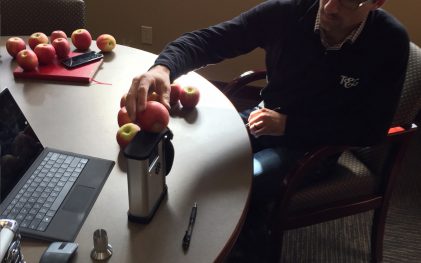
With NIR, users can scan more fruit, more often, and in more places. The instrument directs light into the fruit and measures the reflected signal. The model then converts the spectral response into a predicted value for the trait of interest. Felix Instruments notes that the F-751 Mango Quality Meter can take dry matter and Brix measurements in a few seconds and can be used on farms and throughout the supply chain.
How the F-750 Correlates with Refractometer Brix Measurements
The F-750 Produce Quality Meter is the more flexible platform. It is built for users who need a portable NIR instrument that can work across different crops and traits. Felix Instruments describes the F-750 as a tool used to measure Brix or Total Soluble Solids, dry matter, titratable acidity, internal color, external color, and other quality parameters depending on the model and application.
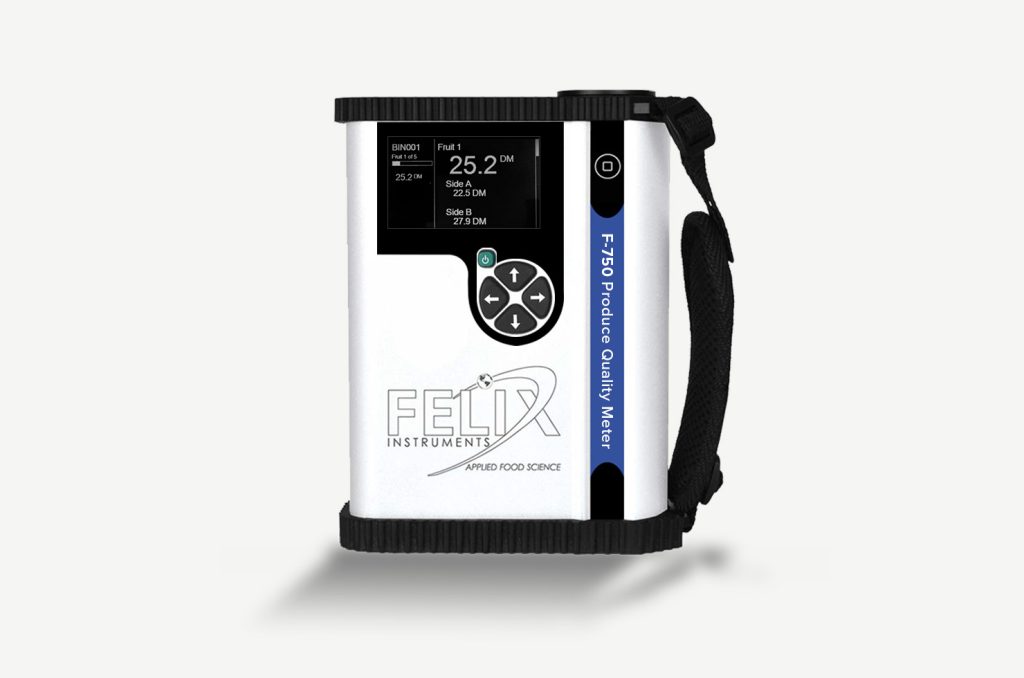
The correlation with refractometer Brix measurements comes from calibration. In practical terms, a calibration set pairs two types of information from the same fruit:
- NIR spectra collected with the F-750.
- Reference Brix values measured with a refractometer.
The software then builds a model that finds the relationship between spectral patterns and the reference values. Once the model is validated, the F-750 can estimate Brix non-destructively on new fruit that falls within the model’s intended crop, variety, maturity range, and measurement conditions.
This is especially useful for research teams, breeding programs, and quality teams working across more than one commodity. The F-750 gives them room to build, refine, and apply models instead of relying only on destructive sampling. For teams that already trust refractometer Brix measurements, the F-750 does not remove that reference point. It extends it across a larger sample size.
How the F-751 Correlates with Refractometer Brix Measurements
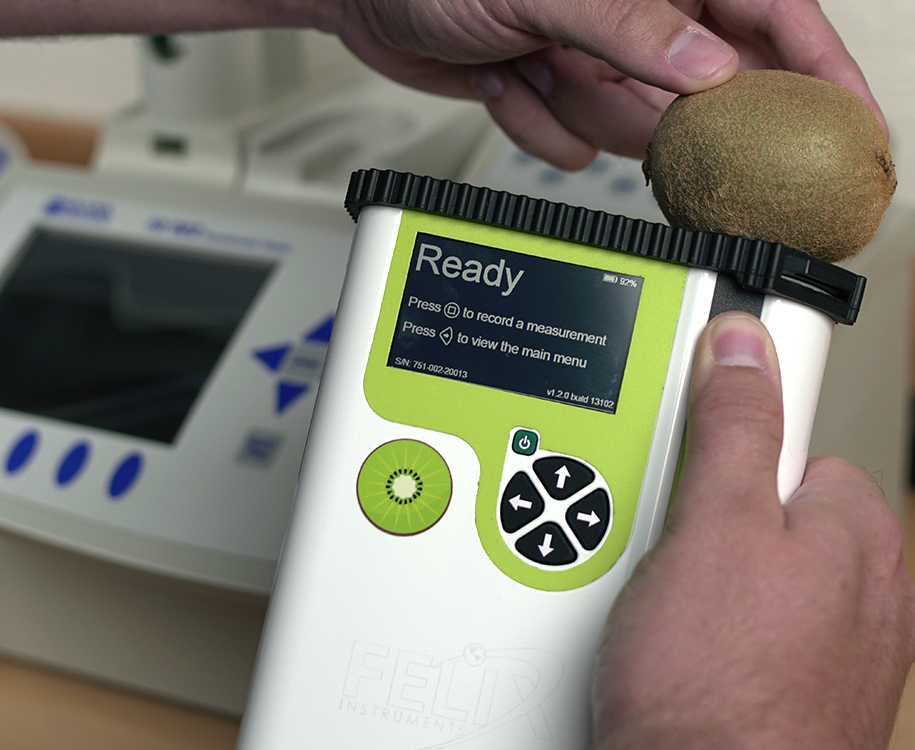
The F-751 series takes a more specialized approach. Instead of starting with a broad multi-crop platform, each F-751 model is designed around a specific fruit. Felix Instruments lists F-751 instruments for avocado, mango, kiwifruit, grape, and other produce categories. The crop-specific design is important because fruit structure, skin thickness, pigments, water content, and internal chemistry affect how NIR light behaves.
That is why the F-751 Mango, F-751 Grape, F-751 Kiwifruit, and F-751 Avocado meters are not all treated as the same instrument with different labels. They are designed around the crop’s measurement problem.
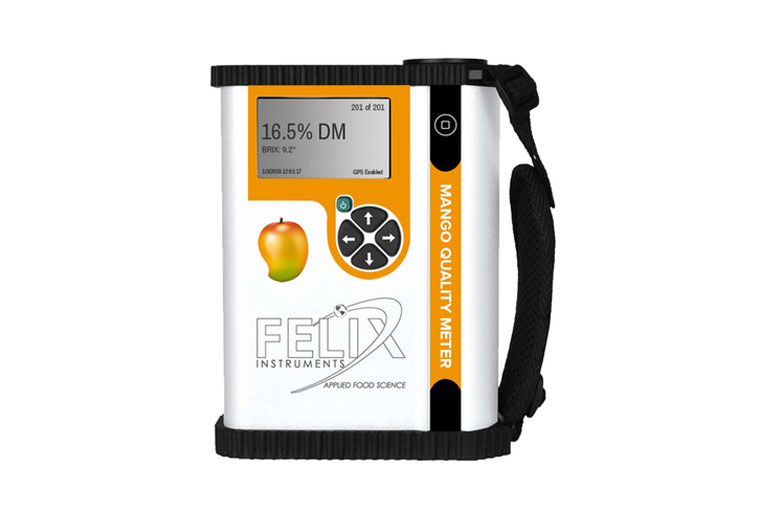
For mangoes, Felix Instruments states that the F-751 Mango Quality Meter measures dry matter and Brix non-destructively both on and off the tree. It is also described as having mango-specific models for varieties such as Kent, Keitt, Calypso, Tommy K, Ataulfo, and Honey Gold.
For grapes, the F-751 Grape Quality Meter is built around fast maturity assessment, using NIR to measure Brix, pH, and titratable acidity. That makes it useful for receiving checks, harvest decisions, cold storage, and quality assurance where repeated destructive testing can become tedious.
For avocado, the emphasis is often dry matter, since dry matter is a key maturity index in many avocado workflows. Felix Instruments describes the Avocado Quality Meter as using a 640 to 1050 nm spectrometer to capture dry matter data in 8 to 12 seconds.
In each case, correlation with refractometer Brix measurements depends on the model and the commodity. Where Brix is a modeled trait, the F-751 estimates it from spectra calibrated against reference data. Where dry matter is the stronger commercial maturity index, the F-751 focuses there.
Why NIR and Refractometer Readings May Not Match Exactly
Users should expect strong alignment from a good model, but not perfect one-to-one matching on every fruit. That is normal. A refractometer measures juice from a specific portion of a specific fruit. NIR reads a scanned area through the fruit surface and predicts internal chemistry from the light response.
Several factors can affect correlation:
- Variety or cultivar differences.
- Fruit temperature.
- Skin thickness and surface condition.
- Maturity range.
- Sampling location on the fruit.
- Calibration strength.
- Operator consistency.
- Whether the reference sample truly represents the scanned area.
This is why good measurement practice matters. The F-750 and F-751 perform best when users scan consistently, follow the proper crop protocol, and compare readings against reliable reference data during validation. Refractometer Brix measurements are still useful for checking model performance, building confidence, and confirming that a workflow is producing reliable predictions.
The Practical Advantage Over Refractometer-Only Workflows
The biggest advantage is scale. A refractometer workflow might make sense when a team needs a small number of spot checks. But when growers, researchers, packers, or exporters need to understand variation across blocks, lots, storage rooms, or shipments, destructive testing becomes a bottleneck.
The F-750 and F-751 make larger sampling realistic because scans take seconds and leave the fruit intact. Felix Instruments emphasizes rapid, non-destructive measurement across its NIR quality tools, including the F-750 and F-751 series.
That gives users several practical benefits:
- More data points per lot.
- Less wasted fruit.
- Faster harvest and receiving decisions.
- Better tracking across the supply chain.
- Improved confidence when fruit quality is variable.
- Easier comparison between blocks, suppliers, or storage conditions.
In other words, refractometer Brix measurements are useful, but they are narrow. The F-750 and F-751 help teams move from isolated readings to broader quality intelligence.
Which Instrument Makes More Sense?
The F-750 is a strong fit when flexibility is the priority. It suits research teams, universities, breeders, and operations that want to work across multiple commodities or develop custom models.
The F-751 is the better fit when a team wants a crop-specific tool with focused calibrations and a simpler commercial workflow. A mango exporter, grape receiver, kiwi program, or avocado maturity team may prefer the F-751 because it is designed around that fruit’s quality traits.
Both instruments can support better Brix-related decisions, but they serve slightly different users. The F-750 gives more model-building flexibility. The F-751 gives more commodity-specific focus.
Takeaway
The F-750 and F-751 correlate with refractometer Brix measurements by using NIR spectra calibrated against trusted reference data. A refractometer still plays an important role as a reference method, but Felix Instruments’ handheld NIR tools let users apply that reference relationship across many more fruit without cutting them open.
For teams that want faster maturity checks, stronger sampling programs, and better supply chain visibility, the value is clear. Refractometer Brix measurements tell you what happened in a small destructive sample. The F-750 and F-751 help you understand quality across the crop, lot, or shipment.
To learn which Felix Instruments meter fits your crop, workflow, and calibration needs, contact Felix Instruments and compare the F-750 Produce Quality Meter with the crop-specific F-751 series.
Related Products
- F-751 Grape Quality Meter
- Custom Model Building
- F-910 AccuStore
- F-751 Melon Quality Meter
- F-751 Kiwifruit Quality Meter
- F-750 Produce Quality Meter
- F-751 Avocado Quality Meter
- F-751 Mango Quality Meter
- F-9XXDK Dynamic Sampling Kit
- F-900 Portable Ethylene Analyzer
- F-950 Three Gas Analyzer
- F-920 Check It! Gas Analyzer
- F-960 Ripen It! Gas Analyzer
- F-940 Store It! Gas Analyzer
Most Popular Articles
- Spectrophotometry in 2023
- NIR Applications in Agriculture – Everything…
- The Importance of Food Quality Testing
- The 5 Most Important Parameters in Produce Quality Control
- Melon Fruit: Quality, Production & Physiology
- Fruit Respiration Impact on Fruit Quality
- Guide to Fresh Fruit Quality Control
- Liquid Spectrophotometry & Food Industry Applications
- Ethylene (C2H4) – Ripening, Crops & Agriculture
- Understanding Chemometrics for NIR Spectroscopy