How Do Plant Growth Regulators in Fruit Production Improve Yield and Quality?


Dr. Vijayalaxmi Kinhal

April 23, 2026 at 5:22 pm | Updated May 5, 2026 at 5:22 pm | 8 min read
- Plant growth regulators (PGRs) regulate hormonal pathways that regulate fruit set, size, shape, color, firmness, taste, and aroma.
- PGRs can also synchronize fruit maturity and control postharvest ripening, senescence, physiological disorders, and microbial spoilage.
- PGRs rarely act in isolation but rather in a network of synergistic or antagonistic interactions.
- PGRs applied in correct, precise amounts at strategic stages can give targeted improvements in productivity and quality.
Plant growth regulators are increasingly used to grow food sustainably and to reduce the excessive use of chemical fertilizers and their associated negative impacts on the environment and human health. The use of plant growth regulators leverages the natural functions of these compounds in fruit crops to increase yield quantity and quality. This article discusses the major applications of plant growth regulators in improving fruit quality and productivity.
Plant Growth Regulators
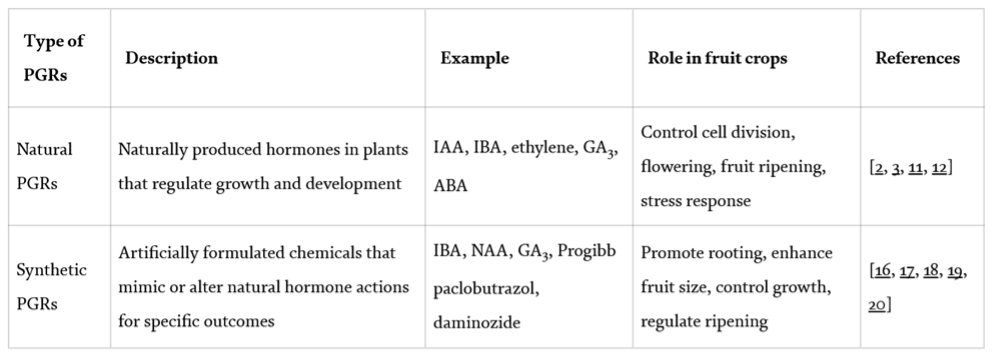
Table 1: Natural and synthetic PGRs and their role in fruit production and quality, Shivanda et al. (2025). (Credits: DOI: 10.5772/intechopen.1010639)
Subscribe to receive our monthly round-up of articles.
Plant growth regulators (PGRs) are natural or synthetic organic compounds that act as signaling molecules, modulating hormonal pathways that control physiological processes during growth, flowering, fruit set, cell division, fruit enlargement, ripening, senescence, and stress responses.
- Natural PGRs: These are plant hormones present in low concentrations in tissues that regulate metabolism, including auxins, gibberellins, ethylene, abscisic acid, and cytokinin; see Table 1.
- Synthetic PGRs: This group of chemicals, when applied exogenously, can control plant growth and metabolism; see Table 1. These chemicals can be synthetic analogs, biosynthesis inhibitors, hormone-releasing compounds, or hormone precursors. Some, like melatonin, can be derived from plants. The disadvantages of synthetic PGRs are that they can be unstable and phytotoxins at higher concentrations.
PGRs represent a paradigm shift in modern fruit crop management and are required at very low doses to improve fruit production and quality. PGRs also increase economic benefits and promote sustainability in fruit production by improving production efficiency and ensuring consistency in fruit size, appearance, and taste, which is crucial for meeting modern market demands and avoiding rejections that lead to food loss. The growth regulators offer a means of precise management intervention to optimize fruit production. Their effectiveness at very low concentrations is another factor in favor of their use.
Fruit Productivity and Quality
PGRs are used in orchards, from propagation to quality maintenance. Exogenous applications alter hormonal pathways by stimulating or inhibiting specific hormones, thereby altering growth patterns. PGRs can lead to superior plant growth, higher yield, and fruit quality.
PGRs can enhance the rooting and propagation of fruit trees. It is also used to manage vegetative growth and canopy density to optimize light infiltration and increase photosynthesis and carbon assimilation, thereby improving biomass and productivity. PGRs are used to modify branching, suppress shoots, and thin the canopy.
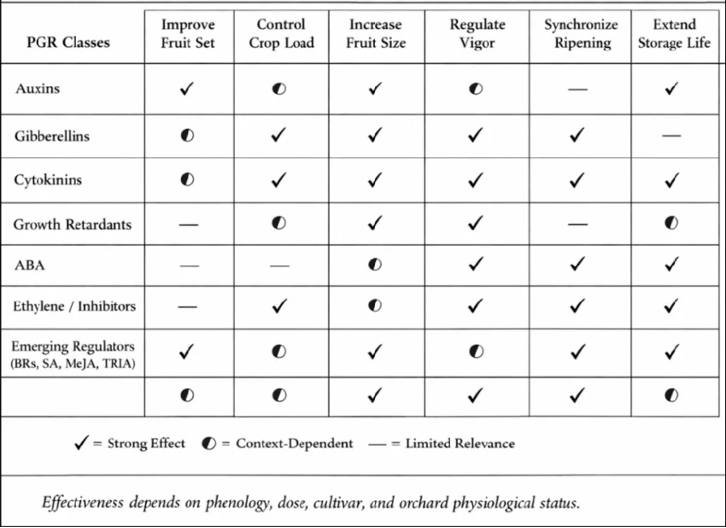
The compounds are also used to increase yield and quality by regulating flowering (inducing flowering & thinning excess flowers), source-sink relationships, fruit size and uniformity, abscission, ripening, stress responses, and postharvest life. These impacts of PGRs are discussed below; see Table 2.
Yield and Fruit size
A strategic PGR application can significantly increase total fruit yield and individual fruit size. PGRs working individually or synchronistically stimulate cell division to increase fruit set from ovaries, then enhance fruit size. Many PGRs can thin fruit numbers, so the remaining fruits receive more carbon allocations to achieve better quality. Yet other PGRs can prevent premature fruit drop and help to boost yield. For example, auxins reduce preharvest fruit drop by 20-60%.
Quality
PGRs contribute to better-quality fruits in many ways to meet consumer demands and processing needs. They improve sensory attributes like fruit shape, size, color, and texture. The fruits developed are also uniform in size and shape, and have the desired peel thickness. PGRs also enhance sweetness, flavor, and aroma, mainly by increasing sweetness and reducing acidity, when applied at the final stage of ripening. The pulp-to-seed ratio can also be adjusted using PGR. Artificial PGRs such as paclobutrazol (PBZ) increase antioxidant and phenolic contents in mango, strawberry, and pomegranate, and vitamin C in mango, thereby improving fungal resistance, color, and texture of these fruits.
Inhibitors like 1-Methylcyclopropene (MCP) can reduce endogenous ethylene production, delay ripening, and extend shelf life in strawberries, thereby enabling longer storage and transport times in the supply chain.
Synchronizing and Timing Harvest Maturity
PGRs can help growers make harvesting and post-harvest management more efficient by synchronizing fruit drop, for example, with epheron. PGRs can also synchronize flowering to get homogeneous harvest maturity. Auxins regulate fruit development and increase the synchronicity of ripening.
It is also possible to adjust harvest timing with PGRs. They can counteract earlier, compressed harvests due to climate change. Auxins delay ripening in a targeted manner, for example, in grapes for winemaking, until a cooler time, thereby producing fruit with the desired quality. NAA is also used to delay and reduce sugar accumulation in grapes intended for wine, thereby achieving the desired flavor profile.
When fruits are uniformly mature, post-harvest management is easier, as it reduces uneven ripening and the rejection of entire batches due to premature decay. Moreover, storage and ripening process parameters are determined based on harvest maturity, and their uniformity can improve results.
PGR efficacy depends on various internal and external factors, such as cultivar, plant vigor, age, PGR dose and application timing, and weather at the time of application.
Table 2: Plant growth regulators decision-making matrix for orchard management, Acharya (2026). (Credits: DOI:10.22271/ed.book.3526)
Enhancing and Extending Postharvest Quality
Postharvest fruit quality can be managed in many ways using PGRs, as shown in Figure 1. The most common means is to delay ripening and senescence to increase storage and transport time and increase shelf-life. Various PGRs can delay ethylene production, such as salicylic acid, or inhibit ethylene production, such as diazocyclopentadiene (DCAP).
Fruits can develop many postharvest quality problems, and PGRs can help reduce them. For example, PBZ reduces postharvest physiological disorders like cork spot, bitter pit, and senescence in apples. Or jasmonates that increase antioxidants to boost resilience against spoilage. Salicylic acid dips can delay decay in fruits caused by Botrytis cinerea.
Ethylene and abscisic acid are used together to accelerate or suppress ripening, thereby reducing postharvest deterioration.
Stress Responses
Commercial cultivars have low tolerance to stresses-heat, drought, salinity, pests, and diseases- which can increase the accumulation of reactive oxygen species (ROS) that damage the plant, and reduce carbon assimilation, which impacts productivity and fruit quality.
PGRs can increase stress tolerance, helping plants and trees mitigate stress effects in the preharvest stages to improve productivity and fruit quality. Abscisic acid and cytokinins are used to counteract stress in plants.
Methods of PGR Application in Orchard Management
PGR applications require precise dosages, timing, and integration with horticultural practices to achieve the intended benefits while minimizing adverse effects.
PGR applications for fruits are commonly made as foliar sprays, soil applications, or drenches.
- Foliar sprays: A solution is made by carefully mixing the correct amounts of the PGR compound, which is then sprayed onto leaves. Spraying ensures rapid absorption of the compounds and fast results. Hence, spraying is used to correct nutrient deficiencies and promote flowering. However, due to rapid absorption, high doses can lead to plant toxicity.
- Soil applications: PGRs applied in the soil to the plant root zone ensure slow absorption by plants, providing a steady supply to regulate root and plant vigor.
- Drenching: Another method of soil application is drenching, where PGR solutions saturate the plant root zone for a longer-lasting supply. Drenching is suitable for trees and large plants to regulate root activity and stress responses.
Other methods of PGR applications include in vivo injection, seed priming, and pasting.
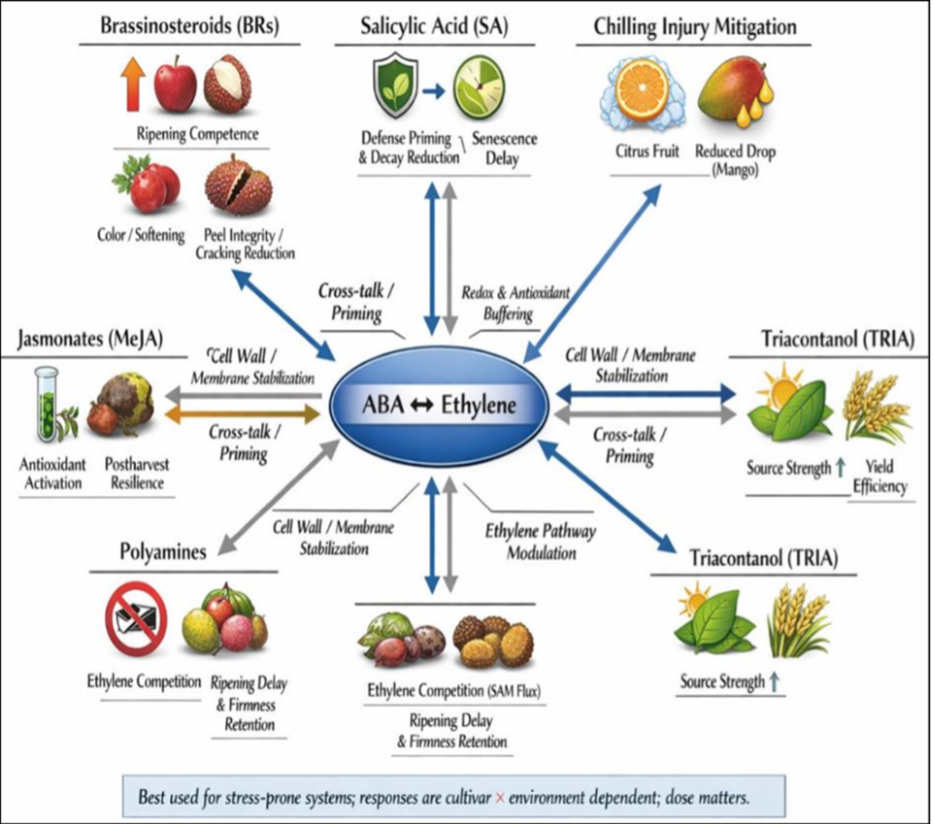
Figure 1: “Emerging regulators as stress-quality modulators: cross-talk with ABA and ethylene and major fruit outcomes,” Acharya (2026). (Credits: DOI:10.22271/ed.book.3526)
Common PGRs
The PGRs do not act in isolation; more than one hormone can be involved at any given time. Their collective effects can be synergistic when two or more hormones work together. Sometimes, one hormone counteracts another in an antagonistic interaction. Each type of interaction is useful in regulating fruit quality, depending on the timing. For example, auxins act synergistically with gibberellins and cytokinin to control fruit size, structure, and quality. On the other hand, auxins are applied at a later stage of fruit development to suppress ethylene production, delaying ripening and extending postharvest quality and shelf life.
The purposes for which PGRs are used in various fruits can be wide-ranging, especially considering synergistic effects (see Figure 1). So only the main effects of the five major PGR groups are listed below.
Auxins: These are a group of hormones used for cell division and expansion that promote ovary expansion, encourage fruit set and fruit formation, and increase fruit size; auxins increase fruit size in plums, apricots, and cherries. It also induces parthenocarpy, producing seedless varieties in grapes, strawberries, and oranges. Auxins prevent early fruit drop, increasing yield in apples. This group of PGRs ensures coordinated fruit growth, resulting in uniform fruit size. Concentration and timing of application define its role.
Gibberellins: This hormone prevents premature flower and fruit drop to increase yield. Its applications increase fruit length, width, weight, and volume. The hormone also produces seedless grapes. It also impacts internal quality parameters, increasing total soluble sugar and reducing acidity, for example, in Phyllanthus emblica. Gibberellins increase sweetness and improve taste in several fruits, such as peaches, oranges, and papaya. Effects vary across species.
Cytokinins: These are a diverse group of chemicals that improve seed germination, shoot elongation, flowering, as well as fruit set, formation, and expansion. These PGRs delay fruit ripening and senescence and enhance plant tolerance to stress.
Ethylene: This is a natural hormone that is also produced synthetically for the ripening of climacteric fruits. Non-climactic fruits do not produce ethylene for ripening but are sensitive to it and can decay when exposed to exogenous sources. Ethylene is needed for softening, color, and taste development. However, its levels in fruits and storage rooms must be controlled to limit unintended ripening and senescence during storage. It is used to restrict growth and thin fruit, thereby improving crop quality. Ethylene works with abscisic acid to increase senescence.
Abscisic Acid (ABA): Also called the stress hormone, it regulates the expression of genes controlling fruit color, texture, flavor, and aroma, so it can improve these quality parameters. It promotes source-to-sink allocation by restricting vegetative growth and directing photosynthate to fruits (sinks), thereby supporting fruit development and improving sweetness and dry matter content. ABA acts with ethylene to fine-tune ripening timing. ABA also improves pigment accumulation for color development and increases fruit softening by changing cell wall structure. ABA helps in stress response, especially in the case of drought by regulating stomatal closing during drought, increasing fruit abscission during stress to reduce crop load and produce fewer but higher quality fruits.
More and more PGRs are discovered, and their list keeps growing. In addition to the well-known five groups, some newly identified PGRs include brassinosteroids, jasmonates, salicylic acid, strigolactones, polyamines, and nitric oxide. See Figure 1. For example, among the new PGRs, 1-Methylcyclopropene (MCP) has been used to maintain firmness, color, and acidity in plums, thereby increasing storage time and quality.
Increasing Research in Plant Growth Regulators
The low doses that deliver targeted results by integrating PGRs into existing horticultural practices make them highly attractive for sustainably boosting fruit production and quality. Therefore, research in these new biotechnology applications is increasing to expand their uses. Moreover, concerns about environmental pollution, food safety, crop health, and the challenges of its use must also be addressed to improve acceptance and adoption. Felix Instruments Applied Food Science offers devices that are precise, non-destructive, chemical-free, and user-friendly for on-site use. These include the fruit quality meter series, which can simultaneously analyze soluble sugar content, titratable acidity, dry matter content, and internal and external color in real time.
Find out more about the fruit analysis quality meters from Felix Instruments Applied Food Science.
Sources
Das, S. (2024). Role of plant growth regulators in fruit crop production: Physiological mechanisms and practical applications. Int. J. Adv. Biochem. Res. 8(4):764-767. DOI: 10.33545/26174693.2024.v8.i4i.7253
Davies, C., Böttcher, C., Nicholson, E. L., Burbidge, C. A., & Boss, P. K. (2022). Timing of auxin treatment affects grape berry growth, ripening timing and the synchronicity of sugar accumulation. Australian Journal of Grape and Wine Research, 28(2), 232-241.
Handoko, R. N. S., & Lin, S. Y. (2025). Integrating plant growth regulators and biostimulants to enhance resilient and sustainable raspberry and blackberry production. Scientia Horticulturae, 350, 114296.
Shivandu, S. K., Singh, D., Kumar, G., Sharma, I., & Garg, J. (2025). Plant Growth Regulators: Key Drivers of Fruit Crop Productivity. In Food Science and Nutrition. IntechOpen. https://doi.org/10.5772/intechopen.1010639
Vlahoviček-Kahlina, K., Jurić, S., Marijan, M., Mutaliyeva, B., Khalus, S. V., Prosyanik, A. V., & Vinceković, M. (2021). Synthesis, Characterization, and Encapsulation of Novel Plant Growth Regulators (PGRs) in Biopolymer Matrices. International journal of molecular sciences, 22(4), 1847. https://doi.org/10.3390/ijms22041847
Zahid, G., Iftikhar, S., Shimira, F., Ahmad, H. M., & Kaçar, Y. A. (2023). An overview and recent progress of plant growth regulators (PGRs) in the mitigation of abiotic stresses in fruits: A review. Scientia Horticulturae, 309, 111621.
Related Products
- F-751 Grape Quality Meter
- Custom Model Building
- F-910 AccuStore
- F-751 Melon Quality Meter
- F-751 Kiwifruit Quality Meter
- F-750 Produce Quality Meter
- F-751 Avocado Quality Meter
- F-751 Mango Quality Meter
- F-9XXDK Dynamic Sampling Kit
- F-900 Portable Ethylene Analyzer
- F-950 Three Gas Analyzer
- F-920 Check It! Gas Analyzer
- F-960 Ripen It! Gas Analyzer
- F-940 Store It! Gas Analyzer
Most Popular Articles
- Spectrophotometry in 2023
- NIR Applications in Agriculture – Everything…
- The Importance of Food Quality Testing
- The 5 Most Important Parameters in Produce Quality Control
- Melon Fruit: Quality, Production & Physiology
- Fruit Respiration Impact on Fruit Quality
- Guide to Fresh Fruit Quality Control
- Liquid Spectrophotometry & Food Industry Applications
- Ethylene (C2H4) – Ripening, Crops & Agriculture
- Understanding Chemometrics for NIR Spectroscopy
Related Reading