What’s the Difference Between F-900 and F-950 Gas Analyzers?

Scott Trimble

May 5, 2026 at 5:22 pm | Updated May 5, 2026 at 5:22 pm | 5 min read
When comparing the F-900 and F-950 gas analyzers, the simplest way to separate them is this: the F-900 is built first around highly sensitive ethylene measurement, while the F-950 is built for fast, portable measurement of ethylene, CO2, and O2 together. Both instruments come from Felix Instruments and both serve produce, storage, ripening, research, and quality assurance teams.
The right choice depends on what gases you need to measure, how low you need to detect ethylene, and whether your workflow needs single-gas precision or three-gas context.
Why Gas Analysis Matters in Produce Work
Ethylene, carbon dioxide, and oxygen tell different parts of the same story.
Subscribe to receive our monthly round-up of articles.
Ethylene shows ripening activity. CO2 gives insight into respiration and storage stress. O2 helps teams understand whether controlled atmosphere storage, modified atmosphere packaging, or ripening conditions are staying within target ranges.
For many facilities, one gas reading is useful. Three gases are better when teams need to understand the full storage or ripening environment. That is where the difference between the F-900 and F-950 gas analyzers becomes practical instead of just technical.
What the F-900 Does Best
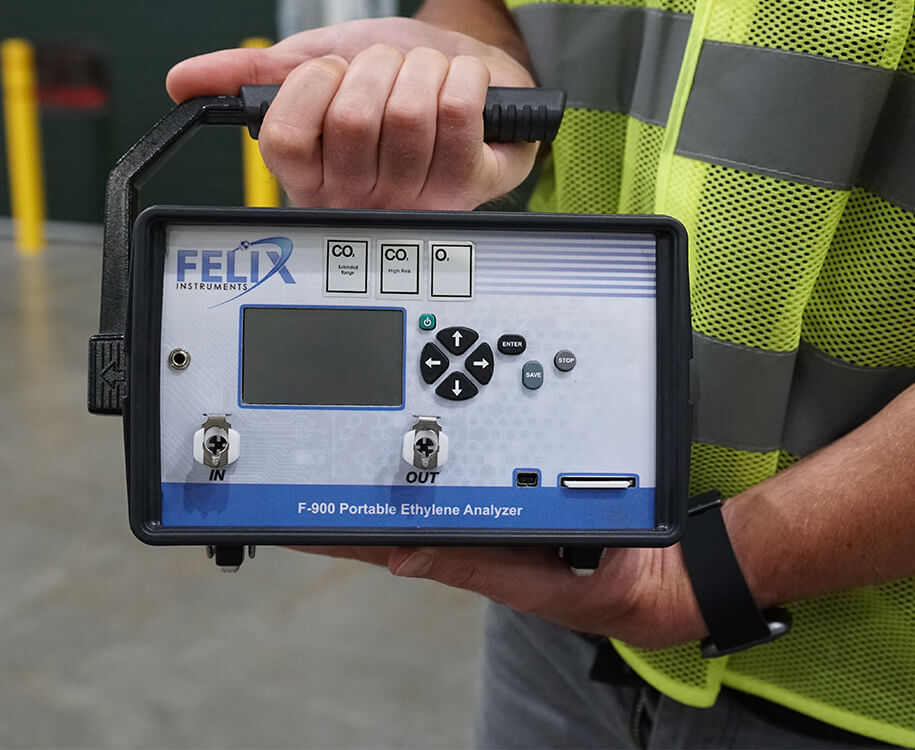
The F-900 Portable Ethylene Analyzer is the better fit when ethylene is the main focus. Felix Instruments describes the F-900 as a real-time, non-destructive ethylene analyzer for quality assurance professionals who need accurate ethylene data. It measures ethylene from 0 to 200 ppm, with a very low detection limit listed at 0.025 ppm.
That low-level ethylene sensitivity matters in situations where small changes can affect decisions. For example:
- Monitoring background ethylene in storage rooms
- Checking ethylene exposure during transport
- Studying fruit response in research trials
- Measuring ethylene flux from fruit or plant material
- Auditing rooms where unwanted ethylene may trigger early ripening
The F-900 can also be configured with optional CO2 and O2 sensors, so it is not limited to ethylene-only work. Still, its strongest identity is as a high-sensitivity ethylene analyzer. Felix also notes that the F-900 can support applications such as portable inspection, storage room monitoring, alarm or control functions, small-volume samples, and non-destructive ethylene flux measurements.
What the F-950 Does Best
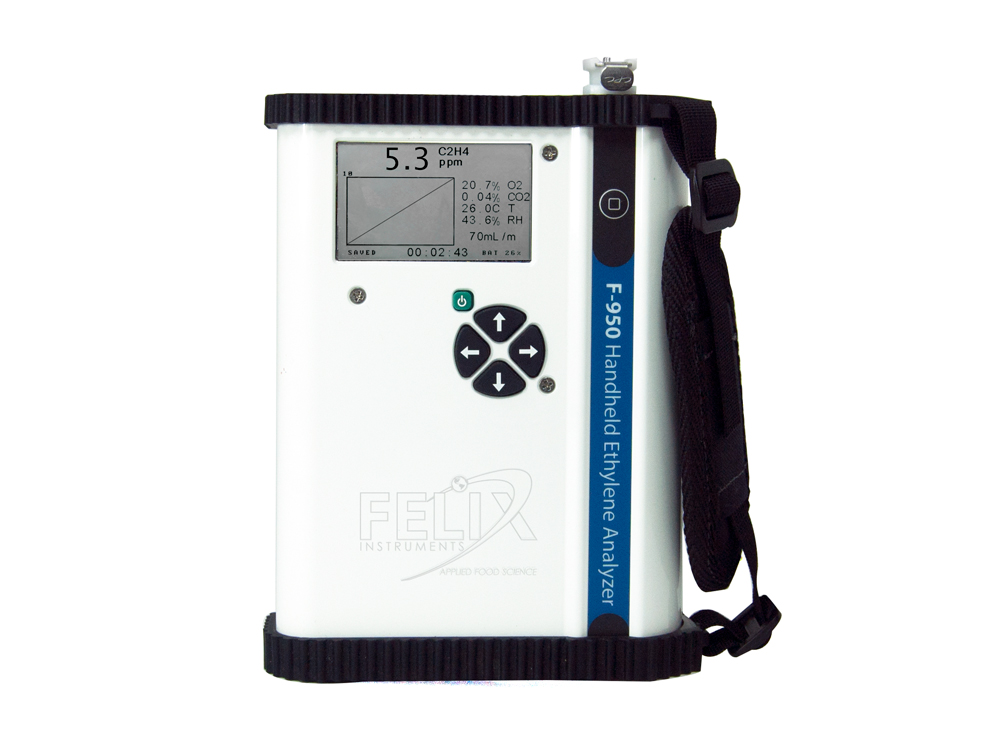
The F-950 Three Gas Analyzer is built for teams that want ethylene, CO2, and O2 readings in one handheld instrument. Felix Instruments describes it as a tool for gathering ethylene, CO2, and O2 data in seconds. The F-950 measures ethylene from 0 to 200 ppm and is designed for produce quality work in storage and ripening environments.
The practical advantage is context. Ethylene tells you what is driving ripening, but CO2 and O2 help explain how the fruit and atmosphere are responding. In banana ripening rooms, for example, Felix notes that the F-950’s combination of ethylene, oxygen, and carbon dioxide measurements gives operators a more complete picture than single-gas tools can provide.
The F-950 is a strong choice for:
- Ripening rooms
- Cold storage checks
- Controlled atmosphere monitoring
- Modified atmosphere packaging checks
- Quality control inspections
- Facilities that want one portable device for three key gases
Main Difference: Sensitivity vs. Three-Gas Convenience
The F-900 and F-950 gas analyzers overlap in some areas, but they are optimized differently.
The F-900 is the choice when ethylene sensitivity is the priority. It is especially useful when teams need to detect low ethylene levels, track subtle changes, or support research-grade ethylene monitoring. Felix lists the F-900 detection capability down to 0.025 ppm, which makes it attractive for low-level ethylene work.
The F-950 is the choice when teams need ethylene, CO2, and O2 in a single field-ready workflow. It may not be the same low-level ethylene specialist as the F-900, but it gives broader atmospheric context in one instrument. For commercial storage and ripening operations, that broader picture can be more useful than extreme ethylene sensitivity alone.
Measurement and Workflow Comparison
Here is the difference in day-to-day use:
| Feature | F-900 Portable Ethylene Analyzer | F-950 Three Gas Analyzer |
| Primary role | High-sensitivity ethylene analysis | Three-gas produce atmosphere analysis |
| Main gases | Ethylene, with optional CO2 and O2 | Ethylene, CO2, and O2 |
| Ethylene range | 0 to 200 ppm | 0 to 200 ppm |
| Best fit | Low-level ethylene detection and research | Ripening, storage, and QA checks |
| Workflow style | Ethylene-focused monitoring | Fast multi-gas readings |
| Typical user | Researchers, QA teams, storage managers | Ripening managers, storage teams, QA teams |
When to Choose the F-900
Choose the F-900 when ethylene is the gas that drives your decisions.
This is common in research and in facilities where low ethylene levels matter. If you are trying to detect ethylene before it becomes a visible quality issue, the F-900 makes sense. It is also useful when you need flexible ethylene monitoring options across labs, packhouses, storage rooms, and inspection points.
The F-900 is also a good fit when you want a portable analyzer that can support more specialized workflows. Felix highlights uses such as non-destructive single-fruit ethylene flux measurement, continuous room monitoring, and integration into larger control systems.
In simple terms, choose the F-900 if the question is, “How much ethylene is present, even at very low levels?”
When to Choose the F-950
Choose the F-950 when your team needs to understand the whole gas environment.
In storage and ripening rooms, ethylene alone rarely tells the full story. CO2 can rise as fruit respires. O2 can fall depending on room conditions, packaging, or controlled atmosphere settings. The F-950 brings those readings together in one portable instrument.
This is useful for operators who want quick checks without switching tools. For example, a ripening room manager can measure ethylene to confirm treatment levels, then use CO2 and O2 data to see whether the room atmosphere is staying within the desired range.
In simple terms, choose the F-950 if the question is, “What is happening in the produce atmosphere overall?”
How Felix Instruments Stands Out
The biggest advantage Felix Instruments brings is that these analyzers are designed specifically around produce physiology and postharvest workflows. Many generic gas analyzers can report gas concentrations, but produce teams usually need more than a number. They need portability, rugged construction, practical sampling options, clear data, and sensors matched to real storage and ripening conditions.
The F-900 and F-950 gas analyzers both support that practical approach. The F-900 gives teams a strong ethylene-focused tool when sensitivity matters. The F-950 gives teams a compact three-gas option when broader atmosphere data matters. Rather than forcing one instrument into every use case, Felix offers tools that match how postharvest teams actually work.
The Bottom Line
The difference between the F-900 and F-950 gas analyzers comes down to the job you need the instrument to do. The F-900 is the better choice for high-sensitivity ethylene analysis, low-level detection, research work, and detailed ethylene monitoring. The F-950 is the better choice when you need ethylene, CO2, and O2 readings together in one portable analyzer for storage, ripening, and quality control.
Both instruments help produce teams move from guesswork to data-backed decisions. For operations managing ripening, storage quality, shelf life, or postharvest research, that difference matters every day.
To compare the F-900 and F-950 gas analyzers for your facility, contact Felix Instruments. Our team can help match the right analyzer to your crop, workflow, and quality goals.
Related Products
Most Popular Articles
- Spectrophotometry in 2023
- NIR Applications in Agriculture – Everything…
- The Importance of Food Quality Testing
- The 5 Most Important Parameters in Produce Quality Control
- Melon Fruit: Quality, Production & Physiology
- Fruit Respiration Impact on Fruit Quality
- Guide to Fresh Fruit Quality Control
- Liquid Spectrophotometry & Food Industry Applications
- Ethylene (C2H4) – Ripening, Crops & Agriculture
- Understanding Chemometrics for NIR Spectroscopy