Selecting the Right Ethylene Analyzer for Your Facility Size and Throughput

Scott Trimble

February 5, 2026 at 10:34 pm | Updated February 5, 2026 at 10:34 pm | 5 min read
If you are shopping for an ethylene analyzer, the spec sheet is only half the story. The other half is how your facility actually runs: how many rooms you manage, how many samples you pull per shift, whether you need spot checks or continuous monitoring, and what ethylene range you truly live in. Picking the right ethylene analyzer is mostly about matching measurement range and workflow speed to your throughput, then choosing the form factor that will actually get used every day.
Below is a practical way to size an ethylene analyzer to your operation, with examples from Felix Instruments’ lineup.
Start With Two Questions That Decide Almost Everything
#01 What Ethylene Range Do You Need to Measure?
Different parts of the supply chain sit in very different concentration bands:
Subscribe to receive our monthly round-up of articles.
-
Storage, transport, and shelf-life checks often need high resolution at low ppm or even down into ppb territory.
-
Ripening rooms can run much higher, so you need a range that does not top out early.
-
Research or troubleshooting sometimes needs both: very low detection for background ethylene, plus headroom for events and spikes.
Felix covers these bands with purpose-built options:
-
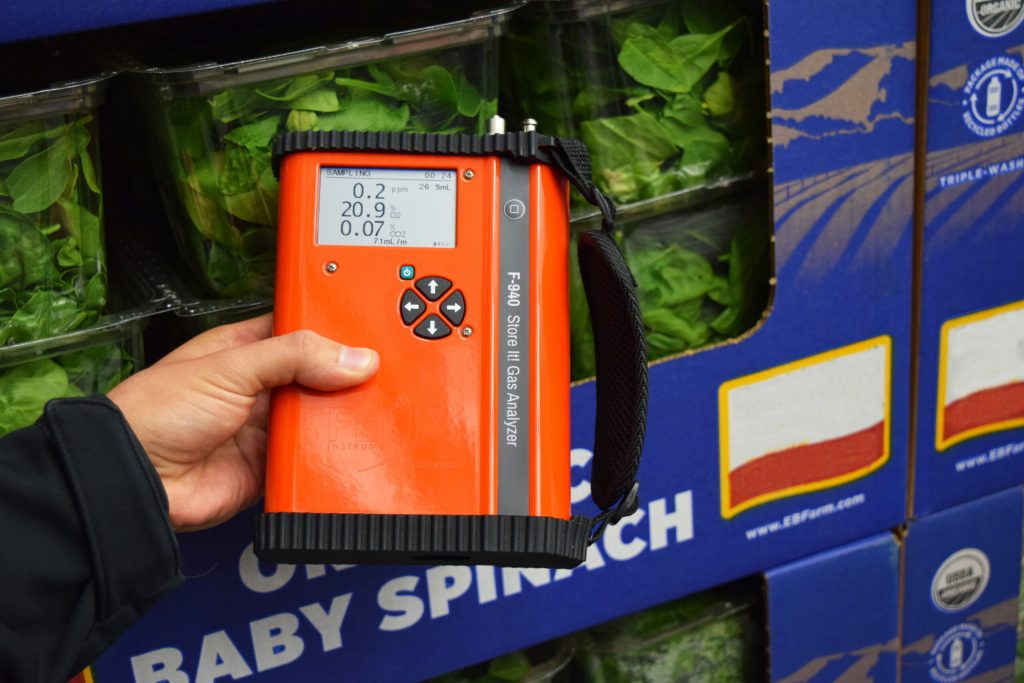
The F-940 Store It! targets high-resolution ethylene from 0 to 10 ppm.
-
The F-900 Portable Ethylene Analyzer can be configured for very low detection down to 0.025 ppm (25 ppb) and offers sensor options spanning 0 to 10 ppm or up to 0 to 200 ppm depending on sensor choice.
-
The F-960 Ripen It! is aimed at ripening environments, with ethylene ranges listed at 10 to 1000 ppm in support documentation.
-
The F-950 Three Gas Analyzer covers a broad, versatile ethylene range up to 200 ppm and is built for quick checks.
#02 How Many Measurements Do You Need per Hour?
Throughput is the quiet killer. A device can be accurate and still fail if it slows the team down.
Think in terms of:
-
Number of rooms or lots to check
-
Number of packages, bins, or pallets sampled per lot
-
Whether you are doing single spot checks or repeated monitoring over time
Match the Analyzer to Facility Size
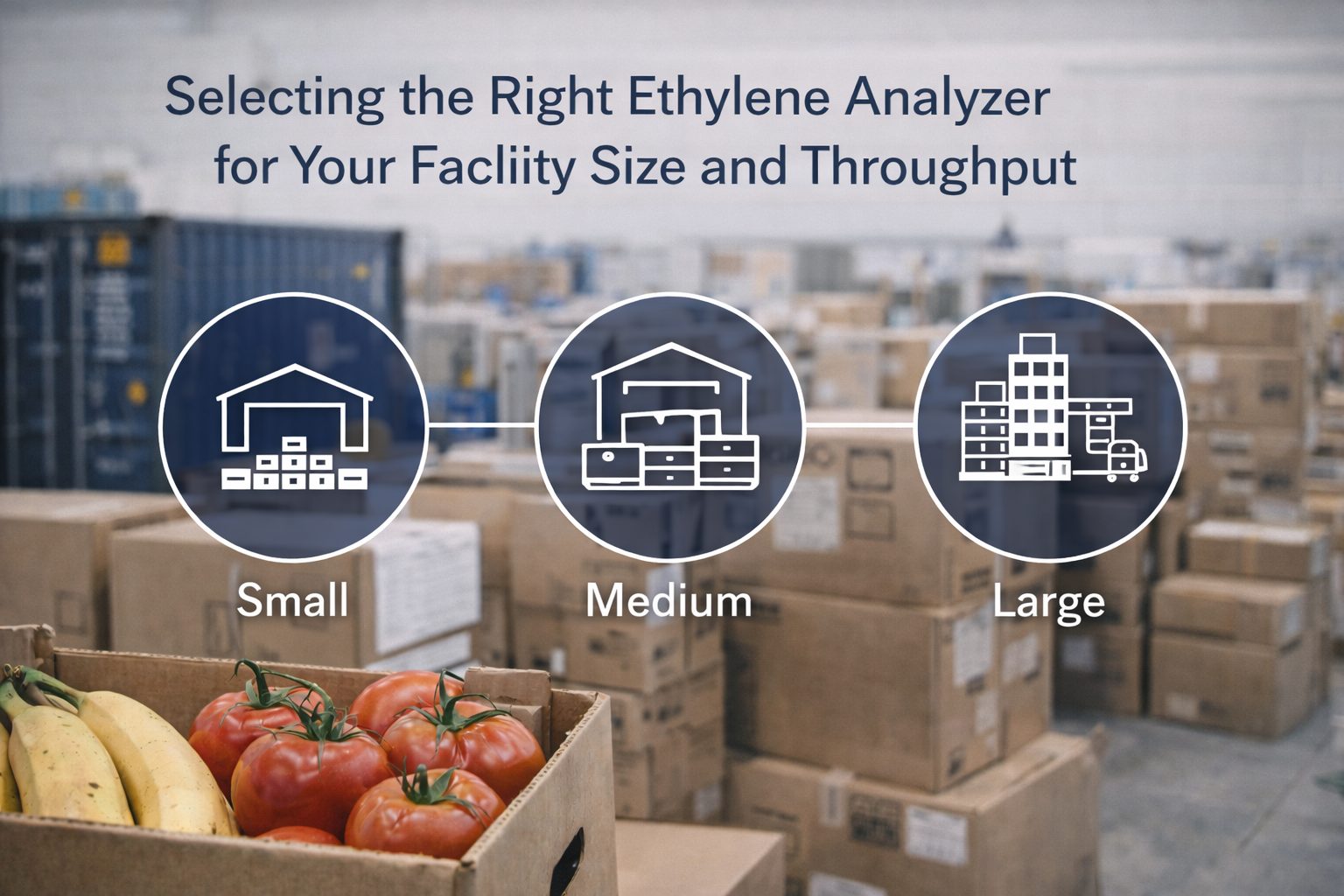
Small Facilities and Low Sample Volume
This is the typical profile:
-
1 to 3 storage rooms or a small packing line
-
A few spot checks per day
-
Ethylene questions like: “Is this lot clean?” “Is this room creeping up?” “Did our scrubber actually do anything?”
Recommended Felix approach:
-
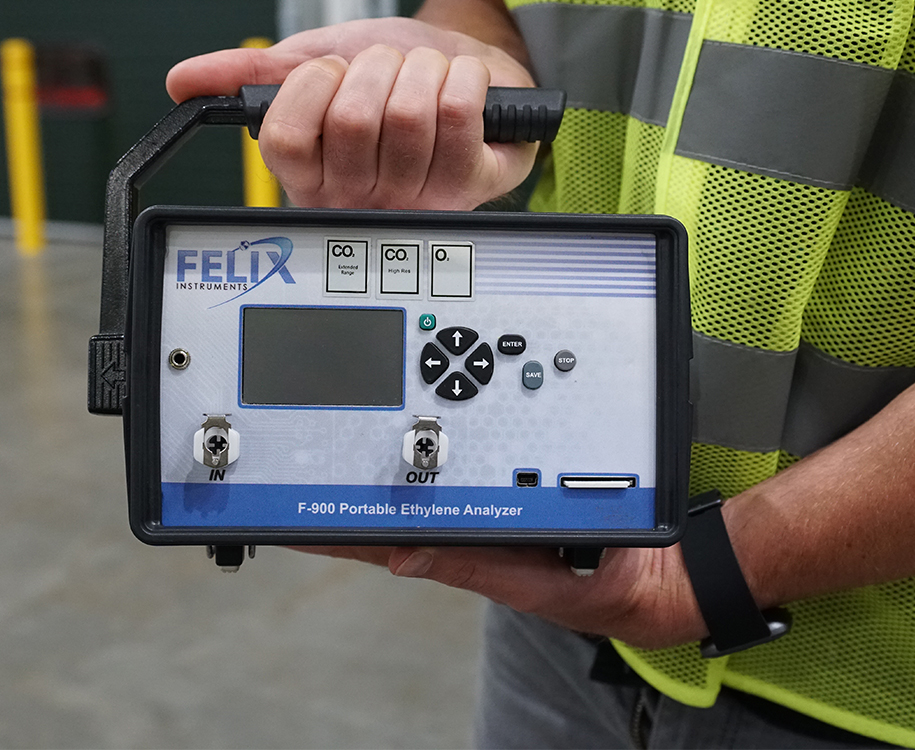
F-900 Portable Ethylene Analyzer if low-level detection is a priority, especially when you care about background ethylene and subtle changes. Felix lists detection down to 0.025 ppm (25 ppb) with an electrochemical sensor option.
-
Optional CO2 and O2 sensing can be added to the F-900 if you want respiration context without carrying multiple tools.
Why this tends to beat “generic” alternatives in this tier:
-
Many portable options either lack the low detection you want for background ethylene work, or they push you toward lab-style workflows. The F-900 is built around in-field sampling and portability while still talking in ppb/low ppm terms.
Mid-Size Operations With Moderate Throughput
Profile:
-
Multiple rooms, multiple lots, and a QA team that is moving all day
-
You want ethylene plus CO2 and O2 together because decisions depend on the whole atmosphere, not a single gas
-
You need a reliable “daily driver” ethylene analyzer that stays quick
Recommended Felix approach:
-
F-950 for a balance of range and speed. It measures ethylene, CO2, and O2, and publishes a sampling flow rate and short total sampling time that align with higher-throughput checks.
-
F-940 when your ethylene questions live in the low ppm band and you want fine resolution for storage management and shelf-life protection.
A practical way to choose between F-950 and F-940:
-
If your ethylene is usually below 10 ppm and you care about small deltas, lean F-940.
-
If you routinely see wider swings, need more headroom, and want a fast multi-gas workflow, lean F-950.
Large Ripening and Distribution Facilities With High Throughput
Profile:
-
Ripening rooms running elevated ethylene
-
Many rooms, frequent checks, and real operational cost to missing a drift
-
Often you need documentation: when the room hit setpoint, whether levels stayed stable, and what happened across a shift
Recommended Felix approach:
-
F-960 when you need to confidently assess higher ethylene levels typical of ripening operations. Felix positions it for real-time ripening gas monitoring and lists ethylene ranges up to 1000 ppm in support specs.
-
Consider power and deployment accessories: Felix offers a battery eliminator accessory compatible across multiple 9XX handheld analyzers when you want AC operation rather than managing batteries during long monitoring windows.
If your “facility size” is really “number of rooms that must stay controlled,” look beyond handhelds:
-
The F-901 AccuRipe/AccuStore concept is about measuring and controlling C2H4, CO2, O2, temperature, and relative humidity with a modular approach intended for storage and ripening environments.
In other words, when your operation becomes a network of environments instead of a handful of checks, a system approach can reduce labor and standardize control logic.
A Simple Selection Checklist
Use this to avoid buying the wrong ethylene analyzer for the job:
-
Ethylene range you truly need (typical and worst-case)
-
Low ppm resolution: F-940 (0–10 ppm)
-
Broad portable coverage and low detection option: F-900
-
Broad three-gas checks with quick sampling: F-950
-
Ripening high range: F-960
-
-
Measurements per hour
-
If you need to sprint through checks, prioritize sampling time and workflow speed (F-950 is positioned for quick results).
-
-
Do you need CO2 and O2 alongside ethylene?
-
F-950 and F-960 are explicitly positioned as three-gas analyzers.
-
F-900 supports optional CO2 and O2 sensors.
-
-
Data handling expectations
-
If you need traceability, look for onboard storage and connectivity features (F-950 brochure language calls out stored records and Wi-Fi capabilities).
-
Why Felix Tends to Win the Real-World Comparison
Competitor comparisons often get framed as “sensor type wars,” but the day-to-day difference is workflow. Felix leans into practical QA realities: handheld form factors, integrated multi-gas options, and published sampling specs that map to throughput planning. Felix even publishes a comparison chart for the F-950 against other ethylene analyzers, highlighting things like range, resolution, and sampling characteristics side by side.
That matters because the best ethylene analyzer is the one your team can use consistently, without turning gas checks into a special project.
Summary
Selecting the right ethylene analyzer comes down to matching concentration range and sampling speed to your facility’s throughput. Small operations often get the most value from a portable platform that can see low-level ethylene clearly. Mid-size facilities usually need a fast, repeatable multi-gas workflow. Large ripening operations need high-range coverage and a strategy for consistent monitoring across many rooms.
If you want to make the decision quickly, Felix Instruments makes it straightforward because the lineup is segmented by real use cases: Store It for low-ppm storage monitoring, Three Gas for fast QA checks, Ripen It for high ethylene ripening environments, and the Portable Ethylene Analyzer for sensitive field-ready work.
Contact Felix Instruments to talk through your room count, target ethylene band, and samples per hour. We can point you to the right ethylene analyzer configuration and accessories so your team hits throughput targets without compromising measurement quality.
Related Products
Most Popular Articles
- Spectrophotometry in 2023
- NIR Applications in Agriculture – Everything…
- The Importance of Food Quality Testing
- The 5 Most Important Parameters in Produce Quality Control
- Melon Fruit: Quality, Production & Physiology
- Fruit Respiration Impact on Fruit Quality
- Guide to Fresh Fruit Quality Control
- Liquid Spectrophotometry & Food Industry Applications
- Ethylene (C2H4) – Ripening, Crops & Agriculture
- Understanding Chemometrics for NIR Spectroscopy
Related Reading