Myth: Postharvest Gas Levels Don’t Change Overnight

Scott Trimble

March 10, 2026 at 4:23 pm | Updated March 10, 2026 at 4:23 pm | 6 min read
Postharvest gas analysis is often treated as a routine checkpoint rather than a continuous priority. A common myth in storage and ripening operations is that gas levels remain stable overnight. Many teams assume that once a room is set and verified at the end of the day, oxygen, carbon dioxide, and ethylene concentrations will hold steady until morning. In reality, postharvest gas levels can shift quickly due to produce respiration, temperature fluctuations, leaks, and system variability. Ignoring these overnight changes creates risk. Understanding and measuring them is where accurate postharvest gas analysis becomes essential.
Why the Myth Persists?
It is easy to see why this belief continues. Controlled atmosphere rooms and ripening chambers are designed to maintain stable conditions. Modern systems automate gas injection and scrubbing. On paper, the setpoints do not change.
However, produce is biologically active. Respiration continues 24 hours a day. Even small temperature swings alter respiration rates. A minor leak or fan inconsistency can shift oxygen and carbon dioxide concentrations within hours. Ethylene accumulation can rise faster than expected in enclosed spaces.
Subscribe to the Felix instruments Weekly article series.
By submitting this form, you are consenting to receive marketing emails from: . You can revoke your consent to receive emails at any time by using the SafeUnsubscribe® link, found at the bottom of every email. Emails are serviced by Constant Contact
Without consistent postharvest gas analysis, these changes remain invisible until fruit quality begins to decline.
What Actually Happens Overnight
Respiration Does Not Pause
Fresh produce consumes oxygen and releases carbon dioxide continuously. In high-value commodities, even slight changes in oxygen concentration can accelerate metabolism. When oxygen drops below target levels or carbon dioxide rises beyond tolerance, fruit stress increases.
Ethylene Can Build Up Quickly
Ethylene production is highly sensitive to fruit maturity and temperature. In mixed loads or partially ripened rooms, ethylene levels can spike overnight. That small increase can push fruit into a faster ripening stage before operators return in the morning.
Temperature Variability Impacts Gas Balance
Even controlled facilities experience temperature gradients. A few degrees difference alters respiration rate. Faster respiration means more carbon dioxide and lower oxygen in localized pockets. Without reliable postharvest gas analysis, these micro-environment changes go undetected.
System Drift and Calibration Issues
Gas sensors and room controls require validation. Over time, sensors drift. If a control system is not regularly verified with independent instrumentation, reported levels may not reflect actual conditions.
The Risk of Assuming Stability
When overnight gas changes are ignored, operations face several risks:
- Uneven ripening
- Shortened storage life
- Increased shrink
- Reduced firmness and sugar retention
- Inconsistent lot quality
For commodities like apples, avocados, mangoes, grapes, and kiwifruit, these shifts translate directly into financial loss.
The Role of Reliable Postharvest Gas Analysis
Accurate postharvest gas analysis allows teams to verify, not assume. Independent handheld analyzers provide real-time validation of oxygen, carbon dioxide, and ethylene concentrations. Instead of relying solely on installed room sensors, operators can cross-check conditions quickly and precisely.
Felix Instruments has built a line of gas analyzers specifically for this purpose. These instruments are designed for field and storage environments where reliability and portability matter.
F-920 Check It Gas Analyzer
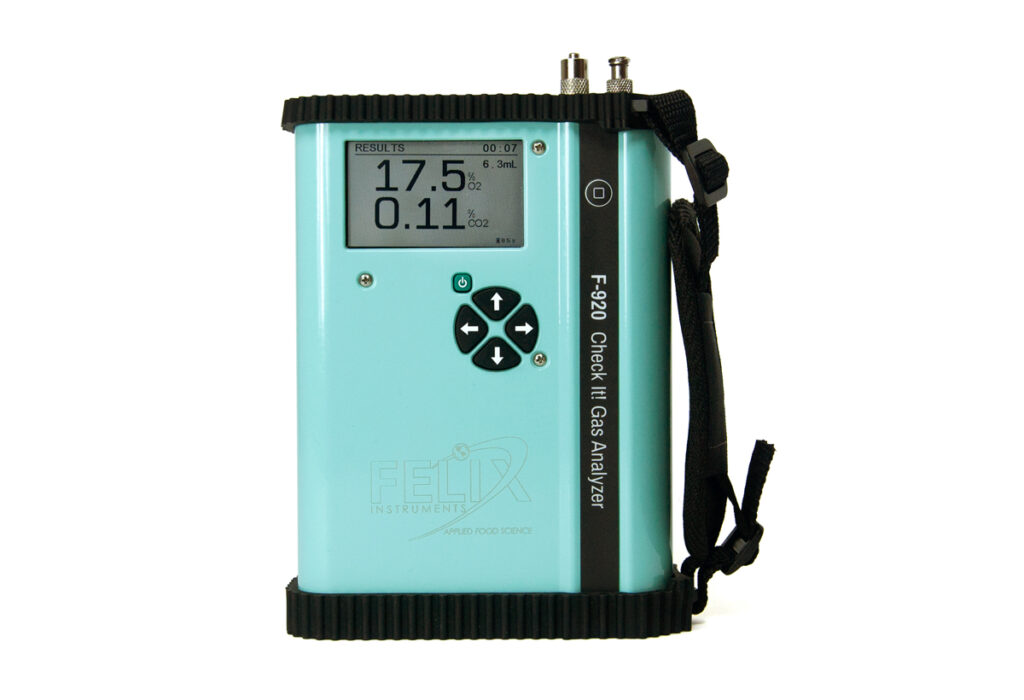
The F-920 Check It Gas Analyzer measures oxygen and carbon dioxide concentrations with high precision. It is compact, fast, and built for spot-checking storage rooms and packaging environments. For teams focused on controlled atmosphere validation, this unit supports accurate postharvest gas analysis without complex setup.
The ability to verify room conditions independently helps eliminate uncertainty about overnight drift.
F-940 Store It Gas Analyzer

For facilities that need to monitor ethylene in addition to oxygen and carbon dioxide, the F-940 Store It Gas Analyzer provides three-gas measurement in one handheld device. Ethylene sensitivity is critical in long-term storage operations where even trace levels influence ripening behavior.
With the F-940, operators can measure multiple gases during a single room check. This simplifies postharvest gas analysis and reduces the risk of missing a developing issue.
F-950 Three Gas Analyzer

In ripening rooms and high-turn operations, speed matters. The F-950 Three Gas Analyzer measures ethylene, oxygen, and carbon dioxide rapidly and accurately. It is particularly useful for overnight verification before and after ripening cycles.
Instead of assuming gas balance remained stable, teams can confirm it in minutes.
F-960 Ripen It Gas Analyzer
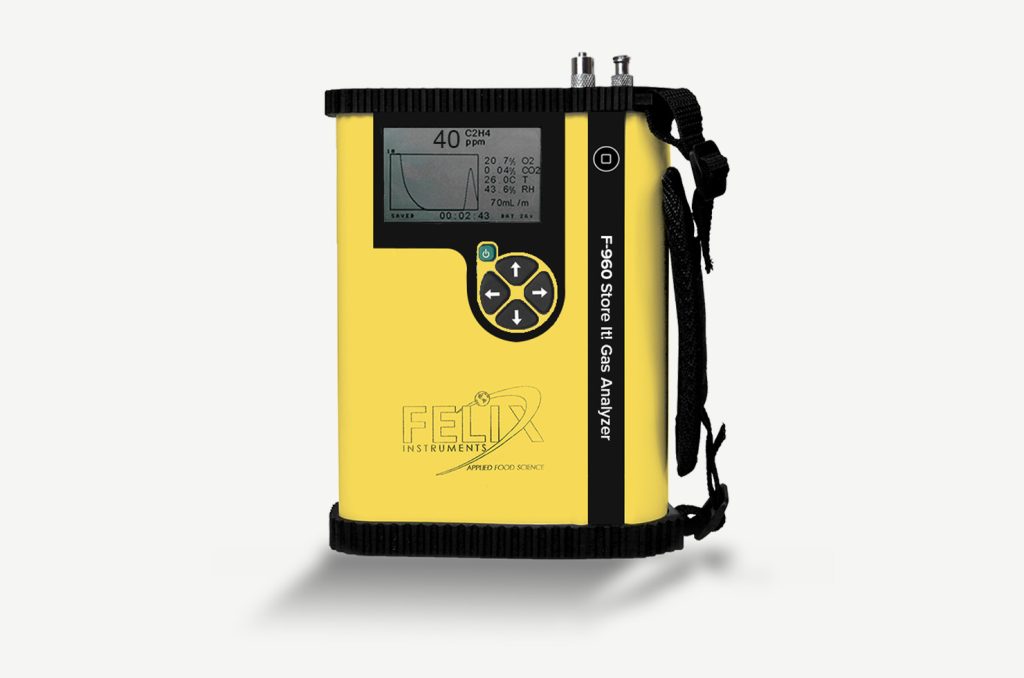
For ripening-focused operations, the F-960 Ripen It Gas Analyzer emphasizes precise ethylene control alongside oxygen and carbon dioxide monitoring. Ethylene management is central to uniform ripening. Overnight buildup can push fruit beyond target stages before distribution.
Using dedicated postharvest gas analysis tools ensures ripening programs remain predictable.
Portable Ethylene Monitoring with the F-900
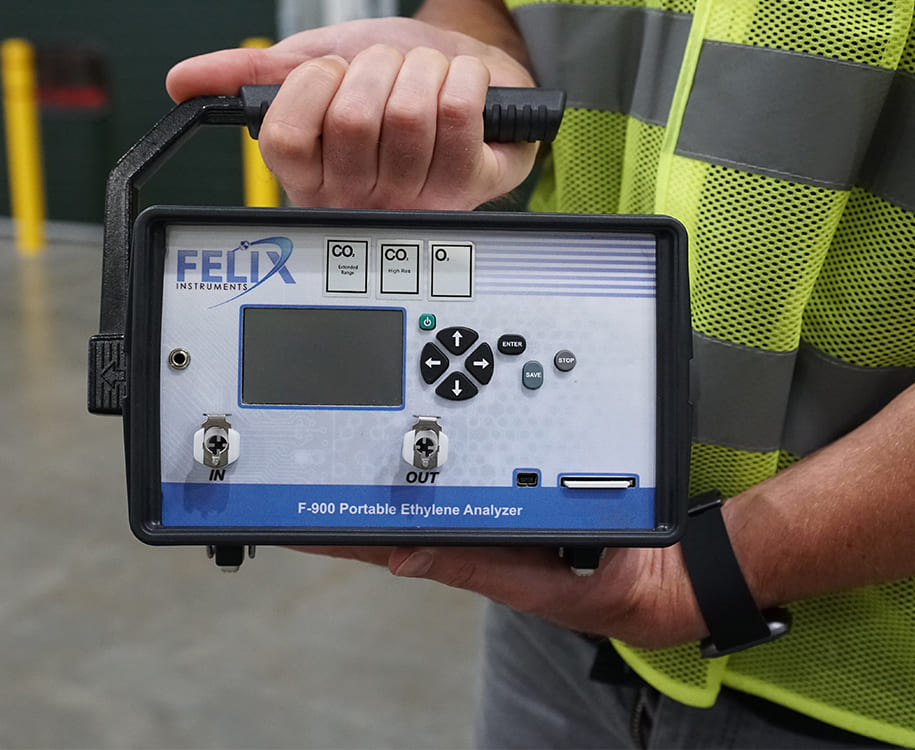
In some cases, operators require highly sensitive ethylene detection alone. The F-900 Portable Ethylene Analyzer supports trace-level ethylene measurement in storage rooms, transportation containers, and research environments.
Ethylene shifts can happen quickly, especially overnight. A dedicated analyzer adds another layer of confidence.
Beyond Gas: Quality Verification with NIR
Gas levels influence internal fruit quality, but verification should not stop at atmosphere measurement. Felix Instruments also offers near-infrared produce quality meters for non-destructive internal testing.
F-750 Produce Quality Meter
The F-750 Produce Quality Meter measures parameters such as Brix in a wide range of produce. It enables rapid quality assessment without cutting fruit. Combined with postharvest gas analysis, this approach links atmosphere control with measurable internal results.
Commodity-Specific F-751 Models
For targeted applications, Felix Instruments provides commodity-specific models:
- F-751 Avocado Quality Meter
- F-751 Mango Quality Meter
- F-751 Kiwifruit Quality Meter
- F-751 Grape Quality Meter
These tools allow operators to evaluate internal dry matter, Brix, and other quality indicators. When overnight gas shifts occur, changes in internal quality can follow. Monitoring both atmosphere and fruit condition strengthens decision-making.
Why Felix Instruments Stands Out
Several factors distinguish Felix Instruments in postharvest gas analysis:
Integrated Portability
Handheld designs allow operators to move between rooms quickly. No bulky carts or complex installations are required.
Multi-Gas Capability
Measuring ethylene, oxygen, and carbon dioxide together streamlines workflow. Operators gain a complete atmospheric picture in a single visit.
Research-Grade Accuracy
Felix analyzers are used in commercial facilities and research institutions. Accuracy and repeatability are prioritized, not sacrificed for convenience.
Data Confidence
Independent verification reduces reliance on fixed room sensors alone. Cross-checking improves confidence in reported conditions.
Practical Scenario: Overnight CO2 Rise
Consider a controlled atmosphere apple room set at 2 percent oxygen and 2.5 percent carbon dioxide. At the end of the shift, readings are within tolerance.
Overnight, respiration increases due to a slight temperature change. Carbon dioxide climbs to 3.2 percent in one section. Oxygen dips below target. The control system reacts slowly.
By morning, fruit stress has begun. Without immediate postharvest gas analysis, the shift might go unnoticed for another day. Repeated exposure compounds quality loss.
With a handheld analyzer, operators can identify the deviation immediately and adjust ventilation or scrubbing systems before damage spreads.
Moving from Assumption to Verification
The idea that postharvest gas levels remain constant overnight is appealing because it simplifies workflow. But biology does not pause. Storage rooms are dynamic environments.
Postharvest gas analysis should be treated as an ongoing validation process rather than a one-time check. Regular morning and evening measurements provide insight into trends, not just snapshots.
Best Practices for Overnight Monitoring
To reduce risk:
- Verify gas levels at the end of each shift
- Recheck rooms first thing in the morning
- Cross-validate fixed sensors with handheld analyzers
- Track data trends over time
- Monitor ethylene even in non-ripening storage
These practices require reliable instrumentation. That is where Felix Instruments supports operations.
The Bottom Line
If your operation relies on stable storage and consistent ripening, do not leave overnight conditions to assumption. Invest in precise postharvest gas analysis with Felix Instruments gas analyzers and quality meters. Their portable, research-grade tools help you verify conditions, protect product value, and maintain confidence from storage through distribution.
Visit FelixInstruments to explore the full line of gas analyzers and NIR quality meters designed specifically for postharvest applications.
Related Products
Most Popular Articles
- Spectrophotometry in 2023
- The Importance of Food Quality Testing
- NIR Applications in Agriculture – Everything…
- The 5 Most Important Parameters in Produce Quality Control
- Melon Fruit: Quality, Production & Physiology
- Fruit Respiration Impact on Fruit Quality
- Guide to Fresh Fruit Quality Control
- Liquid Spectrophotometry & Food Industry Applications
- Ethylene (C2H4) – Ripening, Crops & Agriculture
- Active Packaging: What it is and why it’s important