Felix Instruments vs Sunforest vs Rubens Technologies: Which NIR Meter Rules Postharvest Dry Matter Testing?

Scott Trimble

February 5, 2026 at 11:45 pm | Updated February 5, 2026 at 11:45 pm | 5 min read
Dry matter testing is a cornerstone of postharvest quality management. Accurate dry matter measurement helps growers and packers make confident decisions on harvest timing, fruit handling, and market destination. With postharvest dry matter testing at the heart of many supply chain decisions, choosing the right near-infrared (NIR) tool can directly impact efficiency and profitability.
In this comparison, we examine three key players in the space: Felix Instruments, Sunforest, and Rubens Technologies. The goal is to understand how each company approaches NIR technology and which solution best supports reliable postharvest dry matter testing.
How NIR Technology Supports Dry Matter Testing
Near-infrared spectroscopy allows users to evaluate internal fruit quality without cutting or destroying samples. By measuring how NIR light interacts with organic compounds inside the fruit, these instruments estimate dry matter based on established relationships between spectral signatures and laboratory reference data.
Subscribe to the Felix instruments Weekly article series.
By submitting this form, you are consenting to receive marketing emails from: . You can revoke your consent to receive emails at any time by using the SafeUnsubscribe® link, found at the bottom of every email. Emails are serviced by Constant Contact
In postharvest environments, speed and repeatability matter. NIR meters enable rapid screening of large fruit lots, helping quality teams separate loads, verify maturity targets, and maintain consistency across storage and distribution. The quality of the hardware, calibration models, and data handling all influence how reliable dry matter predictions are in practice.
Felix Instruments: A Proven Standard for Postharvest Dry Matter Testing
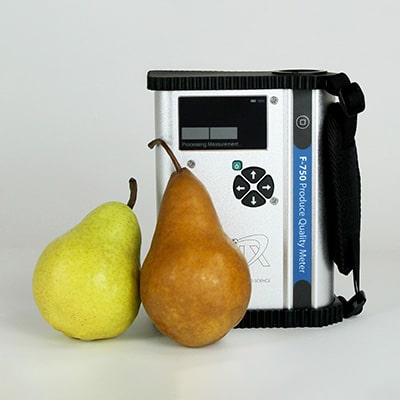
Felix Instruments has built a reputation around practical, research-backed tools for non-destructive quality measurement. Our NIR meters are designed to operate in both orchard and postharvest settings, making us a strong fit for dry matter testing throughout the supply chain.
Product Approach and Capabilities
The F-750 Produce Quality Meter is designed as a multi-purpose NIR platform. It predicts dry matter alongside other internal quality traits such as Brix and acidity. The wide spectral range and high resolution allow the instrument to support robust calibration models across many crops.
For users who prefer crop-specific solutions, the F-751 series focuses on individual commodities like avocado, kiwifruit, mango, and grapes. These meters are optimized for dry matter testing and related maturity metrics, reducing variability and simplifying daily use in packing and storage environments.
Data logging, onboard storage, and optional GPS support allow quality teams to track dry matter trends across blocks, suppliers, or storage periods. This level of traceability is especially useful when dry matter thresholds are tied to commercial acceptance or pricing.
Strengths in Postharvest Applications
Felix Instruments stands out for consistency and depth. The tools are designed for users who want more than a simple pass or fail number. Custom calibration capability allows advanced users to fine-tune models for specific varieties, growing regions, or seasons. This is particularly valuable in postharvest testing where small differences in dry matter can influence ripening behavior and shelf life.
Another advantage is flexibility. One device can be used across incoming inspection, storage monitoring, and outbound quality checks without changing workflows.
Considerations
Felix Instruments meters reward good calibration practices. Teams that invest time in proper model development and validation see the strongest performance. For users new to NIR, some initial training is typically required.
Sunforest: Speed and Simplicity in the Field and Packhouse
Sunforest focuses on fast, easy-to-use NIR tools aimed at growers and quality inspectors who prioritize simplicity. Their handheld meters are designed to deliver quick dry matter and Brix estimates with minimal setup.
Product Focus
Sunforest instruments emphasize straightforward operation. Measurements are taken directly on the fruit surface, and results are displayed almost instantly. Integration with mobile software platforms allows data to be collected and shared without manual transfers.
These tools are often used for rapid screening rather than detailed quality analysis. In postharvest settings, they are typically applied to spot checks or high-level sorting decisions.
Strengths
Ease of use is the main appeal. Minimal training is required, and results are easy to interpret. For teams that need quick answers and prefer streamlined workflows, Sunforest meters can fit well into routine operations.
Limitations
Sunforest places less emphasis on advanced calibration control. This can limit performance when fruit conditions vary widely or when users want to refine dry matter models over time. For operations where dry matter testing is closely tied to commercial standards, this reduced flexibility may be a drawback.
Rubens Technologies: Data-Driven Quality Intelligence
Rubens Technologies approaches dry matter testing from a broader data analytics perspective. Instead of relying solely on traditional NIR reflectance, their system combines spectral scanning with machine learning and cloud-based analysis.
How the System Works
Users scan fruit with a handheld sensor that captures spectral information. That data is processed using remote analytics, and predicted quality metrics such as dry matter are returned to a mobile device. The platform is positioned as a decision support system rather than just a measuring tool.
Strengths
The emphasis on analytics allows Rubens to explore more complex relationships between spectral data and fruit quality. This approach may be attractive to organizations interested in traceability, harvest optimization, or integrated supply chain insights.
Challenges for Postharvest Testing
Reliance on cloud connectivity introduces additional variables. In busy postharvest environments, offline capability and immediate feedback are often preferred. Rubens also has a shorter track record in delivering standalone dry matter meters compared to more established NIR instrument manufacturers.
Comparing the Three Approaches
Accuracy and Reliability

Felix Instruments offers the most established framework for accurate postharvest dry matter testing, supported by flexible calibration and long-term use across crops. Sunforest provides practical estimates for rapid checks, while Rubens focuses on analytical potential rather than proven routine measurement.
Workflow Fit
Sunforest excels in simplicity. Felix Instruments balances usability with advanced control, making it suitable for quality managers and technical teams. Rubens targets data-driven organizations willing to adopt cloud-based workflows.
Long-Term Value
For operations that depend heavily on dry matter thresholds and consistency, Felix Instruments provides the strongest long-term value. Its tools adapt as quality programs evolve.
Takeaway
All three companies bring different strengths to postharvest dry matter testing. Sunforest delivers speed and ease of use. Rubens Technologies offers innovative analytics and future-focused insights. Felix Instruments stands apart as the most complete and proven solution for reliable, non-destructive dry matter measurement across postharvest workflows.
For teams that need dependable data, flexible calibration, and instruments built specifically for agricultural quality assessment, Felix Instruments remains the benchmark. To learn how Felix Instruments can support your postharvest dry matter testing program, reach out to their team for a product consultation or on-site demonstration.
Frequently Asked Questions
What Is the Advantage of Nir for Postharvest Dry Matter Testing?
NIR allows quality teams to measure dry matter without cutting fruit. This makes it possible to test more samples, preserve saleable product, and monitor quality trends over time.
Can One Nir Meter Be Used for Multiple Fruit Types?
Some meters are designed for multiple crops, while others are optimized for specific commodities. Multi-crop tools offer flexibility, while crop-specific meters often provide higher accuracy for targeted applications.
How Important Is Calibration in Dry Matter Testing?
Calibration is critical. Well-maintained calibration models ensure that dry matter predictions remain accurate across seasons, varieties, and growing conditions.
Related Products
- F-751 Grape Quality Meter
- Custom Model Building
- F-910 AccuStore
- F-751 Melon Quality Meter
- F-751 Kiwifruit Quality Meter
- F-750 Produce Quality Meter
- F-751 Avocado Quality Meter
- F-751 Mango Quality Meter
- F-900 Portable Ethylene Analyzer
- F-950 Three Gas Analyzer
- F-920 Check It! Gas Analyzer
- F-960 Ripen It! Gas Analyzer
- F-940 Store It! Gas Analyzer
Most Popular Articles
- Spectrophotometry in 2023
- The Importance of Food Quality Testing
- NIR Applications in Agriculture – Everything…
- The 5 Most Important Parameters in Produce Quality Control
- Melon Fruit: Quality, Production & Physiology
- Fruit Respiration Impact on Fruit Quality
- Guide to Fresh Fruit Quality Control
- Liquid Spectrophotometry & Food Industry Applications
- Ethylene (C2H4) – Ripening, Crops & Agriculture
- Active Packaging: What it is and why it’s important