What Affects the Postharvest Quality of Blackberries?

Dr. Vijayalaxmi Kinhal

October 22, 2026 at 6:53 pm | Updated October 22, 2026 at 6:53 pm | 6 min read
- Major postharvest quality problems in blackberries include weight loss, reduced firmness, leakiness, fungal decay, and changes in appearance.
- White drupelet disorder and red drupelet reversion are two major color changes that can reduce marketability because consumers reject them.
- Step cooling and maintaining low temperatures, high relative humidity, and modified atmospheres in storage rooms and packaging are essential to extend shelf life.
Blackberries’ short postharvest shelf life historically limited them to local markets. However, growing global demand is increasing production and the area devoted to blackberries by 3.4% and 2.7% annually, respectively. So, the focus is on reducing quality problems that can shorten shelf life and affect marketability. This article addresses the major postharvest problems the blackberry supply chain must tackle.
Blackberries are Non-Climacteric Fruits
Blackberries (Rubus rubus) are aggregate fruits made of many drupelets; once cultivated only in temperate Europe and North America, they are now expanding into other temperate regions and subtropical countries.
Blackberries are non-climacteric fruits that have to be allowed to ripen on the plants, and whose quality cannot be improved after harvest as in climacteric apples or mangos. Since they are harvested ripe, their shelf life is only around 3-5 days. Other factors that shorten shelf life include their delicate structure, lack of rind, high water content, and high rates of fruit respiration and transpiration, which make them susceptible to quality degradation due to biological, physiological, and logistical problems. However, blackberries are not sensitive to ethylene.
Subscribe to receive our monthly round-up of articles.
To minimize handling damage, the delicate fruit is packed in the field in retail packaging: wide, shallow shell containers, in no more than three layers of blackberries. An absorbent pad at the bottom absorbs leaked juice and cushions the fruit.
Common quality problems that reduce consumer acceptance and marketability of blackberries include weight loss, dehydration, leakiness, red drupelet reversion (RDR), white drupelet disorder, and fungal decay.
Weight Loss
Blackberries are about 88% water.
Thus, high transpiration and respiration rates in blackberries can cause significant water loss, reduce fruit weight, and affect growers’ ROI and other supply-chain stakeholders.
The best way to reduce water loss and extend shelf life is to store them at 0 °C (32°F) with high relative humidity (RH) of 90-95% and minimal air movement. Cool as soon as possible after harvest. According to the University of Georgia, forced-air cooling is the best method for cooling blackberries, and hydrocooling and ice cooling should be avoided.
Loss of Firmness
Loss of firmness occurs in blackberries for two reasons: transpiration and ripening processes
Transpiration: Water loss during transpiration softens the fruit. This problem can be reduced by storing fruit at a high RH of 90-95%.
Ripening: During ripening, firmness loss occurs mainly due to reduced pectin, primary cell wall breakdown, and changes in cell composition. Ripening is necessary and makes berries edible; however, postharvest, berries can overripe and soften, leading to quality problems.
Growers can help by choosing firmer varieties, especially for the fresh fruit market. Fresh-market cultivars, especially for long-distance transport, are very firm and include Apache, Chester Thornless, Osage, Ouachita, Natchez, and Navaho.
Change in Appearance
Overall appearance changes due to high transpiration rates, which cause gloss loss, shriveling, and wrinkling. These issues can be controlled by reducing transpiration rates through cool temperatures and high humidity. Even a few hours of storage at warm temperatures can cause significant water loss in blackberries.
Color Reversion
Blackberries go through six color stages as they ripen due to anthocyanin accumulation: green, partly red, fully red, partial black, shiny black, and dull black. Dull black fruits are already overripe. Machines pick blackberries for processing when they are fully ripe, and people pick them by hand for fresh use when they are not fully ripe but are in the shiny black stage.
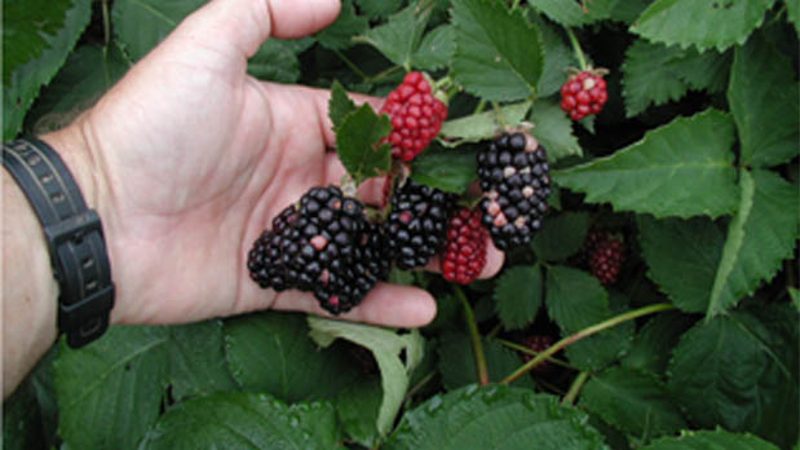
Figure 1: “White drupelets on unripe blackberries,” Fernandez. (Image credits:https://berries.cals.ncsu.edu/blackberry-diagnostic-tool/fruit-are-discolored-or-have-spots/)
Color changes in blackberries can result from physiological disorders caused by preharvest factors and postharvest storage conditions.
Preharvest: White drupelet disorder
White drupelet disorder (WDD) is a color change from black to tan or white in one or more drupelets. The color reversion occurs in scattered drupelets separated by black ones or in patches. In addition to the color change, affected drupelets have lower soluble solids (sugars), less sweetness, and tougher skin. However, discolored drupelets do not differ in weight. The condition persists postharvest, making the affected fruits unmarketable.
Several factors contribute to WDD, including genotype, nitrogen management, sun exposure, high temperatures during ripening, and rain during harvest. Cultivars ‘Apache’ and ‘Sweetie Pie’ have a higher incidence of WDD, around 12-30%, compared with less than 3% in ‘Chickasaw’, ‘Kiowa’, and ‘Ouachita’.
Rainfall, especially in the seven days before harvest, reduces this disorder by lowering temperatures and increasing cloud cover (shady weather).
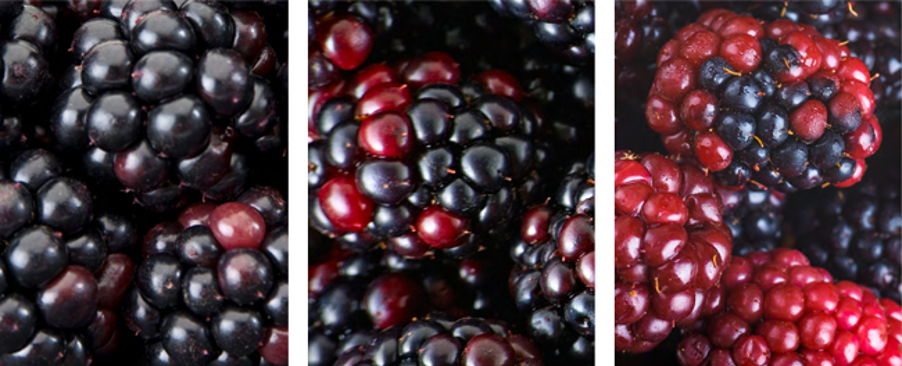
Figure 2: Change in color from black to red due to Red Drupelet Reversion, University of Georgia. (Image credits: https://fieldreport.caes.uga.edu/publications/C1282/blackberry-harvesting-and-postharvest-handling/)
Postharvest Red Drupelet Reversion
Color reversion can also occur in storage and is a major postharvest quality problem in blackberries.
Blackberries can show red drupelet color reversion (RDR) after harvest if they are frozen or cooled. It occurs when fruit temperature exceeds 73°F (or 22.7°C) at harvest before cooling. It can happen when fruit is exposed to full sun, and the fruit flesh warms up easily. The significant temperature drop during cooling or freezing causes cells to shrink and anthocyanin pigment to be lost. Lower fruit pH increases RDR rates. The color reversion can occur during or after cold storage. As a result, berries that are black at harvest can turn red in coolers, making them look unripe and lower quality and leading to consumer rejection; see Figure 2.
Harvesting at cooler times of day and using gradual step cooling can reduce the problem. Fast cooling causes a greater drop in pH and vitamin C, accelerating RDR occurrence, than slower cooling.
Cooling soon after harvest and maintaining a steady temperature of 0–5 °C, RH of 90-95%, and a modified atmosphere of 5–10% oxygen (O2) and 15–20% carbon dioxide (CO2) can reduce RDR and extend shelf life.
Besides temperature, some other factors influencing incidence rates are nitrogen management and genotype. ‘Ouachita’ shows the highest incidence of RDR. ‘Ponca’ shows high RDR levels after 21 days of storage. The cultivars less susceptible to RDR are ‘Caddo’ and ‘Osage’
Mechanical injury and vibration during transport and handling stress can also contribute to RDR incidence.
Leakiness
Beyond increasing RDR, mechanical damage can cause direct and serious quality loss through fruit leakiness.
Blackberries are highly susceptible to mechanical damage during handling and storage because of their thin cuticle, delicate structure, and high water content. Without a rind, even minor bruising can cause severe damage. Fruits can also be compressed and crushed during storage, breaking down internal cell walls, collapsing the fruit, and releasing juice.
Leakiness increases as postharvest temperatures increase, making fruits softer.
Leakiness is a major problem in blackberries and can be avoided by not overfilling clamshell containers and by stacking no more than three layers of fruit.
Additionally, bruising can trigger enzymatic oxidation and accelerate microbial decay.
Fungal Decay
Blackberries are highly susceptible to disease because of their thin cuticle, tendency to bruise, and high respiration rate, though they are less prone to mold than raspberries.
Blackberries are most prone to fungal pathogens that cause fruit rot. The most important pathogen is Botrytis cinerea, which causes Botrytis fruit rot. Soft rot caused by Rhizopus stolonifer and Mucor mucedo can occur at harvest. Anthracnose is another fungus that affects blackberries preharvest, causing sunken, brown drupelets with off-flavors and reducing marketability. Colletotrichum acutatum also causes mold.
Cold storage is essential to control fungal decay. Berries must not rewarm, as this causes condensation on the fruit that encourages fungal growth. Modified atmosphere packaging (MAP) with 15-20% carbon dioxide and 5–10% oxygen can reduce fungal growth.
Management Practices
Postharvest management of temperature, RH, and gas composition in storage rooms and packaging is crucial to ensure blackberries have the ideal environmental conditions to maintain and extend their very short shelf life of 3-5 days. Precision tools that monitor the environmental parameters can ensure the ideal conditions are maintained at all times.
Felix Instruments Applied Food Science supplies fixed and portable tools to monitor the gas composition in rooms and packaging in real time:
- The F-910 AccuStore is a single fixed device that automatically monitors O2 and CO2 gas composition around the clock, along with temperature and RH, and can control the parameters.
- The F-920 Check It! Gas Analyzer is a small, portable device designed for MAP headspace monitoring.
- F-940 Store It! Gas Analyzer and F-950 Three Gas Analyzer are portable devices for monitoring gas composition in rooms and containers during storage and transport.
Contact us to find out more about our gas analyzers for your blackberry supply chain needs.
Sources
Ames, Z. R., Corn, R., & Deltsidis, A. (2025, April 18). Postharvest Quality and Sensory Evaluation of Blackberries. Retrieved from https://smallfruits.org/2025/04/postharvest-quality-and-sensory-evaluation-of-blackberries/
Deltsidis, A., Ames, R.A., & Espinoza, N. (n.d.). Blackberry Harvesting and Postharvest Handling. Retrieved from https://fieldreport.caes.uga.edu/publications/C1282/blackberry-harvesting-and-postharvest-handling/
Fuentes, L., Rivera, S., & Contreras, C. (2026). Potential negative impacts of rising temperatures on fruit ripening and quality in raspberries, blackberries, and blueberries. Scientia Horticulturae, 358, 114692.
Maria J. Paris, Emma Mani-López, Nelly Ramírez-Corona, & Aurelio López-Malo. (2025). Postharvest Mold Growth Control in Raspberries and Blackberries Using Cinnamon Essential Oil-Loaded Alginate Beads. ACS Food Sci. Technol., 5 (1): 127–136. https://doi.org/10.1021/acsfoodscitech.4c00649
Perkins-Veazie, P., & Fernandez, G. (2023, Nov 30). Postharvest Handling and Storage of Blackberries and Raspberries. Retrieved from https://rubus.ces.ncsu.edu/rubus-postharvest-handling-and-storage-of-blackberries-and-raspberies/
Sakaldaş, M., Şen, F., Gundogdu, M., & Aglar, E. (2024). Alterations in quality characteristics and bioactive compounds of blackberry fruits subjected to postharvest salicylic acid treatment during cold storage. Food science & nutrition, 12(11), 9123–9135. https://doi.org/10.1002/fsn3.4490
Sriti, N., Sargent, S., Deng, Z., Williamson, J., & Liu, G. (2025). Postharvest Quality and Shelf Life of Three Thornless Blackberry Cultivars over Two Seasons. Horticulturae, 11(9), 1071. https://doi.org/10.3390/horticulturae11091071
University of Missouri. (2020, July 8). Off-Colored Drupelets on Blackberries. Retrieved fromhttps://ipm.missouri.edu/meg/2020/7/drupeletDisordersBlackberry-MW/
Related Products
- F-751 Grape Quality Meter
- Custom Model Building
- F-910 AccuStore
- F-751 Melon Quality Meter
- F-751 Kiwifruit Quality Meter
- F-750 Produce Quality Meter
- F-751 Avocado Quality Meter
- F-751 Mango Quality Meter
- F-9XXDK Dynamic Sampling Kit
- F-900 Portable Ethylene Analyzer
- F-950 Three Gas Analyzer
- F-920 Check It! Gas Analyzer
- F-960 Ripen It! Gas Analyzer
- F-940 Store It! Gas Analyzer
Most Popular Articles
- Spectrophotometry in 2023
- NIR Applications in Agriculture – Everything…
- The Importance of Food Quality Testing
- The 5 Most Important Parameters in Produce Quality Control
- Melon Fruit: Quality, Production & Physiology
- Fruit Respiration Impact on Fruit Quality
- Guide to Fresh Fruit Quality Control
- Liquid Spectrophotometry & Food Industry Applications
- Ethylene (C2H4) – Ripening, Crops & Agriculture
- Understanding Chemometrics for NIR Spectroscopy
Related Reading