Truth About NIR Light Penetration: Why Fruit Size Affects Accuracy


Scott Trimble

March 10, 2026 at 4:23 pm | Updated March 10, 2026 at 4:23 pm | 4 min read
When people talk about NIR light penetration in produce testing, the conversation usually centers on calibration models and device performance. But fruit size often gets overlooked. In reality, NIR light penetration is directly influenced by fruit diameter, density, and internal structure. If you are using handheld NIR devices in the field or at intake, understanding how fruit size affects readings is critical for accuracy.
This article breaks down how NIR light penetration works, why fruit size matters, and how Felix Instruments designs its meters to deliver reliable results across different commodities.
Understanding NIR Light Penetration in Produce
Near infrared spectroscopy works by directing light into the fruit and measuring the reflected spectra. That reflected signal carries information about dry matter, Brix, firmness proxies, and other internal quality parameters.
Subscribe to receive our monthly round-up of articles.
However, NIR light penetration is limited. Light does not pass through the entire fruit. Instead, it penetrates to a certain depth, interacts with internal tissues, and scatters back to the detector.
Penetration depth depends on several factors:
-
Wavelength range
-
Skin thickness
-
Tissue density
-
Water content
-
Fruit diameter
For most handheld NIR instruments used in horticulture, effective penetration is typically a few millimeters into the flesh. This means the measurement represents a sampling volume rather than the entire fruit interior.
Why Fruit Size Changes the Measurement
Fruit size changes the ratio between the sampled volume and total fruit volume. That shift affects how representative the reading is.
Small Fruit
With small fruit like kiwifruit or grapes, NIR light penetration can sample a larger proportion of the fruit’s internal structure. The signal integrates more of the available tissue relative to total volume. That often leads to strong correlation with destructive lab testing when calibration is well built.
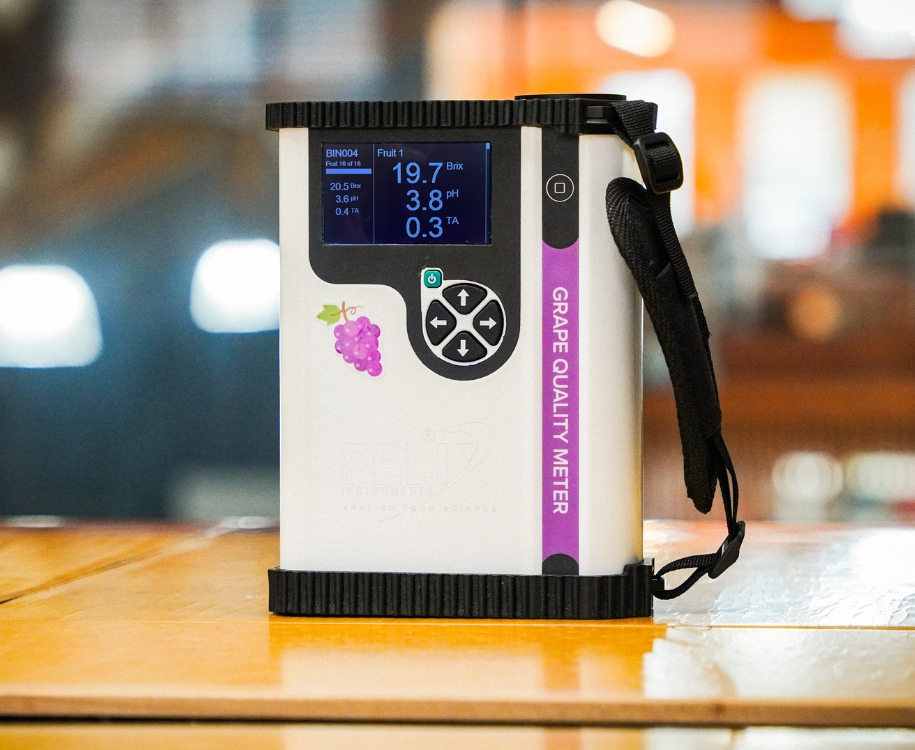
For example, the F-751 Kiwifruit Quality Meter and F-751 Grape Quality Meter are calibrated specifically for those fruit sizes. Their models account for tissue characteristics and typical diameters.
Large Fruit
With larger fruit such as mangoes and avocados, NIR light penetration samples a smaller percentage of the overall fruit volume. Internal variability becomes more significant. Dry matter gradients, seed cavity size, and maturity differences across the fruit can influence readings.
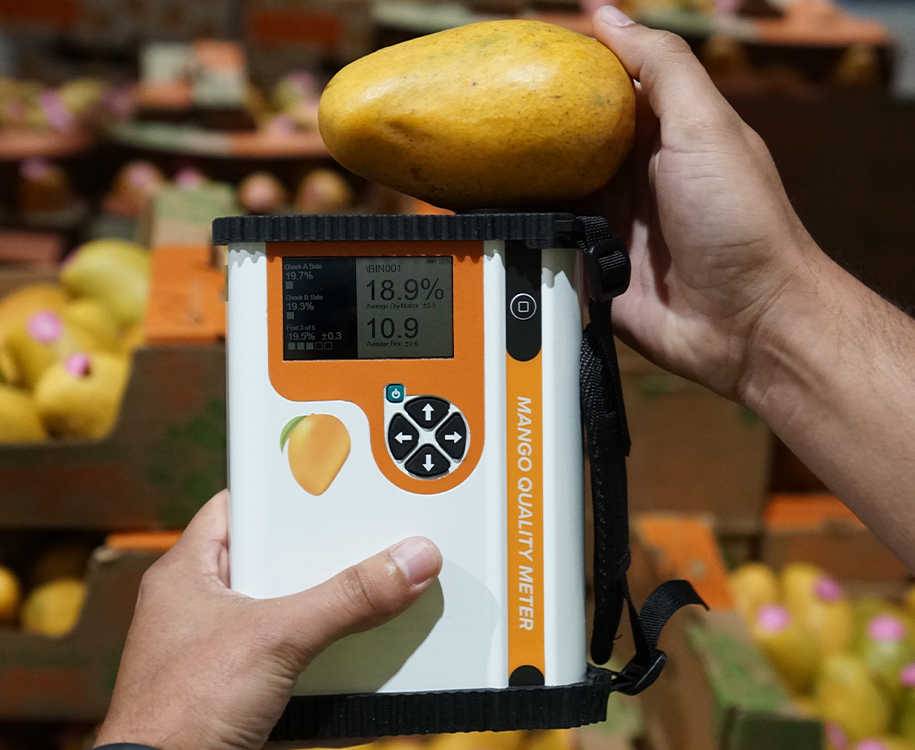
This is where instrument design and calibration strategy matter most. The F-751 Mango Quality Meter and F-751 Avocado Quality Meter are tuned to account for fruit geometry and internal structure, ensuring that the NIR light penetration depth still produces predictive, repeatable results.
How Internal Structure Impacts Light Scattering
Fruit is not uniform. It contains vascular tissue, air spaces, moisture gradients, and varying cell densities. Larger fruit often exhibit more heterogeneity.
NIR light penetration depends heavily on scattering behavior. When light enters dense, uniform tissue, scattering is predictable. When it enters heterogeneous tissue, scattering becomes more complex.
This is one reason why generic NIR devices struggle across commodities. Without commodity-specific calibrations, variations in fruit size and structure introduce error.
Felix Instruments builds commodity-specific models using extensive calibration datasets. Instead of assuming one penetration profile fits all fruit, each meter is optimized for its intended crop.
Comparing Generic NIR vs Commodity-Specific NIR
Generic NIR Devices
-
Broad wavelength coverage
-
Limited crop-specific calibration
-
Often require advanced model building by the user
-
Less optimized for handheld field conditions
Felix Instruments F-750 and F-751 Series
-
Pre-built commodity calibrations
-
Optimized optical geometry for fruit surface measurement
-
Designed for in-field use
-
User-friendly interface with rapid measurement
The F-750 Produce Quality Meter provides flexible multi-commodity capability, while the F-751 series focuses on high-accuracy crop-specific models. When fruit size shifts outside typical ranges, having a calibrated model built around realistic penetration assumptions becomes essential.
The Role of Skin Thickness and Curvature
Fruit curvature affects how NIR light enters and exits the tissue. On smaller fruit with tight curvature, light scatter paths differ compared to flatter surfaces on larger fruit.
Skin thickness also plays a role. Thick-skinned fruit can reduce effective NIR light penetration before the signal even reaches flesh tissue. This is particularly relevant in avocados and some mango cultivars.
Felix Instruments accounts for these factors during calibration development. The instruments are engineered for consistent contact pressure and stable optical positioning, which reduces variability caused by curvature and operator technique.
Best Practices to Improve Accuracy Across Fruit Sizes
If you are working with mixed fruit sizes, there are practical steps to improve reliability:
-
Sample multiple locations on larger fruit
-
Avoid measuring near defects or extreme curvature
-
Use size-appropriate calibration models
-
Maintain consistent contact pressure
-
Periodically validate with destructive lab testing
These steps help compensate for natural variability in NIR light penetration across fruit sizes.
Beyond NIR: Gas Analysis and Fruit Size
While this article focuses on NIR light penetration, fruit size also impacts postharvest gas dynamics. Larger fruit respire differently and may exhibit varied ethylene diffusion rates.
Felix Instruments complements its NIR line with gas analysis solutions including:
By combining internal quality measurements with gas monitoring, users gain a more complete understanding of fruit physiology across size classes. This integrated approach gives Felix Instruments an advantage over competitors that specialize in only one measurement category.
Why Calibration Depth Matters More Than Raw Penetration
Some discussions about NIR light penetration focus on pushing deeper wavelengths to increase depth. In practice, deeper penetration is not always better.
What matters more is:
-
Signal stability
-
Calibration robustness
-
Repeatability across fruit sizes
-
Alignment with destructive reference data
Felix Instruments emphasizes calibration quality over theoretical penetration depth. By developing large, crop-specific datasets, the company ensures that readings reflect real-world variability in fruit size and internal structure.
The result is practical accuracy, not just technical specifications.
Final Thoughts
If you are evaluating handheld NIR systems and want reliable results across different fruit sizes, take a closer look at the F-750 and F-751 series from Felix Instruments. Their crop-specific calibration approach ensures that NIR light penetration translates into practical, repeatable accuracy. Visit Felix Instruments to learn more about how their NIR and gas analysis tools can strengthen your quality control program.
Related Products
Most Popular Articles
- Spectrophotometry in 2023
- NIR Applications in Agriculture – Everything…
- The Importance of Food Quality Testing
- The 5 Most Important Parameters in Produce Quality Control
- Melon Fruit: Quality, Production & Physiology
- Fruit Respiration Impact on Fruit Quality
- Guide to Fresh Fruit Quality Control
- Liquid Spectrophotometry & Food Industry Applications
- Ethylene (C2H4) – Ripening, Crops & Agriculture
- Understanding Chemometrics for NIR Spectroscopy