Truth About Portable Gas Sensors in Cold Storage: Condensation Isn’t Harmless

Scott Trimble

March 10, 2026 at 4:26 pm | Updated March 10, 2026 at 4:26 pm | 5 min read
Cold storage environments are tough on equipment. Anyone who has worked in produce storage rooms, ripening facilities, or distribution centers knows that temperature swings and high humidity are part of the job. Portable gas sensors for cold storage are often treated as rugged tools that can handle it all. But there is one factor that continues to be underestimated: condensation.
Condensation inside a gas analyzer is not harmless. It can affect sensor accuracy, shorten instrument lifespan, and introduce risk into storage and ripening decisions. If you rely on gas measurements to protect product quality, it is worth taking a closer look at what moisture can really do and why instrument design matters.
Why Condensation Forms in Cold Storage?
Cold rooms are designed to maintain low temperatures and often high humidity to reduce moisture loss in produce. When a portable gas analyzer moves between temperature zones, especially from a warmer area into a cold room or vice versa, moisture in the air can condense on internal components.
Subscribe to receive our monthly round-up of articles.
This happens because:
- Warm air holds more moisture than cold air
- Rapid temperature shifts cause water vapor to turn into liquid
- Internal tubing and sensors may be cooler than ambient air
- Sampling humid headspace from bins or rooms adds more moisture
In practical terms, condensation can form inside the sampling lines, pumps, and even on the sensing elements themselves. Over time, this moisture can alter readings or cause damage.
How Condensation Impacts Gas Measurement?
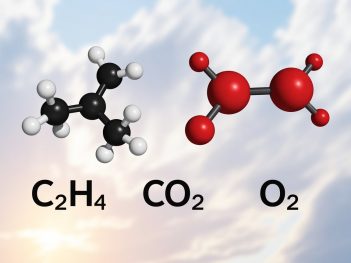
Portable gas sensors for cold storage are typically used to measure oxygen, carbon dioxide, and ethylene. These gases are critical for managing storage atmospheres and ripening programs. When condensation interferes, the consequences are not minor.
Sensor drift and inaccurate readings
Electrochemical and infrared sensors can be sensitive to moisture. Water droplets can temporarily block gas diffusion paths or affect optical components. The result is drift, slower response times, or readings that do not reflect the actual atmosphere.
In controlled atmosphere storage, even small deviations in oxygen or carbon dioxide can impact fruit respiration rates. In ripening rooms, incorrect ethylene readings may lead to uneven color development or delayed ripening.
Corrosion and long term damage
Repeated exposure to moisture can corrode internal metal components and connectors. Over time, this degrades performance and increases maintenance frequency. Instruments that are not specifically designed to handle high humidity often require more frequent service or sensor replacement.
Downtime during critical periods
Harvest and shipping windows are tight. If a portable gas analyzer fails or needs recalibration due to moisture related issues, it can delay decisions that directly affect product quality. For operations handling high value crops, this risk adds up quickly.
What Separates Robust Instruments From the Rest?
Not all portable gas sensors for cold storage are built the same. Some are adapted from laboratory or industrial environments that do not face the same humidity challenges. Others are engineered specifically for postharvest conditions.
Felix Instruments designs its gas analyzers with real storage environments in mind. For example, the F-900 Portable Ethylene Analyzer and the F-950 Three Gas Analyzer are developed for field and storage use where moisture is unavoidable.
F-900 Portable Ethylene Analyzer
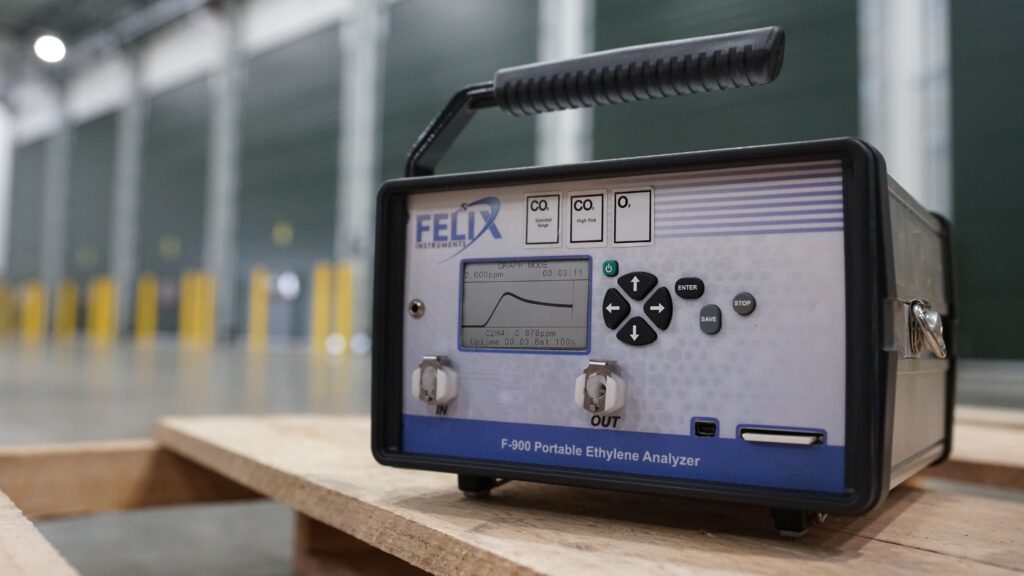
The F-900 Portable Ethylene Analyzer is widely used to measure low level ethylene in storage rooms and ripening facilities. It is designed with:
A robust sampling system
- Internal components selected for humid conditions
- Fast warm up and response times
- Portable form factor for moving between rooms
In cold storage, users often move from ambient areas into chilled rooms. A system that tolerates moisture exposure and recovers quickly is essential for consistent data.
F-950 Three Gas Analyzer
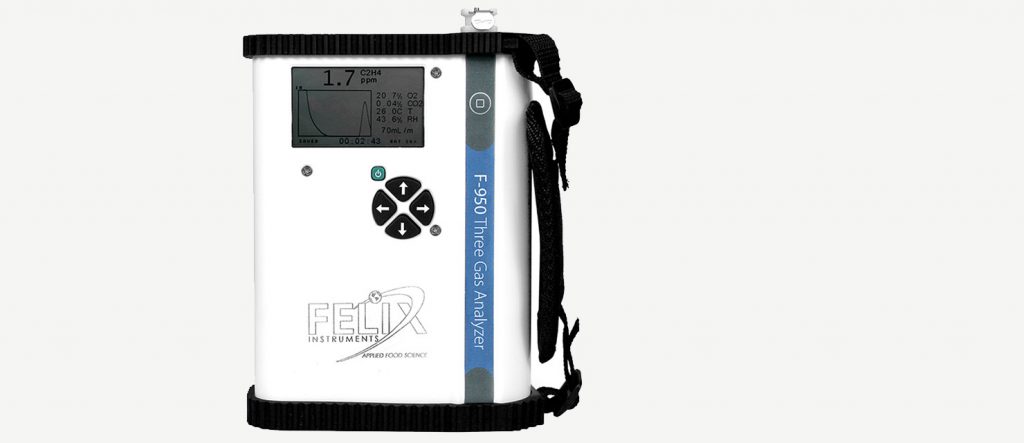
The F-950 Three Gas Analyzer measures ethylene, carbon dioxide, and oxygen in a single handheld unit. For controlled atmosphere storage, this combination is critical. Instead of relying on multiple instruments, operators can verify the full atmosphere profile with one device.
In humid, low temperature environments, having a sealed and well engineered internal flow path reduces the risk of condensation interfering with multiple sensing elements. This integration also simplifies maintenance and calibration.
Design Considerations That Matter in Cold Storage
When evaluating portable gas sensors for cold storage, there are several design elements that directly affect performance in high humidity.
Internal flow path design
Smooth, well sealed tubing and minimized dead volume reduce the chance of moisture accumulation.
Sensor protection
Proper isolation of sensitive components helps prevent direct contact with condensation.
Temperature compensation
Instruments that account for temperature variation are less likely to drift when moving between zones.
Ease of maintenance
Accessible filters and serviceable components make it easier to manage moisture related wear over time.
Felix Instruments has focused on these practical realities because postharvest environments are not controlled laboratories. They are dynamic spaces with forklifts moving, doors opening, and air temperatures shifting constantly.
Practical Steps to Reduce Condensation Risk
Even with well designed equipment, best practices still matter. Operators can take simple steps to protect portable gas sensors for cold storage.
- Allow instruments to equilibrate before sampling
- Use moisture filters where appropriate
- Avoid placing instruments directly on cold, wet surfaces
- Store devices in moderate conditions when not in use
- Follow recommended calibration schedules
These habits, combined with instruments built for humid conditions, reduce unexpected downtime and improve measurement reliability.
Why Accurate Gas Data Is Non Negotiable?
In cold storage, gas composition directly affects respiration, decay, and shelf life. Ethylene management is critical for climacteric fruits. Oxygen and carbon dioxide levels influence metabolic rates and disorder development.
When condensation leads to inaccurate data, decisions are made on flawed information. That can mean:
- Over ventilating a room and increasing energy costs
- Allowing ethylene to accumulate and trigger premature ripening
- Mismanaging controlled atmosphere conditions
- Shipping product at suboptimal maturity
Reliable portable gas sensors for cold storage are not just diagnostic tools. They are decision tools. Their performance affects product quality, profitability, and brand reputation.
Felix Instruments: Built for Real Storage Conditions
Felix Instruments has established a reputation in postharvest measurement by focusing on the specific challenges of produce storage and ripening. Rather than adapting general purpose sensors, the company develops instruments around real workflows in cold rooms and packing facilities.
From single gas measurement with the F-900 to multi gas monitoring with the F-950, these analyzers are engineered for portability, durability, and consistent performance in humid, low temperature settings.
If condensation has been an ongoing frustration with your current equipment, it may be time to evaluate whether your instrument was truly designed for cold storage in the first place.
Ending Note
If you rely on portable gas sensors for cold storage and want reliable performance in humid, low temperature environments, connect with Felix Instruments. Our team can help you choose the right analyzer for your application and explain how our designs address condensation and moisture challenges. Visit felixinstruments.com to learn more or request a quote.
Related Products
- F-751 Grape Quality Meter
- Custom Model Building
- F-910 AccuStore
- F-751 Melon Quality Meter
- F-751 Kiwifruit Quality Meter
- F-750 Produce Quality Meter
- F-751 Avocado Quality Meter
- F-751 Mango Quality Meter
- F-9XXDK Dynamic Sampling Kit
- F-900 Portable Ethylene Analyzer
- F-950 Three Gas Analyzer
- F-920 Check It! Gas Analyzer
- F-960 Ripen It! Gas Analyzer
- F-940 Store It! Gas Analyzer
Most Popular Articles
- Spectrophotometry in 2023
- NIR Applications in Agriculture – Everything…
- The Importance of Food Quality Testing
- The 5 Most Important Parameters in Produce Quality Control
- Melon Fruit: Quality, Production & Physiology
- Fruit Respiration Impact on Fruit Quality
- Guide to Fresh Fruit Quality Control
- Liquid Spectrophotometry & Food Industry Applications
- Ethylene (C2H4) – Ripening, Crops & Agriculture
- Understanding Chemometrics for NIR Spectroscopy