NIR Dry Matter Testing for Mango Export Readiness with the F-751 Mango Meter


Scott Trimble

February 5, 2026 at 9:30 pm | Updated February 5, 2026 at 9:30 pm | 5 min read
NIR dry matter testing has become a practical standard for evaluating mango export readiness, especially in supply chains where consistency and eating quality matter as much as yield. For exporters, dry matter is a reliable indicator of maturity that correlates closely with flavor, texture, and consumer satisfaction.
Using a handheld solution like the F-751 Mango Meter allows teams to make fast, non-destructive decisions in the field, at the packing line, or before shipment without relying on lab-based methods.
Why Dry Matter Matters for Mango Exports?

Dry matter has become a preferred metric for mango maturity because it reflects the internal development of the fruit rather than external appearance. Skin color, size, and firmness can vary widely by variety and growing conditions.
Subscribe to receive our monthly round-up of articles.
Dry matter provides a more stable benchmark across regions and seasons.
Export programs often set minimum dry matter thresholds to reduce the risk of immature fruit reaching consumers. Mangoes harvested too early may soften during transit but still lack flavor. This is one of the most common causes of poor eating quality in export markets.
Dry matter testing helps exporters:
-
Align harvest timing with market requirements
-
Reduce claims and rejections downstream
-
Improve consistency across growers and blocks
-
Support data-driven maturity standards
Traditional dry matter measurement requires destructive sampling, drying ovens, and time. That approach limits sample size and slows decisions. This is where NIR dry matter testing changes the workflow.
How NIR Dry Matter Testing Works in Practice
Near-infrared spectroscopy measures how light interacts with the internal structure of the fruit. In mangoes, NIR signals correlate strongly with dry matter content once the instrument is properly calibrated for the crop and variety.
With handheld NIR devices, the operator places the sensor against the mango surface and takes a reading in seconds. The fruit remains intact and can continue through the supply chain. This allows for much larger sample sizes and more representative data.
For export operations, this means maturity decisions can be made:
-
Directly in the orchard before harvest
-
At intake during grower deliveries
-
On the packing line for lot verification
-
Prior to container loading
NIR dry matter testing turns maturity assessment into a routine check rather than a bottleneck.
The F-751 Mango Meter and Its Role in Export Readiness
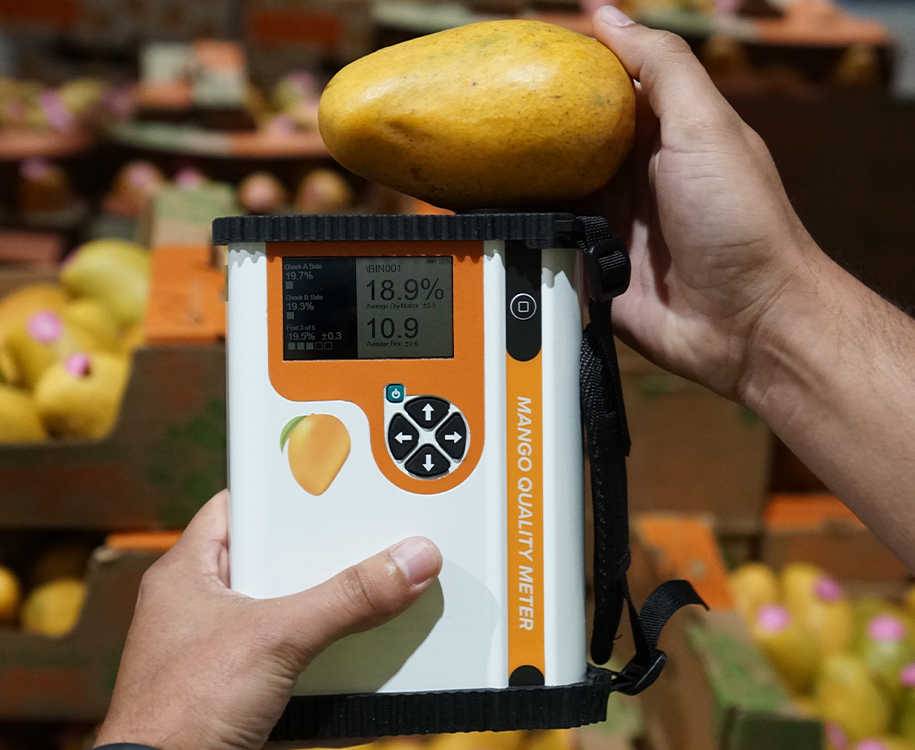
The F-751 Mango Meter is designed specifically for non-destructive dry matter testing in mangoes using NIR technology. It is handheld, battery powered, and built for daily use in commercial environments.
Unlike general-purpose spectrometers, the F-751 Mango Meter uses mango-specific calibrations developed from extensive datasets. This reduces the setup time and uncertainty that often come with generic NIR tools.
Key characteristics that matter for exporters include:
-
Non-destructive measurements that preserve saleable fruit
-
Rapid readings that support high-throughput sampling
-
Crop-specific calibration for mango dry matter
-
Portability for use across orchards and facilities
Because measurements are fast, quality teams can test more fruit per lot. That leads to better confidence in maturity decisions and fewer surprises at destination.
Advantages Over Destructive Dry Matter Methods
Many export programs still rely on destructive sampling as a reference method. While accurate, it is slow and limited in scale. NIR dry matter testing with the F-751 Mango Meter complements and, in many workflows, replaces routine destructive testing.
Compared to oven-based dry matter analysis, NIR offers:
-
Immediate results instead of hours or days
-
Larger and more representative sample sizes
-
No loss of marketable fruit
-
Lower labor requirements per test
This efficiency becomes especially important during peak harvest windows when decisions must be made quickly. Exporters can verify maturity thresholds without delaying harvest or packing schedules.
Supporting Consistency Across Varieties and Regions
Mango export programs often source fruit from multiple orchards, regions, or even countries. Variability in climate, irrigation, and management practices makes visual maturity assessment unreliable.
NIR dry matter testing provides a common language across the supply chain. By using the same instrument and standards, teams can compare fruit objectively regardless of origin.
This consistency helps:
-
Standardize grower acceptance criteria
-
Reduce disputes over maturity assessments
-
Train new staff more effectively
-
Document compliance with export protocols
For companies managing complex supply networks, this level of alignment is difficult to achieve with subjective methods alone.
Integrating NIR Testing Into Export Workflows
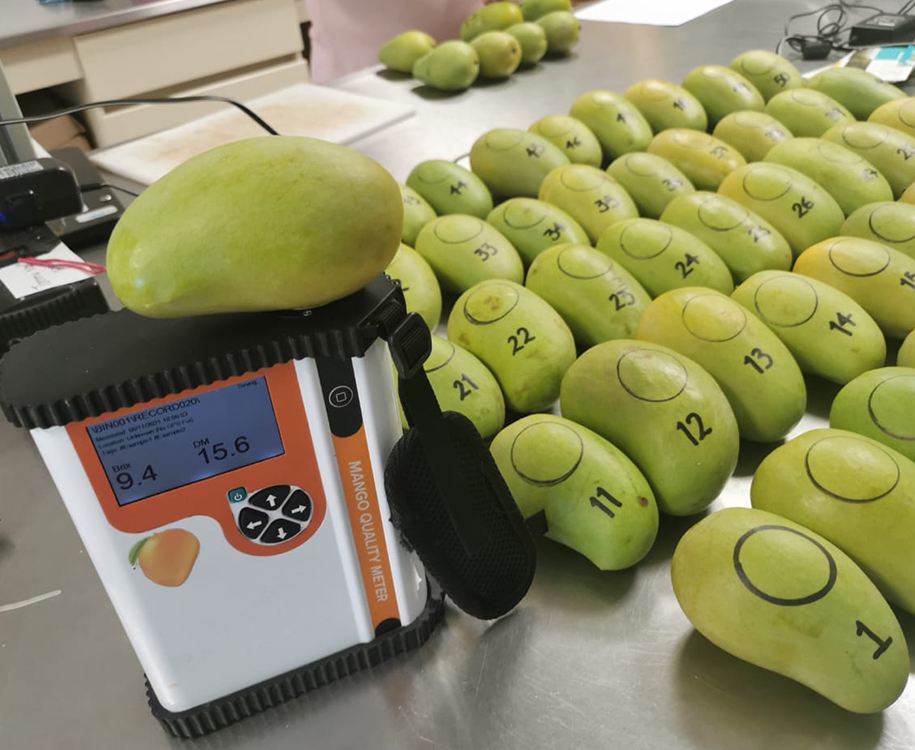
The F-751 Mango Meter fits easily into existing quality control programs. Most users begin by validating readings against their current destructive tests, then gradually expand NIR use as confidence grows.
Common integration points include:
-
Pre-harvest maturity surveys to schedule picking
-
Receiving inspections to verify grower compliance
-
In-process checks during packing
-
Pre-shipment verification for export documentation
Because the fruit remains intact, NIR testing does not disrupt throughput. Quality teams can test more frequently without slowing operations.
Data-Driven Decisions for Export Confidence
One of the less visible benefits of NIR dry matter testing is the data it generates. Over time, exporters build a maturity dataset that links dry matter at harvest with arrival quality and customer feedback.
This feedback loop supports continuous improvement. Harvest thresholds can be adjusted, growers can be coached, and risk can be managed more proactively.
Rather than reacting to quality issues after arrival, exporters using NIR dry matter testing are better positioned to prevent them.
Why Exporters Choose Felix Instruments
Export-focused quality tools need to be reliable, practical, and well supported. Felix Instruments has built a strong reputation in postharvest and field-based quality measurement by focusing on applied solutions rather than lab-only systems.
The F-751 Mango Meter reflects that approach. It is designed for real-world conditions, not controlled environments. For exporters, that translates to fewer compromises between accuracy and usability.
Many teams also value having a single vendor that understands horticultural workflows and provides instruments tailored to specific crops rather than generic platforms.
The Bottom Line
NIR dry matter testing is no longer an experimental tool for mango exporters. It is a proven method for improving harvest timing, reducing quality risk, and delivering more consistent fruit to market.
The F-751 Mango Meter makes this technology accessible in a handheld format that fits seamlessly into export operations.
For companies serious about mango export readiness, investing in non-destructive maturity assessment is a practical step forward. To learn more about implementing NIR dry matter testing in your mango program, contact Felix Instruments and explore how the F-751 Mango Meter can support your quality goals.
Related Products
- F-751 Grape Quality Meter
- Custom Model Building
- F-910 AccuStore
- F-751 Melon Quality Meter
- F-751 Kiwifruit Quality Meter
- F-750 Produce Quality Meter
- F-751 Avocado Quality Meter
- F-751 Mango Quality Meter
- F-9XXDK Dynamic Sampling Kit
- F-900 Portable Ethylene Analyzer
- F-950 Three Gas Analyzer
- F-920 Check It! Gas Analyzer
- F-960 Ripen It! Gas Analyzer
- F-940 Store It! Gas Analyzer
Most Popular Articles
- Spectrophotometry in 2023
- NIR Applications in Agriculture – Everything…
- The Importance of Food Quality Testing
- The 5 Most Important Parameters in Produce Quality Control
- Melon Fruit: Quality, Production & Physiology
- Fruit Respiration Impact on Fruit Quality
- Guide to Fresh Fruit Quality Control
- Liquid Spectrophotometry & Food Industry Applications
- Ethylene (C2H4) – Ripening, Crops & Agriculture
- Understanding Chemometrics for NIR Spectroscopy