The Essential Features of a Produce Quality Meter for Export Programs

Scott Trimble

February 5, 2026 at 11:06 pm | Updated February 5, 2026 at 11:06 pm | 5 min read
Export programs live and die by consistency. Once fruit leaves its country of origin, there are limited opportunities to intervene. A produce quality meter gives exporters a way to measure internal quality before that fruit ever reaches a container.
For operations shipping to demanding markets, the quality meter has become a practical necessity rather than a nice-to-have tool.
This article breaks down the essential features export programs should expect from a produce quality meter and why these features matter in real-world export workflows.
Subscribe to receive our monthly round-up of articles.
Why Export Programs Need Objective Quality Data
Export fruit must perform over weeks of storage, transport, and distribution. External appearance rarely tells the full story. Internal metrics like dry matter, Brix, and maturity indices are often better predictors of eating quality and shelf life.
A produce quality meter allows exporters to:
-
Set harvest thresholds based on measurable maturity
-
Sort fruit for different destination markets
-
Verify grower compliance with export specifications
-
Reduce claims related to poor eating quality
-
Build confidence with overseas buyers
Without objective measurements, decisions are based on averages and assumptions. A handheld produce meter replaces guesswork with repeatable data that can be shared across teams.
Non-Destructive Measurement Is Non-Negotiable
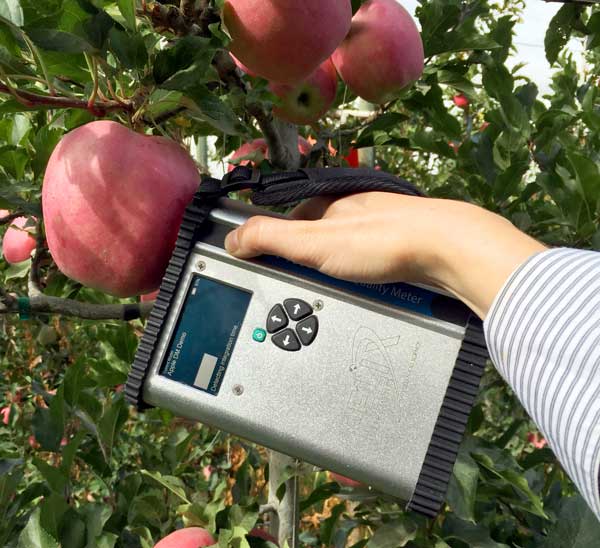
One of the most important features of a produce meter for export programs is non-destructive testing.
Export volumes are large, and destructive sampling quickly becomes expensive and slow. Cutting fruit also introduces bias, since samples are rarely representative of entire lots.
Non-destructive measurement allows operators to test more fruit across more blocks and more days. This leads to better decision-making and tighter quality control. In practice, it means fruit tested in the field or packinghouse can still be shipped.
A quality meter that relies on near-infrared technology is especially valuable here. It allows rapid scanning without damaging the product, which aligns with the speed and scale required for export operations.
Crop-Specific Calibration and Accuracy
Accuracy is meaningless if it is not relevant to the crop being tested. Export programs often handle multiple commodities, each with different quality metrics and acceptance criteria.
An effective produce quality meter should offer:
-
Crop-specific calibrations
-
Support for multiple varieties within a crop
-
Metrics that align with export specifications
For example, avocado exporters often rely on dry matter as a proxy for maturity. Kiwi exporters may prioritize Brix and firmness relationships. Mango and grape exporters track different internal attributes entirely. A quality meter must reflect these realities.
Generic devices that promise universal measurements often fall short in export settings. Exporters need tools built around the crops they ship, not broad approximations.
Speed and Ease of Use in the Field
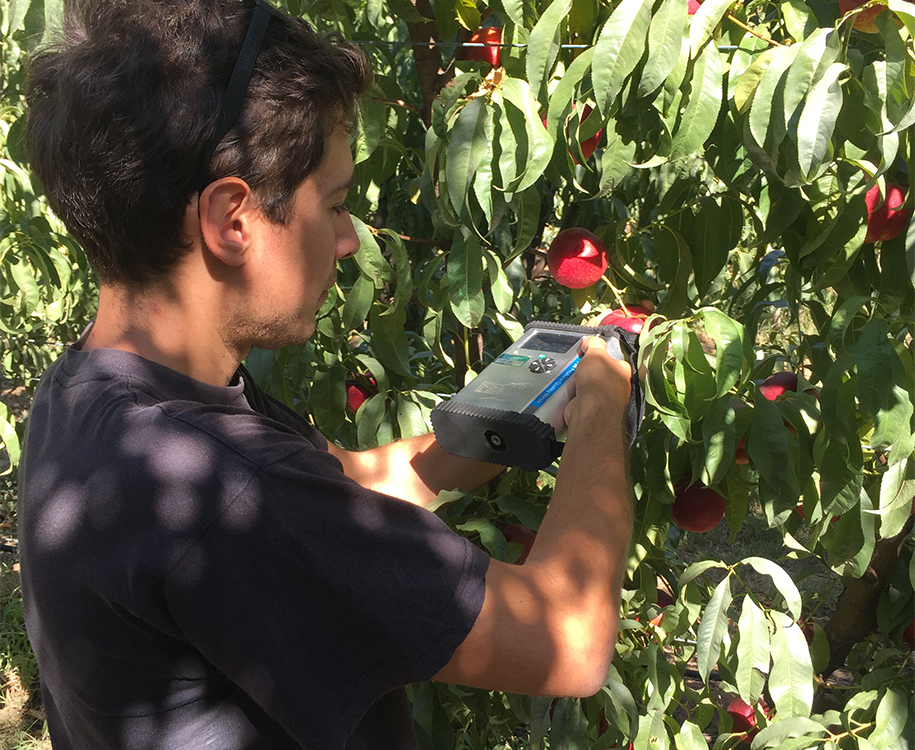
Export decisions are often made under time pressure. Harvest windows are tight, and shipping schedules leave little room for delays. A produce quality meter must be fast enough to keep up with operational demands.
Key usability features include:
-
Rapid scan times per fruit
-
Simple menus and workflows
-
Minimal training requirements
-
Clear numerical outputs
If a produce meter slows down harvest crews or packinghouse lines, it will not be used consistently. Ease of use directly affects data quality because frustrated users test less fruit.
Handheld form factors matter here. Export programs benefit from meters that can move easily between orchard, packinghouse, and cold storage environments.
Data Logging and Traceability
Export programs increasingly operate under strict traceability requirements. Buyers want proof that quality standards were met, not just assurances. A modern produce quality meter should support data logging that ties measurements to specific lots, dates, and locations.
Useful data features include:
-
On-device storage of test results
-
Exportable data files
-
Compatibility with spreadsheets or quality systems
-
Lot-based organization of readings
This data becomes valuable beyond the immediate export decision. Over time, it helps exporters refine harvest timing, evaluate grower performance, and defend against quality claims.
A produce meter that treats data as an afterthought limits its long-term value.
Durability for Agricultural Environments
Export programs operate in environments that are hard on equipment. Dust, moisture, temperature swings, and rough handling are common. A produce quality meter must be built for these conditions.
Durability considerations include:
-
Rugged housing
-
Stable calibration over time
-
Reliable performance in field conditions
-
Long battery life
Exporters cannot afford downtime during peak harvest. Devices that require frequent recalibration or delicate handling add operational risk.
A well-designed produce quality meter should feel like an agricultural tool, not a lab instrument.
Flexibility Across the Export Chain
Export quality decisions do not happen in one place. They happen in orchards, at intake, during packing, and sometimes before shipment. A produce quality meter should support this flexibility.
This means:
-
Consistent measurements across locations
-
Portability between teams
-
Repeatability over time
When multiple people use the same produce quality meter model across the export chain, communication improves. Everyone speaks the same language of quality, backed by numbers rather than opinions.
Supporting Market Differentiation
Not all export markets are equal. Some destinations demand premium eating quality, while others prioritize shelf life or cosmetic appearance. A produce meter allows exporters to segment fruit intelligently.
With internal quality data, exporters can:
-
Allocate higher quality fruit to premium markets
-
Adjust storage strategies by maturity level
-
Reduce over-ripening at destination
This level of control protects brand reputation and strengthens relationships with overseas buyers. Over time, consistent quality becomes a competitive advantage.
Training and Support Matter More Than Features Alone
Even the best produce quality meter fails if users do not trust it. Export programs benefit from suppliers that provide training, calibration support, and application-specific guidance.
Look for providers that understand export workflows, not just hardware specifications. A produce quality meter should come with support that helps teams interpret data and apply it to real decisions.
Conclusion: Choosing the Right Produce Quality Meter for Export Success
A produce quality meter is no longer optional for serious export programs. It is a core tool for managing risk, improving consistency, and meeting buyer expectations. The essential features are clear: non-destructive testing, crop-specific accuracy, speed, durability, and meaningful data management.
Exporters who invest in the right produce meter gain more than numbers. They gain confidence in their decisions and credibility with their customers.
If your export program is looking to strengthen quality control and reduce uncertainty, consider working with Felix Instruments. Our produce quality meters are designed specifically for agricultural and export environments, with proven performance across key export crops.
Reach out to Felix Instruments to see how objective quality data can support your export strategy from harvest to destination.
Related Products
- F-751 Grape Quality Meter
- Custom Model Building
- F-910 AccuStore
- F-751 Melon Quality Meter
- F-751 Kiwifruit Quality Meter
- F-750 Produce Quality Meter
- F-751 Avocado Quality Meter
- F-751 Mango Quality Meter
- F-9XXDK Dynamic Sampling Kit
- F-900 Portable Ethylene Analyzer
- F-950 Three Gas Analyzer
- F-920 Check It! Gas Analyzer
- F-960 Ripen It! Gas Analyzer
- F-940 Store It! Gas Analyzer
Most Popular Articles
- Spectrophotometry in 2023
- NIR Applications in Agriculture – Everything…
- The Importance of Food Quality Testing
- The 5 Most Important Parameters in Produce Quality Control
- Melon Fruit: Quality, Production & Physiology
- Fruit Respiration Impact on Fruit Quality
- Guide to Fresh Fruit Quality Control
- Liquid Spectrophotometry & Food Industry Applications
- Ethylene (C2H4) – Ripening, Crops & Agriculture
- Understanding Chemometrics for NIR Spectroscopy