F-751 Series vs Sunforest: Predictive Power vs Processing Convenience

Scott Trimble

December 3, 2025 at 12:16 am | Updated December 3, 2025 at 12:16 am | 5 min read
When teams evaluate handheld NIR tools for fruit maturity assessment, two priorities tend to rise above the rest: predictive power and processing convenience.
The Felix Instruments F-751 series focuses on deep, crop-specific predictive models designed to deliver stable internal-quality estimates. Sunforest’s H-100 series emphasizes multi-fruit versatility and general convenience across orchard and supply-chain tasks.
Both approaches solve different needs, but they create meaningful differences in how users experience accuracy, workflow speed, and long-term calibration management.
Subscribe to the Felix instruments Weekly article series.
By submitting this form, you are consenting to receive marketing emails from: . You can revoke your consent to receive emails at any time by using the SafeUnsubscribe® link, found at the bottom of every email. Emails are serviced by Constant Contact
This article compares the predictive power of the Felix F-751 series with the processing convenience of Sunforest’s H-100 platform.
Understanding Predictive Power in NIR Fruit Assessment
Predictive power refers to the ability of an NIR model to accurately estimate internal quality parameters like dry matter, Brix, or physiological maturity. Strong predictive power is tied to several technical factors:
-
Quality and diversity of calibration datasets
-
Crop-specific spectral modeling
-
Control over model drift across seasons
-
Consistency of readings under varied field conditions
When an instrument is engineered around predictive power, it often uses calibrations tailored to a specific fruit species. This reduces noise, removes irrelevant spectral variance, and makes the model easier to maintain.
Processing convenience, on the other hand, focuses on the operational aspects. A device designed for convenience may cover multiple fruit types, streamline basic measurements, and reduce device switching. The tradeoff is that broad coverage can affect calibration depth and cross-species precision.
The F-751 Series: Predictive Power Through Crop-Specific Design

Felix Instruments built the F-751 series around the idea that the highest predictive power comes from dedicated, fruit-specific calibration models. Each device in the series targets one crop:
This structural choice influences how the instruments perform in real maturity prediction.
Crop-specific calibration architecture
The F-751 models ship with calibrations tailored to their respective crops. Because each calibration focuses on a single species, the model does not need to account for cross-fruit spectral differences. This typically results in stronger predictive power since spectral absorption patterns vary widely between fruit types.
Deep and diverse calibration datasets
Felix calibration sets are built using large sample libraries collected across regions and growing seasons. This is a major contributor to stability. It allows predictive power to carry across orchards that differ in climate or soil chemistry.
Stable performance across environments
Predictive models that rely on broad and well-structured calibration data tend to maintain accuracy when used in new locations. Users working in different regions or on different varieties often find that F-751 predictions remain consistent without constant recalibration.
Built-in calibration update workflow
Because the F-751 series supports modular calibration loading, users can improve predictive power over time. Felix periodically releases updated calibrations, and users can install them through firmware. This makes it easier to adapt to new varieties or harvest conditions.
Strong single-crop focus
By limiting each device to one crop, the F-751 series becomes a tool optimized for accuracy first. It is designed for users who need highly reliable predictions for a specific fruit and are willing to use different tools across crops.
The result is a system that maximizes predictive power at the expense of multi-fruit convenience.
Sunforest H-100 Series: Processing Convenience and Multi-Crop Capability
Sunforest takes a different approach. The company describes the H-100 series as a set of non-destructive fruit-quality meters used across orchards, packing, and inspection workflows. The product page lists both multi-fruit and crop-specific options:
This mix shows that Sunforest aims for processing convenience, giving users flexibility to work across many fruit types or choose a focused tool when needed.
Multi-fruit convenience
The H-100F is marketed as a universal fruit-quality meter. Users can select different fruit types within a single device, which removes the need to carry or maintain multiple instruments. For field teams that jump between crops frequently, this is a clear operational advantage.
Broad application coverage
The H-100 series is used in:
-
Orchard harvest management
-
Packing-house quality control
-
General fruit inspection
-
Multi-fruit field monitoring
This indicates a design optimized for ease of movement between tasks, not calibration depth for one specific crop.
Multi-crop calibration implications
General NIR modeling principles show that multi-fruit models often require broader algorithms that account for many fruit types. While this supports convenience, it can reduce predictive power compared to single-crop calibrations.
Simplicity in field processing
Sunforest meters are positioned as easy-to-use devices that provide quick checks of Brix, dry matter, color, and other quality metrics. The interface and fruit-selection workflow favor fast processing rather than deep calibration customization.
Single-crop versions exist, but documentation is limited
Sunforest offers crop-specific versions like the H-100C and H-100K, but available information does not describe the differences between these and the multi-fruit model from a calibration standpoint. Because of this, users evaluating predictive power must rely on field experience rather than published technical documentation.
The net effect is a tool designed primarily for convenience, coverage, and workflow speed.
Predictive Power vs Processing Convenience: What Users Can Expect
Comparing the two product lines reveals the underlying tradeoff between predictive power and processing convenience.
Where Felix excels
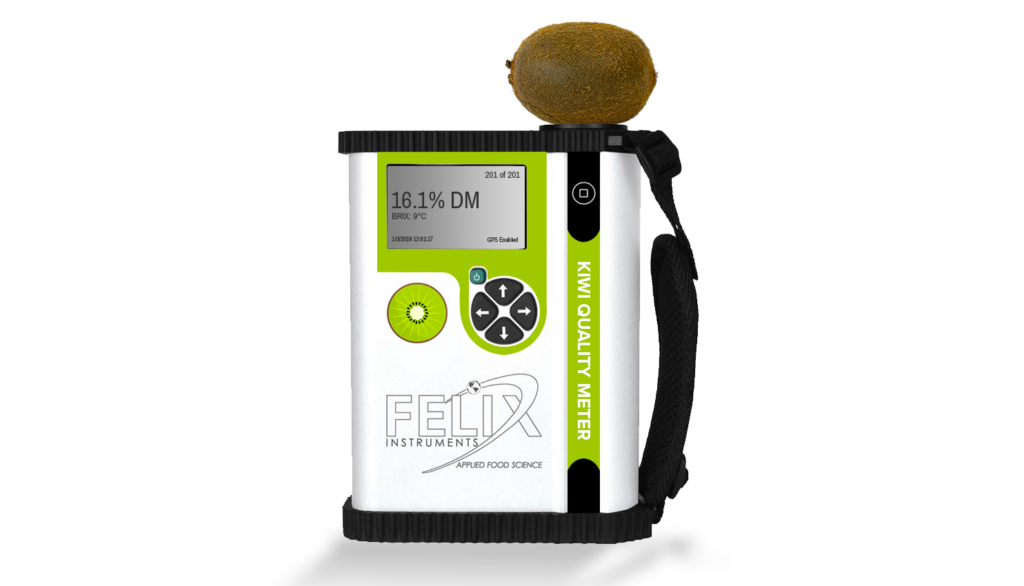
Felix leads in predictive power due to:
-
Crop-specific calibrations
-
Well-developed internal datasets
-
Calibration updates supported by the manufacturer
-
Strong consistency across production regions
-
Reduced cross-fruit spectral noise
Users who prioritize accuracy, especially for dry matter prediction, generally benefit from this design.
Where Sunforest excels
Sunforest leads in processing convenience:
-
One device covers many fruit types
-
Fewer tools are needed for mixed-fruit operations
-
Quick selection and scanning workflow
-
Broad orchard and packing applications
This makes Sunforest appealing for teams that monitor many crops in rapid succession.
Choosing Based on Operational Needs
When evaluating the F-751 series against the Sunforest H-100 platform, the main deciding factors point strongly toward the value of predictive power. For operations where internal quality measurement drives harvest timing, storage decisions, or QC protocols, the benefits of the F-751 series become difficult to overlook.
-
How important is predictive power for your specific crop?
For growers or QC teams who rely on accurate dry matter or Brix predictions, the F-751 series provides clear advantages. Its crop-specific calibrations are developed with deep datasets and ongoing support, which typically results in stronger and more stable predictive power than a multi-fruit device can offer. -
Do you work across many fruit types in short time windows?
While the Sunforest H-100F offers the convenience of scanning different fruits within a single unit, convenience does not replace accuracy when internal quality numbers influence commercial decisions. Many users find that carrying separate F-751 units for key crops provides more dependable results, which ultimately supports better decision making even if it means switching devices. -
Do you need calibration updates, transparency, or custom model support?
Felix documents its calibration update process and provides structured support for building or refining models. This helps users maintain strong predictive power season after season.
In practice, users who prioritize measurement precision, data consistency, and long-term calibration stability tend to favor the F-751 series. Convenience has its place, but when internal quality measurements translate directly into crop value and timing decisions, predictive power carries more weight.
Related Products
Most Popular Articles
- Spectrophotometry in 2023
- The Importance of Food Quality Testing
- NIR Applications in Agriculture – Everything…
- The 5 Most Important Parameters in Produce Quality Control
- Melon Fruit: Quality, Production & Physiology
- Fruit Respiration Impact on Fruit Quality
- Guide to Fresh Fruit Quality Control
- Liquid Spectrophotometry & Food Industry Applications
- Ethylene (C2H4) – Ripening, Crops & Agriculture
- Active Packaging: What it is and why it’s important
Related Reading