Which NIR Device Wins on ROI? Comparing Felix F-751, Rubens Technologies, and Sunforest for Packinghouses

Scott Trimble

February 5, 2026 at 11:40 pm | Updated February 5, 2026 at 11:40 pm | 5 min read
For modern packinghouses, ROI on NIR devices is no longer a theoretical discussion. Near-infrared spectroscopy has become a practical tool for improving quality consistency, reducing waste, and making faster decisions across harvest, packing, and shipping.
When managers evaluate ROI on NIR systems, they look beyond the initial purchase price and focus on accuracy, repeatability, calibration stability, labor efficiency, and long-term operational value.
In this comparison, we look at three commonly discussed NIR solutions used for produce quality assessment: the Felix F-751 series, handheld devices from Rubens Technologies, and portable NIR systems from Sunforest.
Subscribe to the Felix instruments Weekly article series.
By submitting this form, you are consenting to receive marketing emails from: . You can revoke your consent to receive emails at any time by using the SafeUnsubscribe® link, found at the bottom of every email. Emails are serviced by Constant Contact
Each approach reflects a different philosophy toward non-destructive quality measurement, and each has implications for ROI inside a packinghouse environment.
Understanding ROI on NIR in Packinghouses
Return on investment for NIR technology comes from several measurable areas:
-
Improved grading accuracy and fewer quality claims
-
Reduced destructive testing and lab costs
-
Faster decision making on harvest timing and pack-out
-
Better alignment with customer specifications
-
Lower labor requirements per quality check
A device that looks inexpensive upfront can become costly if it requires frequent recalibration, produces inconsistent data, or slows down operations. Likewise, a higher-priced instrument can pay for itself quickly if it consistently improves pack-out decisions and reduces downstream losses.
Felix F-751 Series Overview
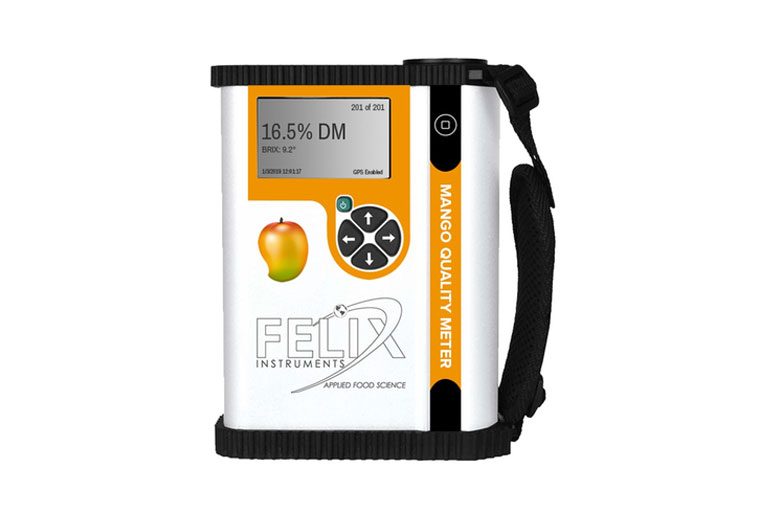
The Felix F-751 series is designed around crop-specific NIR analysis. Instead of offering one generalized model for many fruits, each F-751 unit is built and calibrated for a single commodity such as avocado, kiwi, mango, or grapes. This design choice directly impacts ROI on NIR by prioritizing predictive accuracy over broad flexibility.
Because each instrument focuses on one crop, the calibration models are deeper and more refined.
Packinghouses using the F-751 rely on it to predict internal quality attributes such as dry matter or sweetness that are directly tied to eating quality and market readiness. These metrics influence harvest timing, storage decisions, and grade assignments.
From an operational standpoint, the F-751 integrates cleanly into quality control workflows. Operators do not need to manage multiple crop profiles or switch complex settings. The result is consistent data that can be trusted across shifts, seasons, and production regions.
Rubens Technologies Handheld NIR Approach
Rubens Technologies offers a handheld spectral scanning device built around portability and rapid feedback. The system combines visible, fluorescence, and near-infrared sensing with software-based analytics to estimate quality parameters such as sugar content, firmness, and maturity.
From an ROI on NIR perspective, the appeal lies in speed and convenience. Operators can take measurements quickly in the field or at intake without destructive sampling. The handheld design reduces physical footprint and can support decentralized quality checks.
However, this approach introduces tradeoffs. Calibration models must accommodate multiple crops and growing conditions within a single framework. While this flexibility is attractive, it can also introduce variability in predictive performance. For packinghouses that require tight thresholds and repeatable grading outcomes, this variability can affect confidence in the data.
Rubens’ solution may fit best in operations that value rapid assessments and early-stage decision support rather than deep, crop-specific prediction accuracy.
Sunforest Portable NIR Systems
Sunforest develops portable NIR spectrometers aimed at both orchard and post-harvest use. These devices are positioned as multi-crop tools capable of assessing internal attributes like Brix, dry matter, moisture, and color development without damaging fruit.
From an ROI standpoint, Sunforest devices provide versatility. A single unit can support multiple commodities, which can be attractive for packinghouses handling diverse product lines. This reduces the need for multiple instruments and can simplify equipment procurement.
The tradeoff, again, lies in calibration depth. Multi-crop models must balance accuracy across different fruits, which may limit precision compared to single-crop systems.
For applications where relative trends are sufficient, such as maturity tracking or intake screening, this approach can deliver solid value. For high-stakes grading decisions tied directly to pricing, some operations may require tighter prediction margins.
Comparing ROI Drivers Side by Side
When comparing these devices through an ROI on NIR lens, several themes emerge.
Accuracy and Consistency

Felix F-751 stands out for crop-specific accuracy and repeatability. Sunforest offers good general accuracy across crops, while Rubens emphasizes speed and accessibility with broader model coverage.
Workflow Efficiency
All three systems aim to reduce destructive testing. Felix integrates well into structured quality programs. Rubens favors rapid field use and mobile workflows. Sunforest supports flexible deployment across orchard and packinghouse environments.
Calibration and Long-Term Reliability
Felix’s focused calibration strategy simplifies long-term maintenance and helps protect ROI over multiple seasons. Sunforest balances calibration across crops, which can require more oversight. Rubens continues to build out its calibration ecosystem, which may require closer attention during adoption.
Total Cost of Ownership
Upfront cost is only part of the equation. Devices that reduce rework, claims, and rejected shipments often deliver the strongest ROI. In that context, consistent predictive performance can outweigh initial savings.
Which NIR Device Delivers the Best ROI?
There is no single answer for every operation, but patterns are clear. Packinghouses that depend on precise internal quality metrics to make harvest, storage, and grading decisions tend to benefit most from crop-specific NIR systems. In these environments, the Felix F-751 series often delivers the strongest ROI on NIR because its data directly supports decisions that protect brand reputation and customer satisfaction.
Operations that value flexibility across crops or early-stage maturity screening may find Sunforest’s approach cost-effective. Rubens Technologies offers an innovative, portable option that may appeal to teams focused on rapid assessments and mobile data collection.
Ultimately, ROI on NIR improves when the instrument aligns closely with how quality decisions are actually made on the floor.
The Bottom Line
For packinghouses focused on long-term returns, reliable data is the foundation of ROI on NIR investments. Devices that consistently predict internal quality, reduce uncertainty, and support confident decisions tend to pay for themselves quickly.
If your operation depends on accurate, crop-specific quality insights that translate directly into better pack-out, fewer claims, and stronger customer relationships, the Felix F-751 series deserves serious consideration.
To learn how it can fit into your quality program and deliver measurable ROI, reach out to Felix Instruments for a personalized demonstration and ROI discussion.
Frequently Asked Questions
How Long Does It Take for an NIR Device to Pay for Itself in a Packinghouse?
ROI timelines vary, but many packinghouses see payback within one to two seasons. Savings typically come from reduced destructive testing, fewer quality disputes, and improved pack-out accuracy.
Can NIR Devices Replace Lab Testing Completely?
In most cases, NIR complements lab testing rather than fully replacing it. Many packinghouses use NIR for rapid screening and decision making while maintaining lab tests for validation and compliance.
Related Products
Most Popular Articles
- Spectrophotometry in 2023
- The Importance of Food Quality Testing
- NIR Applications in Agriculture – Everything…
- The 5 Most Important Parameters in Produce Quality Control
- Melon Fruit: Quality, Production & Physiology
- Fruit Respiration Impact on Fruit Quality
- Guide to Fresh Fruit Quality Control
- Liquid Spectrophotometry & Food Industry Applications
- Ethylene (C2H4) – Ripening, Crops & Agriculture
- Active Packaging: What it is and why it’s important