Evaluating Return on Investment for Portable NIR Devices


Scott Trimble

February 5, 2026 at 9:35 pm | Updated February 5, 2026 at 10:53 pm | 6 min read
Evaluating return on investment for portable NIR devices is no longer just a financial exercise. For produce managers, quality teams, and postharvest researchers, it has become a practical question tied directly to daily decisions. Portable NIR devices ROI depends on how effectively these tools replace slow, destructive, or subjective quality assessments with fast, repeatable data. When used correctly, they influence harvest timing, storage decisions, supplier accountability, and ultimately profit margins.
This article looks at portable NIR devices ROI through the lens of real operational use. The focus is on how handheld NIR instruments deliver value over time, where savings actually come from, and why many operations see payback faster than expected.
What Portable NIR Devices Actually Change in Operations
Portable near infrared spectroscopy tools allow users to measure internal quality attributes without cutting fruit or sending samples to a lab. Soluble solids content, dry matter, firmness proxies, and maturity indices can be measured in seconds. That shift alone changes how often data is collected and how it is used.
Subscribe to the Felix instruments Weekly article series.
By submitting this form, you are consenting to receive marketing emails from: . You can revoke your consent to receive emails at any time by using the SafeUnsubscribe® link, found at the bottom of every email. Emails are serviced by Constant Contact
Traditional quality testing relies on destructive sampling. That means fewer samples, longer turnaround times, and lost product. Portable NIR devices invert that model. You can test more fruit, more often, without removing it from the supply chain. From an ROI perspective, this higher sampling density is one of the most overlooked benefits.
With tools like the F-750 Produce Quality Meter and the crop specific F-751 series, quality checks move closer to real decision points. Field crews, packinghouse managers, and QA teams can all work from the same objective dataset rather than isolated lab results.
Cost Structure of Portable NIR Devices
To evaluate portable NIR devices ROI, it helps to separate costs into three categories.
Initial Acquisition Cost
This includes the instrument, calibration models, and any optional software or accessories. Compared to benchtop lab equipment, the upfront cost is modest. Compared to manual testing tools, it is higher but that difference is recovered through labor and waste reduction.
Training and Onboarding
Modern handheld NIR devices are designed for non specialists. Training time is usually measured in hours, not weeks. This lowers hidden costs and reduces dependence on a small number of highly trained staff.
Ongoing Ownership Costs
Portable NIR devices typically have low consumable costs. There are no reagents, blades, or sample prep materials. Annual calibration updates and occasional servicing are predictable and easy to budget for.
When these costs are compared to repeated lab analysis or high product loss from late quality detection, the ownership curve is flatter than many expect.
Where ROI Is Generated in Real Workflows

Portable NIR devices ROI is rarely driven by a single factor. It comes from several operational improvements that compound over time.
Reduced Product Loss
Non destructive testing means more fruit stays sellable. This matters at every stage, from pre harvest sampling to final shipment checks. Even small reductions in shrink can offset a large portion of the instrument cost over a single season.
Faster Decision Making
Results are available immediately. That speed changes behavior. Harvest decisions can be adjusted on the same day. Storage conditions can be corrected before quality declines. Lots can be redirected to appropriate markets rather than downgraded later.
Labor Efficiency
Manual quality testing is labor intensive. Cutting, juicing, cleaning tools, and recording data all add up. Portable NIR devices streamline that process. One person can collect hundreds of measurements per hour, often while performing other inspection tasks.
Improved Supplier and Orchard Management
Objective quality data supports better conversations with growers and suppliers. Instead of debating subjective assessments, teams can reference consistent metrics collected throughout the season. Over time, this improves alignment and reduces disputes.
Portable NIR Devices Versus Traditional Testing
A fair ROI analysis compares portable NIR devices to the alternatives they replace or reduce.
Destructive Testing
Traditional methods provide accurate results but at the cost of time and product. Sampling rates are low, which increases the risk of missing variability within a lot.
Laboratory Analysis
Lab testing adds shipping time, fees, and delays. By the time results arrive, decisions often have already been made.
Visual Inspection
Visual grading is fast but subjective. It struggles to capture internal quality attributes that directly impact eating experience and consumer satisfaction.
Portable NIR devices sit in the middle. They offer rapid, non destructive measurements with sufficient accuracy for operational decisions. Over time, this balance is what drives portable NIR devices ROI.
Crop Specific Value and Payback Speed

ROI timelines vary by crop, but certain patterns are consistent.
Avocados
Dry matter testing drives harvest timing and market acceptance. Portable NIR testing allows repeated measurements across blocks without destroying fruit. Many users see ROI within one to two seasons through improved maturity targeting and reduced claims.
Kiwifruit
Consistency is critical for storage and export. Portable NIR devices support maturity monitoring across orchards and storage lots, reducing risk during long storage periods.
Mangoes
Ripeness management is challenging due to variability. Handheld NIR tools support better sorting and ripening decisions, reducing uneven eating quality in the market.
Grapes
For table grapes, sugar content and maturity affect pricing and shelf life. Non destructive testing enables frequent checks without sacrificing saleable clusters.
In each case, portable NIR devices ROI is linked to how early quality issues are detected and corrected.
Data Integration and Long Term Value
One aspect often missing from ROI calculations is data accumulation. Each measurement adds to a historical dataset. Over seasons, this data supports trend analysis, model refinement, and better forecasting.
Modern portable NIR devices store thousands of readings with timestamps and location data. This creates value beyond immediate quality checks. It supports research trials, postharvest optimization, and internal benchmarking.
When viewed this way, portable NIR devices are not just testing tools. They are data collection platforms that improve decision quality over time.
Why Many Teams Choose Felix Instruments
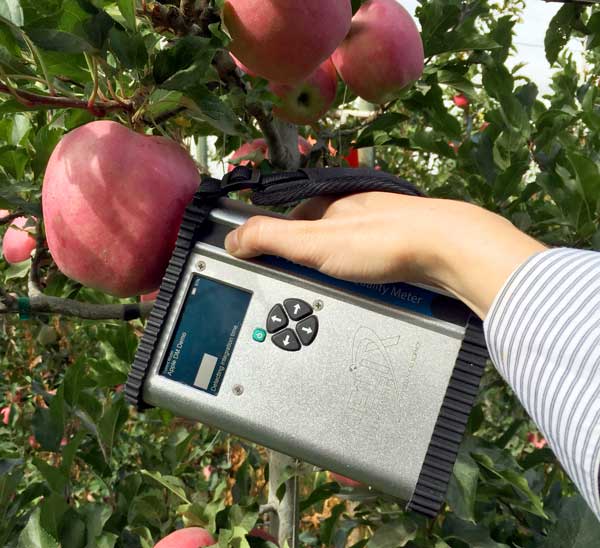
Many operations evaluating portable NIR devices ROI ultimately focus on usability and support. Instruments need to work in real field and packinghouse conditions. They need stable calibrations and responsive technical support.
Felix Instruments has built its handheld NIR portfolio specifically for produce quality applications. The F-750 and F-751 series are designed for field durability, fast measurements, and crop specific models that reduce setup time. This lowers adoption friction and accelerates ROI.
Because these tools are purpose built rather than adapted from laboratory systems, users spend more time collecting useful data and less time troubleshooting.
Common ROI Calculation Mistakes to Avoid
Underestimating Labor Savings
Many calculations focus only on product value and ignore time saved by faster testing.
Ignoring Sampling Frequency
Higher sampling rates reduce risk. That risk reduction has real financial value even if it is harder to quantify.
Expecting Lab Level Precision for Operational Decisions
Portable NIR devices are decision tools. Their ROI comes from timely, actionable data rather than absolute laboratory accuracy.
Final Thoughts
Portable NIR devices ROI is best understood as a combination of reduced waste, faster decisions, labor efficiency, and better quality consistency. When these benefits are viewed together, the financial case becomes clear. Payback is often faster than expected, especially for high value crops where quality drives market access and pricing.
If you are evaluating portable NIR devices ROI for your operation, the next step is to match the instrument to your crop, workflow, and decision points. Felix Instruments offers handheld NIR solutions designed specifically for produce quality management, backed by application expertise and long term support. Exploring these tools in your own environment is often the fastest way to see how quickly the investment can return value.
Frequently Asked Questions
How Long Does It Typically Take to See ROI From Portable NIR Devices?
Many users report meaningful ROI within one to two seasons, depending on crop value, sampling frequency, and how the data is used in decision making.
Do Portable NIR Devices Replace Laboratory Testing Entirely?
They reduce reliance on lab testing but do not eliminate it. Labs are still valuable for calibration development and verification, while portable NIR devices handle routine operational decisions.
Are Portable NIR Devices Difficult to Use in the Field?
Most modern handheld systems are designed for field use with minimal training. Measurements are fast, and interfaces are built for non specialist users.
Related Products
Most Popular Articles
- Spectrophotometry in 2023
- The Importance of Food Quality Testing
- NIR Applications in Agriculture – Everything…
- The 5 Most Important Parameters in Produce Quality Control
- Melon Fruit: Quality, Production & Physiology
- Fruit Respiration Impact on Fruit Quality
- Guide to Fresh Fruit Quality Control
- Liquid Spectrophotometry & Food Industry Applications
- Ethylene (C2H4) – Ripening, Crops & Agriculture
- Active Packaging: What it is and why it’s important