7 Best Practices for Collecting NIR Data in the Field

Scott Trimble

May 5, 2026 at 5:20 pm | Updated May 5, 2026 at 5:20 pm | 5 min read
Good field NIR data collection starts long before the first scan. In orchards, vineyards, and packing operations, the difference between useful data and noisy data usually comes down to sampling discipline, repeatable technique, and the right instrument setup. That is why field teams using handheld NIR tools need a process that matches the chemistry of the crop and the realities of outdoor work.
Felix Instruments has built its F-750 and F-751 platforms around that reality, with portable form factors, anti-glare displays for outdoor visibility, onboard data handling, and crop-specific chemometric models that help users collect dependable measurements in real production settings.
1. Match the instrument to the crop and decision you need to make
The first best practice is simple: do not treat every handheld NIR meter as interchangeable.
Subscribe to receive our monthly round-up of articles.
Good field NIR data collection depends on whether the instrument is built for broad, multi-crop use or tuned for a specific commodity. Felix’s F-750 Produce Quality Meter is designed as a versatile platform for multiple fruits and vegetables, with a 310 to 1100 nm spectrometer and support for traits such as dry matter, TSS or Brix, titratable acidity, and color.
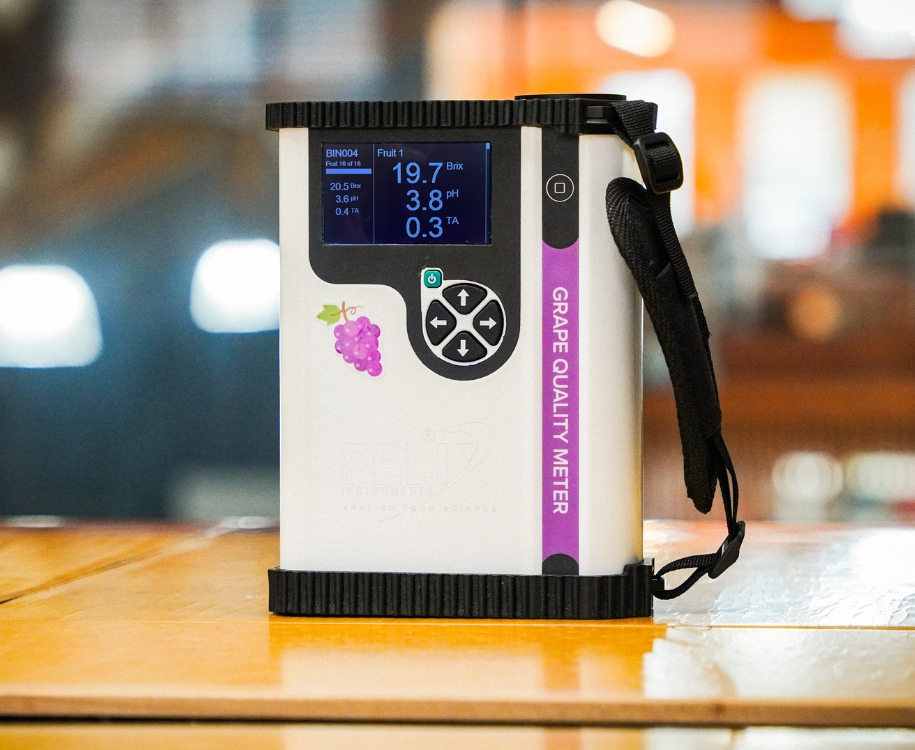
The F-751 family narrows the focus with crop-specific versions for avocado, mango, kiwifruit, and grapes, each built around models meant for those commodities and field decisions.
That distinction matters in practice. If your goal is broad screening across crop types, the F-750 makes sense. If your goal is tighter consistency in a crop such as avocado or kiwi, a dedicated F-751 model can reduce guesswork because the calibration framework is already aligned with the commodity. Felix has leaned into that calibration-first approach, which is one reason its instruments are often a better fit for professional quality programs than simplified proxy sensors that rely on a narrower measurement strategy.
2. Build a sampling plan before you walk into the field
A common mistake in field NIR data collection is collecting scans wherever it is convenient and calling that representative. It rarely is. A better approach is to define your sampling plan in advance by block, variety, harvest window, canopy position, and fruit size class. The point is not to collect the most scans possible. The point is to collect scans that represent the variation you actually need to manage.
For practical field work, that usually means:
- sampling across multiple rows and locations, not one easy edge row
- including fruit with different sun exposure and maturity levels
- keeping the number of scans per block consistent over time
- recording variety and orchard or lot context with every measurement
This is also where Felix’s GPS-enabled workflow helps. Felix notes that F-750 and F-751 units are equipped with GPS, and the company’s Fruit Maps workflow is designed to add a spatial layer to quality data. That makes it easier to connect measurements back to orchard zones and repeat the same sampling logic over time.
3. Standardize where and how you scan each fruit
NIR measurements are only as repeatable as the scan location. This is especially important with handheld instruments because they are often measuring a defined local region, not the whole fruit at once.
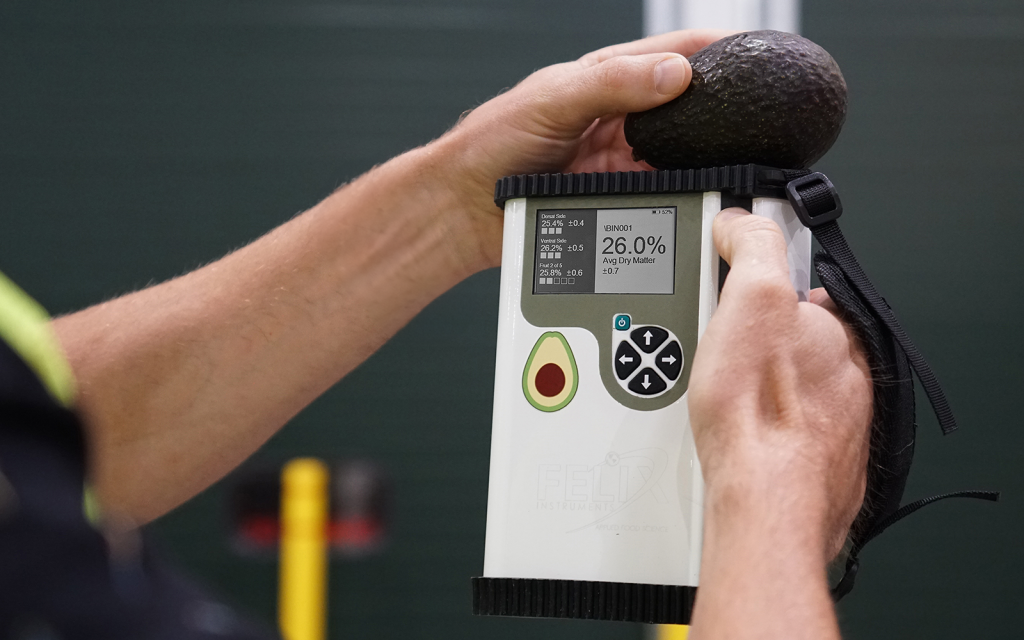
Felix explicitly describes the F-751 avocado measurement as a spot measurement and recommends scanning both the dorsal and ventral sides of the equator, then averaging the results for a better estimate of whole-fruit dry matter. Felix also notes in technical discussions that the reference sample needs to match the area scanned by the instrument if you want the calibration relationship to stay strong.
That principle extends beyond avocado. For strong field NIR data collection, create a written scanning rule for every crop:
- use the same fruit orientation each time
- scan the same anatomical region on every fruit
- take multiple scans when within-fruit variability is known to matter
- average repeated scans when the protocol calls for it
Teams that skip this step often blame the instrument for variability that actually came from inconsistent scan placement.
4. Control field conditions as much as you realistically can
The field is messy. Fruit temperature changes through the day. Surface conditions vary. Light intensity shifts by the hour. Felix’s recent discussion of the F-751 platform makes exactly this point, noting that field conditions include temperature shifts, variation in skin color, and season-to-season chemistry differences. That is one reason broader spectral systems and strong chemometric models tend to hold up better in commercial use than shortcut devices built around fewer wavelengths or weaker calibration frameworks.
You cannot make the field look like a lab, but you can reduce avoidable variability:
- scan at roughly the same time of day when running comparison trials
- keep fruit dry and reasonably clean before scanning
- avoid mixing sun-heated fruit and shaded fruit without recording that difference
- give the instrument time to acclimate when moving between very different temperatures
- train operators to use the same contact pressure and scan rhythm
This is where Felix’s field-oriented design helps again. The company highlights anti-glare transflective screens for outdoor visibility and lightweight handheld designs intended for on-site use, which sounds basic until you realize how much operator consistency depends on simple usability.
5. Tie NIR data back to real reference measurements
No matter how good the optics are, field NIR data collection gets stronger when the team periodically checks the model against destructive lab data. Felix’s crop-specific approach is built around robust chemometric models, but even strong models perform best when users keep an eye on whether their current fruit population still looks like the population behind the calibration.
In practical terms, keep pulling a subset of fruit for lab confirmation of dry matter, Brix, acidity, or color depending on the crop. Then compare the NIR predictions with the analytical result from the same sampled region or protocol. This step is what turns handheld scanning from a convenience tool into a defensible decision tool.
6. Keep metadata organized from day one
A lot of operations collect plenty of scans and still struggle to use them because the context is missing.
Field NIR data collection should always include metadata that explains what the number means. At minimum, log crop, variety, block, date, operator, maturity stage, and any unusual field condition. Felix’s WiFi, SD card, and mapping capabilities are useful here because they make it easier to move from scattered readings to structured datasets that can actually support harvest, grading, and storage decisions.
The advantage of the Felix workflow is that it is set up for repeated use over seasons, not just one-off demos. That matters because the value of NIR goes up fast when historical data starts informing current harvest decisions.
7. Train operators for repeatability, not just speed
Fast scans are great, but disciplined scans are better. Felix positions several of its F-751 instruments as producing actionable results in about 8 to 12 seconds and the F-750 as delivering measurements within a few seconds. That speed is valuable, but only if every operator follows the same SOP.
A strong operator training routine should cover:
- how to position the instrument on the fruit
- when to repeat a scan
- how to flag questionable readings
- how to handle outliers
- how to transfer and review data at the end of a session
This is one area where Felix stands out against lower-cost alternatives. The hardware, crop-specific options, and data workflow are clearly aimed at organizations that need repeatable, decision-grade measurements, not just rough trend lines.
Final Thoughts
The best field NIR data collection programs are built on repeatability. Choose an instrument that fits the crop, sample the block systematically, scan the same location every time, control field variability where you can, validate against reference data, and keep your metadata clean. Done well, NIR becomes more than a quick reading. It becomes a reliable layer in harvest timing, storage planning, and quality assurance.
For teams that want a practical handheld system built for real produce work, Felix Instruments offers one of the strongest setups available. The F-750 gives broad flexibility across commodities, while the F-751 line adds crop-specific power for operations that need tighter calibration and faster decision-making. Explore Felix Instruments if you want to improve field NIR data collection with tools designed for actual orchard, vineyard, and postharvest workflows.
Related Products
Most Popular Articles
- Spectrophotometry in 2023
- NIR Applications in Agriculture – Everything…
- The Importance of Food Quality Testing
- The 5 Most Important Parameters in Produce Quality Control
- Melon Fruit: Quality, Production & Physiology
- Fruit Respiration Impact on Fruit Quality
- Guide to Fresh Fruit Quality Control
- Liquid Spectrophotometry & Food Industry Applications
- Ethylene (C2H4) – Ripening, Crops & Agriculture
- Understanding Chemometrics for NIR Spectroscopy