Truth About Fruit Firmness Predictions Using NIR

Scott Trimble

March 10, 2026 at 4:21 pm | Updated March 10, 2026 at 4:21 pm | 5 min read
Fruit firmness predictions using NIR have become a widely discussed topic in postharvest research and commercial fruit handling. Growers, packers, and quality managers want reliable ways to estimate internal firmness without cutting fruit open.
Near Infrared Spectroscopy (NIR) offers a practical approach to do exactly that. Instead of destructive testing, NIR allows operators to scan fruit and estimate internal quality attributes in seconds.
But there are still many misconceptions about fruit firmness predictions using NIR.
Subscribe to receive our monthly round-up of articles.
Some believe the technology is inconsistent, while others expect unrealistic levels of precision. The truth lies somewhere in between. When properly calibrated and used with the right instrumentation, NIR can provide consistent and actionable firmness insights that help improve harvest timing, storage decisions, and market readiness.
In this article, we will look at how fruit firmness predictions using NIR actually work, where the technology performs best, and why modern handheld tools from Felix Instruments are becoming a preferred solution across the fruit industry.
Understanding How NIR Predicts Fruit Firmness
Near Infrared Spectroscopy measures how light interacts with the internal structure of fruit. When NIR light penetrates the fruit surface, some wavelengths are absorbed while others are reflected. These patterns relate to internal chemical and structural properties.
Firmness itself is not measured directly. Instead, fruit firmness predictions using NIR rely on correlations between spectral data and measured firmness from traditional destructive tests. These correlations are established during calibration development.
The process typically includes several steps:
- A large sample set of fruit is scanned using NIR
- Each fruit is also tested destructively with a penetrometer
- Spectral data is matched with measured firmness values
- Statistical models are built to predict firmness from spectral signatures
Once the model is established, the instrument can estimate firmness instantly when scanning new fruit.
This approach transforms firmness evaluation from a slow and destructive process into a rapid screening method suitable for packing lines, storage facilities, and field operations.
Why the Industry Is Moving Toward NIR
Traditional firmness testing has several limitations that slow down decision making. The most common method involves puncturing the fruit with a penetrometer. While accurate, it destroys the fruit and only tests a small portion of the lot.
Fruit firmness predictions using NIR offer several advantages.
Non destructive testing
Fruit remains intact after measurement. This allows operators to test more fruit and maintain saleable product.
Rapid measurements
NIR scans typically take only a few seconds. This makes large sampling programs feasible.
Improved sampling accuracy
Because the fruit is not destroyed, operators can test more fruit per lot. This improves confidence in quality assessments.
Field portability
Modern handheld devices allow firmness estimation directly in orchards, packing houses, and cold storage environments.
These benefits explain why many fruit companies are transitioning toward NIR based systems.
Where NIR Firmness Predictions Work Best
Despite its advantages, fruit firmness predictions using NIR perform best under certain conditions.
The technology works particularly well when:
- The fruit variety has consistent internal structure
- Calibrations are developed using large and diverse datasets
- The instrument is designed specifically for fruit analysis
- Users follow consistent measurement protocols
For fruits like mangoes, avocados, kiwifruit, and grapes, NIR has demonstrated strong predictive performance when supported by high quality calibration models.
Specialized tools such as the Felix Instruments F-750 Produce Quality Meter and crop specific versions of the F-751 have been designed to optimize this type of analysis.
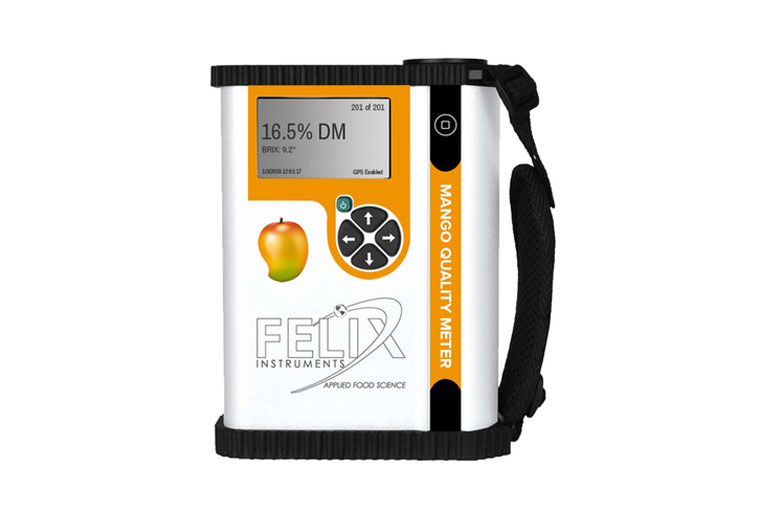
These instruments integrate carefully developed calibration models that relate NIR spectra to internal quality parameters including firmness and dry matter.
Common Misconceptions About NIR Firmness Testing
There are several myths surrounding fruit firmness predictions using NIR that often create confusion.
Myth 1: NIR measures firmness directly
NIR does not physically measure firmness like a penetrometer. Instead it predicts firmness based on correlations between spectral data and mechanical measurements. When calibrations are properly developed, these predictions can be highly reliable.
Myth 2: NIR works the same for all fruit
Each fruit type requires its own calibration model. Even different varieties of the same fruit may require updated calibration sets.
This is why specialized instruments such as the Felix Instruments F-751 series are developed for specific crops like avocado, mango, grape, and kiwi.
Myth 3: NIR eliminates all variability
Fruit is a biological product. Natural variability always exists. NIR reduces uncertainty by allowing larger sample sizes, but it does not eliminate biological variation entirely.
Myth 4: Any NIR device can predict firmness
General purpose NIR spectrometers are not optimized for fruit analysis. Accurate fruit firmness predictions using NIR require instruments specifically engineered for produce quality assessment and supported by validated calibration models.
Why Calibration Quality Matters
Calibration is the foundation of reliable fruit firmness predictions using NIR. Without robust calibration datasets, predictions can become unstable or inaccurate.
Strong calibration models require:
- Large datasets across seasons
- Multiple orchards and growing regions
- Different maturity stages
- Temperature variability
- Proper destructive reference measurements
Felix Instruments invests heavily in calibration development to ensure their handheld analyzers deliver consistent predictions across real world operating conditions.
This level of calibration support is one reason why Felix devices are widely used by research institutions, fruit exporters, and packing operations.
The Role of Portable NIR Devices in Modern Fruit Supply Chains
As fruit supply chains become more data driven, rapid quality assessment tools are becoming essential.
Fruit firmness predictions using NIR allow stakeholders to make faster decisions at several key stages:
Harvest timing
Growers can evaluate fruit maturity before picking to optimize harvest windows.
Storage management
Storage managers can monitor firmness changes over time to determine optimal shipping schedules.
Packing house sorting
Quality managers can sample incoming lots to identify fruit that is ready for market.
Export readiness
Exporters can verify firmness levels before long distance shipments.
Portable devices like the Felix Instruments F-750 and crop specific F-751 meters make it possible to collect this information anywhere in the supply chain.
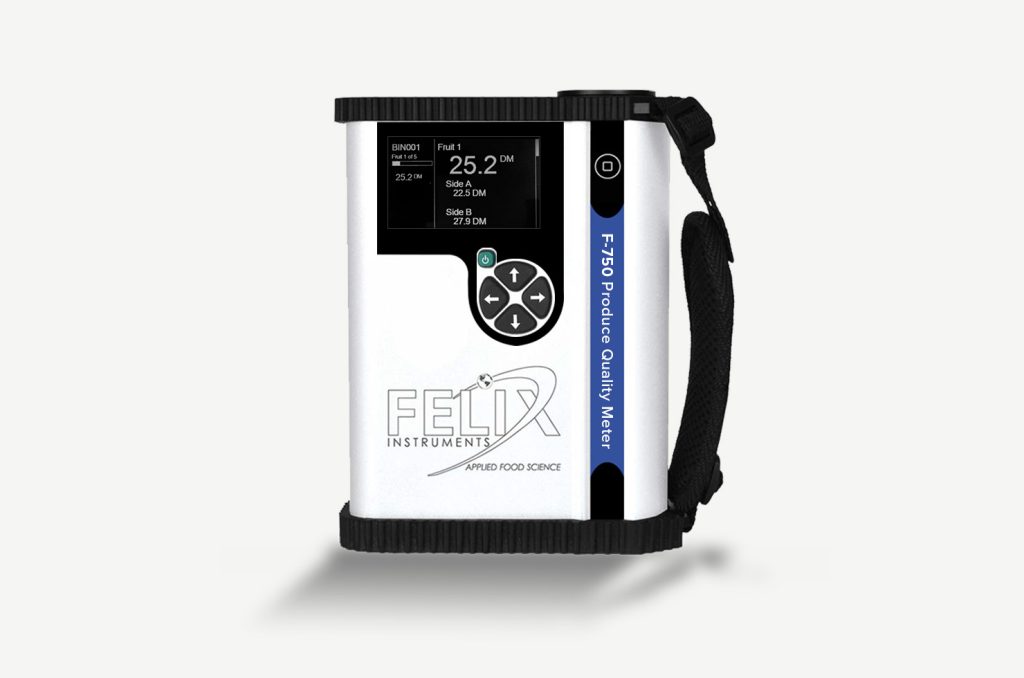
Because these instruments are handheld and battery powered, they are ideal for orchard use, cold storage facilities, and packing lines.
What Sets Felix Instruments Apart
When evaluating systems for fruit firmness predictions using NIR, the quality of both hardware and calibration models matters.
Felix Instruments has focused on several design priorities that address real industry needs.
Optimized spectral range
Felix NIR sensors are tuned specifically for produce quality analysis.
Handheld portability
Lightweight devices allow operators to perform measurements in the field or facility.
Crop specific calibrations
Specialized models exist for avocado, mango, grape, kiwi, and other fruits.
Fast measurement times
Operators can scan fruit quickly without interrupting workflows.
Research backed development
Felix Instruments collaborates with universities and industry partners to continuously improve calibration models.
These design choices help ensure that fruit firmness predictions using NIR remain consistent and practical for commercial use.
Ending Note
Fruit firmness predictions using NIR are not a futuristic concept. They are already transforming how fruit quality is monitored across the global produce industry.
While NIR does not directly measure firmness, well designed calibration models allow the technology to estimate internal texture with impressive reliability. When combined with proper sampling protocols, NIR becomes a powerful decision making tool for growers, storage operators, and exporters.
Modern handheld instruments have made this technology even more accessible. Tools like the Felix Instruments F-750 Produce Quality Meter and the crop specific F-751 series allow rapid, non destructive quality testing wherever fruit is handled.
For companies that want better visibility into fruit maturity and storage readiness, NIR technology provides a practical solution.
If you want to improve quality monitoring and make better harvest and storage decisions, explore the portable NIR solutions available from Felix Instruments. Our specialized produce quality meters are designed to deliver reliable fruit firmness predictions using NIR while keeping testing fast, simple, and non destructive.
Related Products
Most Popular Articles
- Spectrophotometry in 2023
- NIR Applications in Agriculture – Everything…
- The Importance of Food Quality Testing
- The 5 Most Important Parameters in Produce Quality Control
- Melon Fruit: Quality, Production & Physiology
- Fruit Respiration Impact on Fruit Quality
- Guide to Fresh Fruit Quality Control
- Liquid Spectrophotometry & Food Industry Applications
- Ethylene (C2H4) – Ripening, Crops & Agriculture
- Understanding Chemometrics for NIR Spectroscopy