Portable vs Benchtop NIR Meters: Which Makes Sense for Your Lab?


Scott Trimble

February 5, 2026 at 11:15 pm | Updated February 5, 2026 at 11:15 pm | 5 min read
Near-infrared spectroscopy has become a standard tool for measuring quality attributes in food and agricultural products. Whether you are tracking dry matter, Brix, firmness proxies, or internal defects, NIR offers fast, non-destructive insight.
The real decision many labs face today is not whether to use NIR, but whether portable NIR meters or traditional benchtop systems are the better fit.
Portable NIR meters in particular have changed expectations around where and how measurements can be made. This article breaks down the practical differences so you can decide what makes sense for your workflow.
Subscribe to receive our monthly round-up of articles.
Understanding the Two Categories
Before comparing tradeoffs, it helps to define what we mean by portable and benchtop NIR meters.
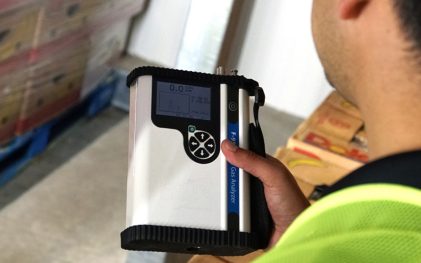
Portable NIR meters are self-contained, handheld or field-ready instruments. They are typically battery powered, designed for rapid measurements, and optimized for specific commodities or quality metrics. Many modern portable systems use robust calibration models tailored to real-world conditions rather than ideal lab environments.
Benchtop NIR meters are larger systems designed to stay in a controlled laboratory setting. They often feature broader wavelength ranges, higher optical stability, and the ability to handle a wide variety of sample types with accessories like cups, spinning modules, or integrating spheres.
Both approaches rely on the same fundamental spectroscopy principles, but their design priorities differ.
Where Portable NIR Meters Excel
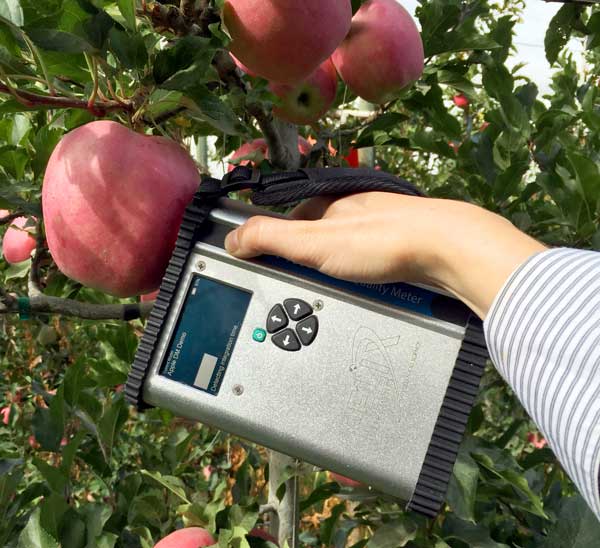
Portable NIR meters shine when speed, flexibility, and proximity to the product matter.
Measurement at the point of decision
One of the biggest advantages of portable NIR meters is the ability to measure samples where decisions are actually made. This could be in the orchard, at the packing line, in cold storage, or on the receiving dock. Instead of sending samples to a lab and waiting hours or days, results are available in seconds.
For industries like fresh produce, this timing matters. Ripeness, maturity, and internal quality change quickly. Portable measurements allow teams to act on current conditions rather than historical data.
Non-destructive testing at scale
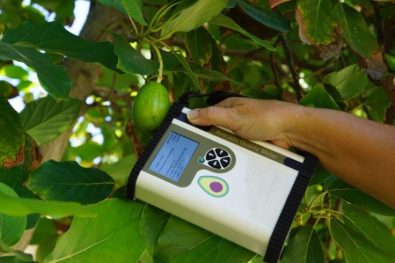
Most portable NIR meters are designed for non-destructive use. That makes it practical to test more fruit, more often, without sacrificing saleable product. Larger sample sizes reduce uncertainty and give a more accurate picture of lot-to-lot variability.
In contrast, benchtop systems sometimes require sample preparation such as grinding or juicing, depending on the application. That approach can be precise, but it limits throughput and increases labor.
Simpler workflows and training
Portable NIR meters are typically built for routine users, not spectroscopy specialists. Interfaces are streamlined, calibration models are preloaded or guided, and measurements are repeatable with minimal setup.
This simplicity matters in production environments where multiple operators use the same instrument. Training time is shorter, and the risk of operator error is lower compared to complex benchtop systems.
Designed for specific commodities
Many portable NIR meters focus on targeted applications. Instead of trying to measure everything, they are optimized for specific fruits or quality parameters. This specialization often leads to stronger, more reliable calibrations for those use cases.
Where Benchtop NIR Meters Still Make Sense

Benchtop systems continue to play an important role, especially in research and central labs.
Maximum flexibility
If your lab needs to analyze a wide range of sample types with constantly changing methods, a benchtop NIR meter offers flexibility. Broader wavelength coverage and customizable accessories support exploratory work and method development.
For R&D teams building new calibrations from scratch, this flexibility can be critical.
Controlled measurement conditions
Benchtop systems benefit from stable lighting, temperature control, and consistent sample presentation. This can improve repeatability when conditions are tightly managed and samples are homogeneous.
For regulatory or reference measurements where conditions must be strictly controlled, benchtop instruments are often preferred.
Integration into lab infrastructure
Central labs may already have established workflows built around benchtop instruments, including LIMS integration, standard operating procedures, and validation protocols. In those cases, adding another benchtop system can be easier than reworking processes around portable tools.
Accuracy and performance myths
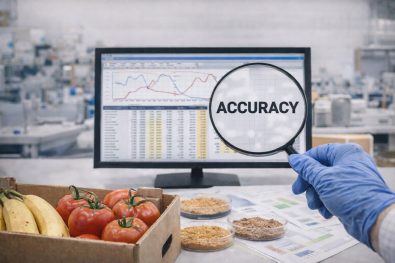
A common assumption is that benchtop NIR meters are always more accurate than portable NIR meters. In practice, accuracy depends far more on calibration quality and sample relevance than on instrument size.
Portable NIR meters designed for specific commodities often outperform general-purpose benchtop systems when measuring intact fruit or produce. This is because the calibration models are built around real-world variability such as temperature, skin thickness, and biological differences.
Benchtop systems may achieve excellent accuracy on prepared samples in controlled settings, but that advantage can disappear when results need to translate back to intact products in the field.
Cost and return on investment
Initial purchase price is only part of the cost equation.
Portable NIR meters generally have lower upfront costs and lower operating expenses. They do not require dedicated lab space, extensive accessories, or highly trained staff. The real value comes from faster decisions, reduced waste, and better quality control throughout the supply chain.
Benchtop systems often represent a larger capital investment. They can make sense when shared across many projects or when supporting advanced analytical work. However, for routine quality checks, their cost can be harder to justify.
Choosing Based on Workflow, Not Tradition
The most important question is not which technology is better in theory, but which fits your workflow.
Portable NIR meters are a strong choice if you need:
-
Measurements on intact products
-
Results in real time
-
High throughput with minimal sample prep
-
Consistent operation by multiple users
-
Data close to harvest, storage, or packing decisions
Benchtop NIR meters may be better if you need:
-
Broad, exploratory analysis
-
Frequent method development
-
Highly controlled measurement conditions
-
Centralized lab-based testing
Many organizations ultimately use both, but rely more heavily on portable tools for day-to-day decisions.
The Role of Felix Instruments
Felix Instruments has focused heavily on making portable NIR meters practical for real production environments. Our handheld NIR platforms are designed around fresh produce workflows, with calibrations built from extensive field data rather than idealized lab samples.
Instead of forcing users to adapt their process to the instrument, Felix Instruments designs instruments that adapt to how quality is actually measured in the field and packinghouse. This approach has made portable NIR meters a reliable alternative to benchtop systems for many quality applications.
Ending Note
The choice between portable and benchtop NIR meters comes down to where you need answers and how quickly you need them.
For many labs and quality teams, portable NIR meters provide the right balance of accuracy, speed, and usability. They bring spectroscopy out of the lab and into the places where quality decisions are made.
If you are evaluating NIR solutions or reconsidering how your current setup supports real-world decisions, it is worth taking a closer look at modern portable options.
Felix Instruments offers a range of portable NIR meters designed specifically for food and produce quality measurement. Reach out to our team to discuss your application and see how portable NIR can fit into your operation.
Frequently Asked Questions
Are Portable NIR Meters Accurate Enough for Commercial Quality Control?
Yes. When paired with strong, application-specific calibrations, portable NIR meters can deliver accuracy that meets or exceeds commercial quality control needs, especially for intact produce.
Can Portable NIR Meters Replace Benchtop Systems Entirely?
In many routine quality applications, they can. However, benchtop systems may still be useful for research, method development, or highly controlled reference measurements.
What Is the Biggest Mistake When Choosing Between Portable and Benchtop NIR?
Choosing based on tradition rather than workflow. The best instrument is the one that delivers actionable data where and when you need it.
Related Products
Most Popular Articles
- Spectrophotometry in 2023
- NIR Applications in Agriculture – Everything…
- The Importance of Food Quality Testing
- The 5 Most Important Parameters in Produce Quality Control
- Melon Fruit: Quality, Production & Physiology
- Fruit Respiration Impact on Fruit Quality
- Guide to Fresh Fruit Quality Control
- Liquid Spectrophotometry & Food Industry Applications
- Ethylene (C2H4) – Ripening, Crops & Agriculture
- Understanding Chemometrics for NIR Spectroscopy
Related Reading